ESA Science & Technology - Hubble
Fact Sheet
News
News

Hubble identifies strange exoplanet that behaves like the long-sought "Planet Nine" [heic2021]
The 11-Jupiter-mass exoplanet called HD 106906 b occupies an unlikely orbit around a double star 336 light-years away and it may be offering clues to something that might be much closer to home: a hypothesized distant member of our Solar System dubbed "Planet Nine."

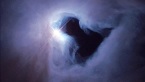
Hubble captures fading of the Stingray Nebula [heic2020]
Astronomers have caught a rare glimpse of a rapidly fading shroud of gas around an aging star. Archival data from the NASA/ESA Hubble Space Telescope reveal that the nebula Hen 3-1357, nicknamed the Stingray nebula, has faded precipitously over just the past two decades.

New Hubble data explains missing dark matter [heic2019]
New data from the NASA/ESA Hubble Space Telescope provides further evidence for tidal disruption in the galaxy NGC 1052-DF4. This result explains a previous finding that this galaxy is missing most of its dark matter.

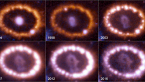
Hubble observes spectacular supernova time-lapse [heic2018]
The NASA/ESA's Hubble Space Telescope has tracked the fading light of a supernova in the spiral galaxy NGC 2525, located 70 million light years away. Supernovae like this one can be used as cosmic tape measures, allowing astronomers to calculate the distance to their galaxies.

Hubble captures crisp new image of Jupiter and Europa [heic2017]
This latest image of Jupiter, taken by the NASA/ESA Hubble Space Telescope on 25 August 2020, was captured when the planet was 653 million kilometres from Earth.