
Success Story
30 Discoveries from ESA's science missions in space
This is the on-line version of ESA Publication BR-147 (April 1999)
Preface
At the close of a century, and after 35 years of our scientific missions, the Science Programme Directorate of the European Space Agency decided to show how well the science programme has used the resources made available by the Member States, on behalf of the space scientific community. Looking back, we can say with pride that these resources allowed us to produce true discovery machines.
The instruments embarked on our missions by the scientific community were at the forefront of technology, with a high potential for further applications and commercial spin-offs. Most missions have been implemented within the budget and on schedule. The overall result is European leadership over a broad front of space science activities.
Here we highlight thirty striking discoveries, from among many other candidates, which contribute unambiguously to the advancement of knowledge. I am sure that through this selection the reader will share with us the pleasure of discovery, and support our efforts to do more in the future. We intend not only to secure those niches of leadership we have gained, but also to show the way to other, completely new revelations.
Welcome to the fascinating world of the frontiers of knowledge!
R.M. Bonnet
ESA Science Missions 1984-1999
|
Mission |
Discoveries |
|
Giotto |
|
|
Ulysses |
|
|
Soho |
|
|
IUE |
|
|
Exosat |
|
|
Hipparcos |
|
|
Hubble |
|
|
ISO |
|
1. The dark body of Halley's Comet unveiled
Since ancient times comets have been regarded with awe and wonder, portents of great political events and upheavals. Yet, until the European Space Agency's Giotto spacecraft flew past Halley's Comet in 1986, their true nature was hidden behind a vast veil of glowing gas and dust.
 |
|
Horst Uwe Keller |
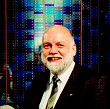
"We discovered that a comet is not really a 'dirty snowball' since dirt is dominant, not ice," said Horst Uwe Keller of the Max Planck Institut für Aeronomie, Katlenburg-Lindau, Germany. "Instead of being spherical like a warm snowball, a comet nucleus is elongated. The physical structure of a comet's interior is defined by its dust content rather than its ice content."
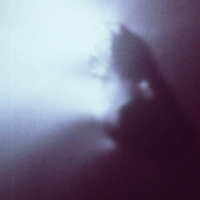
Giotto flew to within 600 km of the comet, revealing for the first time what the nucleus - its solid heart - was really like. Until then, most scientists accepted the model proposed by American astronomer Fred Whipple, who saw a comet as a large, dirty snowball.
A rare opportunity to test Whipple's hypothesis came with the return of Halley's Comet after a 76-year-long absence. Scientists from ESA, the USA and the Soviet bloc agreed to co-operate in investigating the icy intruder. Using positional information on the comet from two Soviet Vega spacecraft, ESA's ground control team directed Giotto towards its target. The reward came on 13 March 1986 with the most detailed pictures ever taken of a comet.
 |
|
Figure 1: Halley's nucleus |
Giotto unveiled a small, potato-shaped object, with crater-shaped hollows and mountains. Although it was only 15 km long and 8 km wide, the nucleus was much larger than expected. However, its density was very low, suggesting a fluffy, porous texture.
Another surprise was the extremely dark surface - blacker than coal - which suggested a thick covering of dust. Several jets of gas and dust spewed into space from active regions on the warmer, sunlit side. These jets gave the comet a strange, wobbling rotation that seems to be stable over centuries or even millennia.
|
|
|
Susan McKenna-Lawlor |
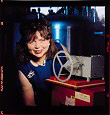
"EPONA has travelled further and faster than anything else ever made in Ireland," said Susan McKenna-Lawlor of St Patrick's College, Maynooth, on the night that her instrument in Giotto took part in the historic encounter with Halley's Comet. As with all ESA science missions, scientists from many Member states shared in this first adventure in deep space, and in its harvest of results.
 |
|
Tony McDonnell |
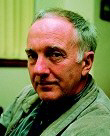
"The important thing was to go there and find out what a comet was really like," said Tony McDonnell of the University of Kent, UK. "Only with this direct exploration were we able to establish the 'ground truth'. This then opened the way for ground-based observers to apply our findings to vast quantities of data on other comets."
2. Comet treasure: raw materials for life
Comets are intriguing objects because they are very primitive, leftover building blocks from the birth of the planets. Although they rarely strike the Earth today, impacts were once much more frequent, and probably played a significant role in our planet's evolution. Most of the water in Earth's oceans may have come from comets.
 |
|
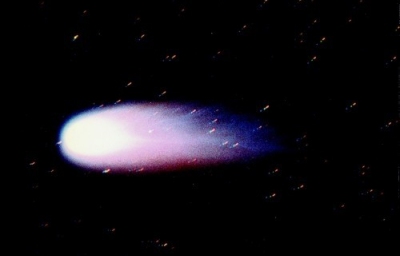
Figure 2: Halley's Comet observed from Earth |
A unique opportunity to learn their secrets came in 1986 with the near-suicidal flight of ESA's Giotto spacecraft to the unexplored nucleus of Halley's Comet. A stream of discoveries followed.
Giotto confirmed that the comet had formed 4.5 billion years ago from ices condensing onto grains of interstellar dust. Since then, it has remained almost unaltered in the cold, outer regions of the Solar System.
 |
|
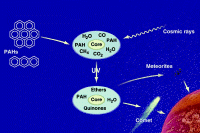
Figure 3: Carbon-rich chemicals supplied to the early Earth by interstellar particles |
As expected, 80 percent of the comet gas was water vapour, with another 10 percent carbon monoxide. The only other significant constituents were carbon dioxide and polymerised formaldehyde, a non-biological organic compound made from hydrogen, oxygen and carbon.
Analysis of Comet Halley's dust particles provided some surprising results. Tiny grains, no larger than specks of cigarette smoke, were found to be much more abundant than expected. Unlike most space dust, it was not stony but organic. Carbon was found to be a major constituent of the dust.
 |
|
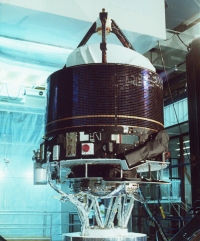
Figure 4: The Giotto spacecraft |
Many particles were similar in composition to a rare, primitive type of meteorite known as a carbonaceous chondrite. Even more surprising was the discovery of so-called CHON particles, rich in carbon, hydrogen, oxygen and nitrogen. Intriguingly, these elements are essential for life as we know it. Dust from comets could have fertilised the Earth, by supplying materials from which nucleic acids and proteins could form.
Did life on Earth start with the help of comets? If so, it almost certainly began in a similar way somewhere else. Giotto's discoveries intensified the interest in exobiology - the search for life beyond the Earth - and the question of whether or not we are alone in the Universe.
 |
|
Fritz Neubauer |
"Giotto discovered a magnetic cavity around Halley's Comet, something which has never been seen before or since," said Fritz Neubauer of the University of Cologne, Germany. "It was worth flying so close to the nucleus, even though it threatened the spacecraft, just to find a region where the magnetic field was essentially zero."
3. How a small comet makes huge waves
 |
|
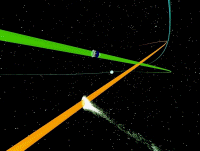
Figure 5: After using Earth's gravity to change orbit, Giotto encountered Comet Grigg-Skjellerup - ESA graphic |
En route, Giotto survived two long hibernations, interrupted only by an Earth flyby on 2 July 1990 - the first time a deep space probe had received an impetus from the Earth's gravity. The resultant change in orbit enabled Giotto to pass within 200 km of Comet Grigg-Skjellerup on 10 July 1992. After the successful encounter, Giotto was once again shut down. The battered spacecraft would briefly return to Earth's vicinity on 1 July 1999.
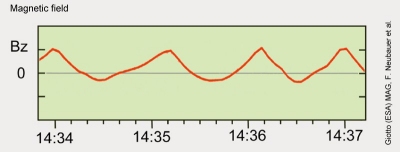
As expected, Grigg-Skjellerup was found to be a smaller, less active version of Comet Halley. The strangest discovery was of unusual magnetic waves near the comet. Activity rose and fell over a period of about 70 seconds and increased in strength. Charged material from the comet, moving in the wind of atomic particles from the Sun, generated the waves.
 |
|
Figure 6: Unusual magnetic waves near Comet Grigg-Skjellerup as observed by the MAG instrument aboard Giotto |
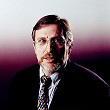
"At Grigg-Skjellerup the magnetic field was relatively constant and perpendicular to the flow of the solar wind, until the huge waves started," said Andrew Coates of University College London's Mullard Space Science Laboratory. "It was a text-book encounter."
 |
|
Gerhard Schwehm |
"Giotto was the Agency's first planetary mission and was a tremendous success, both technically and scientifically," said Gerhard Schwehm of ESA's Space Science Department at Noordwijk in the Netherlands. "It provided a wealth of scientific results and gave scientists the unique chance to study two different comets with the same set of instruments."
Horizons 2000
This webpage celebrates ESA's space science in 15 years since the start of the long-term programme, Horizon 2000. Drawing on Europe-wide skills and ideas, scientist-advisors saw where ESA could score, and balanced quick opportunities with difficult tasks. Longer-term visions came in Horizons 2000 Plus. Despite budgetary constraints the current programme, Horizons 2000, safeguards major ventures and introduces new small projects.
In 1984, Europe's space science was in the junior league. Now, in solar research and comet missions ESA is second to none, and Huygens is on its unique journey to Saturn's moon Titan. Four unrivalled astronomy projects will provide the successors to Hipparcos and ISO.
Excellent spacecraft built in Europe amplify the scientific pay-off in extensions far beyond the specified mission life. Past examples include Giotto plus 5 years and ISO plus 10 months. Approved extensions for Ulysses and SOHO give 6 and 5 years extra.
|
|
|
Roger Bonnet |
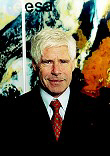
"Every member state can take pride in our success," said Roger Bonnet, ESA's director of science. "With a science budget much smaller than NASA's, we delivered more than our share of discoveries. We were able to plan difficult missions with confidence because of the political will that ensured predictable funding. If the will continues, Horizons 2000 will deliver further astounding results."
4. Gale force winds in most of the Sun's empire
 |
|
C.M. Dixon |
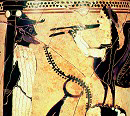
"Don't miss the chance to experience the unpeopled world on the far side of the Sun," Ulysses the sailor told his crew, according to the poet Dante Alighieri in Inferno Canto XXVI.
Non vogliate negare l'esperienza di retro al Sol, del mondo senza gente.
Interplanetary space is nothing like the vast and tranquil void so often imagined. The Earth swims deep inside the heliosphere, a huge cavity of the local interstellar medium filled by an outward-racing plasma of charged atoms and electrons from the Sun called the solar wind. This wind is very different from its meteorological namesake that sweeps the surface of the Earth, but its gusts and shocks, causing aurora and magnetic storms, may affect our weather and can harm satellites, power supplies and communications.
 |
|
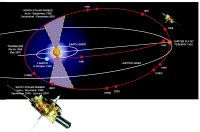
Figure 7: Ulysses and its orbits |
In 1990 the Ulysses space probe, built by European industry for the European Space Agency, was launched by a NASA space shuttle on an unprecedented journey of discovery. The gravity of the planet Jupiter deflected it into an orbit taking it over the Sun's poles.
With an array of sophisticated sensors for gauging the invisible winds, atoms, dust grains and magnetic fields that permeate space around the Sun, Ulysses passed 300 million kilometres above the Sun's southern and northern poles, a region never studied before.
 |
|
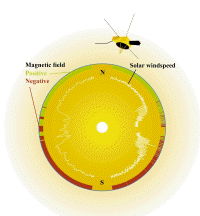
Figure 8: Ulysses (ESA & NASA): SWOOPS and MAG |
The Sun's magnetic equator is also influential. As the Sun rotates, its magnetic equator appears to wobble up and down. The solar wind in the region occupied by the Earth therefore alternates between fast and slow. Before the slow solar wind has time to reach the Earth's orbit, the fast wind overtakes it. The result is a high pressure front, equivalent to a weather front on Earth. Much of our "space weather" is caused by the shock of such interplanetary fronts.
"Just like the mythical character after which it was named, the Ulysses spacecraft has ventured on a voyage of discovery," said Richard Marsden, ESA's project scientist for Ulysses. "Its findings have changed for ever the way we view the Sun's environment, the heliosphere."
5. How the Sun fights the cosmic rays
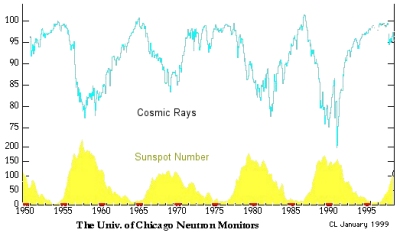
Energetic particles that bear down upon us from distant parts of the Universe can damage living tissue and cause computer faults, and may affect the weather. The Sun helps to shield the Earth from these cosmic rays. Their intensity declines whenever the presence of many sunspots tells of high solar activity (see figure 9).
 |
|
Figure 9: Sunspots up, cosmic rays down. Colorado neutron counts by Univ. Chicago (Ulysses/COSPIN leaders) |
Ulysses confirmed and discovered various ways in which the Sun hampers and weakens cosmic rays before they reach us. Strong bursts of gas from the Sun repel cosmic rays. So do the shocks produced by colliding fast and slow solar wind-streams near the equator. The shocks are rhythmic because they rotate with the Sun. Ulysses found unexpectedly that the Sun's polar regions feel these rhythmic shocks coming from the equatorial zone.
 |
|
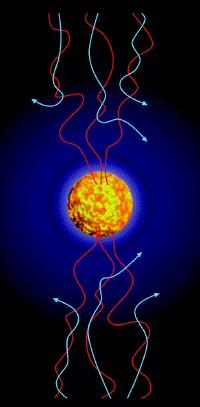
Figure 10: Polar magnetic field lines are folded and kinked |
In contrast to the solar wind, which flows much more steadily in the polar regions than it does near the equator, the magnetic field near the poles fluctuates erratically. The shifts are caused by large-amplitude waves travelling outward from the Sun. Polar magnetic field lines are folded and kinked. They shove cosmic rays away from the Sun and back into the outer heliosphere, just as a raging surf forces a would-be wader out of the ocean and onto the beach.
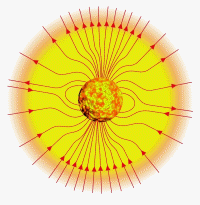
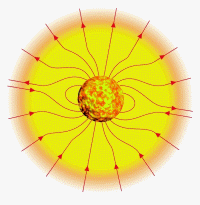
The intensity of cosmic rays is essentially the same over the Sun's poles as it is at the equator. Astrophysicists had reasoned that magnetic fields should converge toward the Sun's north and south magnetic poles, just as the field lines around a bar magnet do. From the point of view of cosmic rays, the field lines over the poles should act as magnetic funnels, concentrating the rays and increasing their intensity (diagram bottom, left). Ulysses found that this picture was wrong. The solar wind spreads the field lines more uniformly (diagram bottom, right).
"We went to the south magnetic pole of the Sun and it wasn't there!" was how André Balogh of Imperial College London expressed his surprise in 1994, when Ulysses first revealed the nature of the polar field.
 |
 |
|
Figure 11: Before Ulysses |
Figure 12: After Ulysses |
Sensors on Ulysses identified atoms wafting into the Solar System from the thin gas that fills the space between the stars. From neutral helium atoms, Ulysses established the speed and direction of the Sun's motion relative to the gas. The proportions of various atoms in this local interstellar gas found by Ulysses are helping to reveal how the material from which the Solar System was made has aged.
From much farther away, Ulysses registered an intense burst of gamma rays from a new class of neutron star, a magnetar, 20 000 light-years away. Despite the immense distance, the five-minute radiation burst was strong enough to disturb the Earth's atmosphere.
6. Star-dust showers us from cosmic space
 |
|
Eberhard Grün |
"The interstellar grains detected by Ulysses are bigger, and it is now thought that they may even reach the orbit of the Earth," said Eberhard Grün of the Max-Planck-Institut für Kernphysik in Heidelberg, Germany. "This discovery provides the opportunity to analyse real stardust - the raw material that the Earth and the planets were made of."
Shooting stars, or meteors, are small grains of dust from interplanetary space, burning up in the Earth's air. Space physicists used to think that all dust in our vicinity came from asteroids or comets. Yet, deep inside the Solar System, the DUST instrument in Ulysses collected and analysed grains of interstellar origin. Small dust grains the size of cigarette smoke (about 0.01 to 0.1 microns) are prevented from reaching the inner regions of the heliosphere because of the magnetic field of the solar wind.
In 1998 Ulysses revisited the orbit of Jupiter and began a second trip to the Sun. It continues to operate flawlessly and has enough attitude- control fuel and electrical power for at least one more orbit, taking it over the solar poles in 2000 and 2001.
If anything, the coming inspection of the polar heliosphere will be even more interesting than the first, which took place when the count of sunspots was at a minimum and the Sun was relatively quiet. The next visit will be at the height of the sunspot cycle, a time of solar frenzy. Investigators are already booking seats for a display of pyrotechnics much grander and more spectacular than the Earth-bound fireworks that will herald the new millennium.
Earth's space environment: ESRO-II to Cluster II
Power cuts, communication blackouts, auroras and damaged satellites are all caused by high-energy solar particles penetrating Earth's magnetic shield. Over the last thirty years, studies of near-Earth space by ESA and its predecessor ESRO (European Space Research Organisation) have significantly increased our knowledge of such events.
 |
|
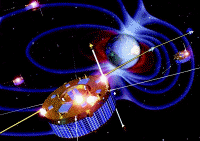
Figure 13: Cluster II (Dornier Space Systems) |
The programme began with the launch of ESRO-II in May 1968. Two more satellites followed over the next seven months. Exciting new information was obtained on Earth's radiation belts, the ionosphere and the aurora borealis (northern lights). HEOS-1 returned new data on the shock wave created by the solar wind as it slammed into Earth's magnetosphere, while HEOS-2 explored the boundaries of Earth's magnetic field. These and further satellites revealed the secrets of basic physical processes taking place in near-Earth space, such as collisionless shocks and magnetic reconnections.
The next step is to send four identical spacecraft around the Earth. The Cluster II mission will give the first three-dimensional view of the ever-changing sea of plasma around our planet.
 |
|
Gerhard Haerendel |
"The cosmos starts a few hundred kilometres above our heads," said Gerhard Haerendel of the Max-Planck-Institut für Extraterrestrische Physik in Garching, Germany. "If we can understand what is happening close to the Earth, we can apply that knowledge and understand similar processes in the rest of the Universe."
7. Holes in the Sun where the solar wind streams out
 |
|
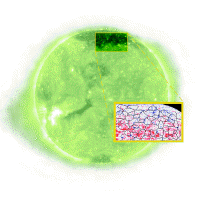
Figure 14: Escaping gas coloured blue. SOHO (ESA & NASA) SUMER on EIT background |
Like water gushing through cracks in a dam, rivers of electrified gas flow outwards around magnetic barriers on the Sun. The gas will then accelerate for its 3-million-kilometres-per-hour rush into space as the fast solar wind.
This discovery by SOHO, reported in 1999, was a big step forward in understanding the source of the wind that comes typically from polar regions of the Sun, at twice the speed of the slow wind from the solar equator. The fast wind can buffet and shock the Earth's space environment. The nature and origin of the solar wind-streams is one of the main mysteries SOHO was designed to solve.
 |
|
Klaus Wilhelm |
"The identification of the detailed structure of the source region of the fast solar wind is an important step in solving the problem of solar wind acceleration," said Klaus Wilhelm of the Max-Planck-Institut für Aeronomie in Lindau, Germany, principal investigator for SUMER. "We can now focus our attention on the gas conditions and the dynamical processes seen in the corners of the magnetic field structures."
 |
|
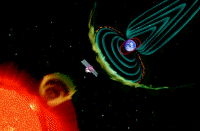
Figure 15: SOHO (Illustration by Steele Hill) |
Since 1996 the European Space Agency has had a two-tonne watchdog for storms in the Sun that may affect the Earth. Its name is SOHO, short for Solar and Heliospheric Observatory, and it is a project of international cooperation between ESA and NASA. Virtually suspended in a spot 1.6 million kilometres from our planet, SOHO has kept a lot more than one eye on our turbulent star. Its twelve instruments have observed from the depths of the Sun's core, to the cataclysms on its surface, to the fiery tempests in its atmosphere and to the tenuous, yet far-reaching solar wind.
Scientists are still debating whether an almost complete lack of sunspots around AD 1700 (known as the Maunder Minimum) may have caused a little ice age on Earth. Some think that cloud cover on our planet might be affected by the interaction between the Sun's magnetic field and cosmic rays from deep space.
 |
|
Pål Brekke |
"If we can get data from SOHO throughout the coming solar maximum, we might learn enough to begin to draw conclusions about the effects of solar activity on the climate of our own planet," said the Norwegian solar physicist Pål Brekke, of the Institute for Theoretical Astrophysics in Oslo and SOHO's deputy project scientist.
8. When to warn the world of dangerous solar blasts
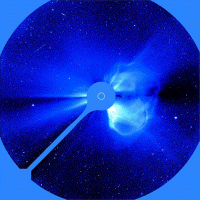
When people living in northern latitudes suffer electrical blackouts, for which neither the weather nor power companies are responsible, the one to blame is very likely the Sun. Blasts of gas from the Sun called mass ejections can cause magnetic storms, which stress power networks, affect navigation systems and may even send birds off course.
 |
|
Figure 16: Sideways blast |
 |
|
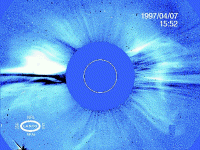
Figure 17: Earthwards? |
 |
|
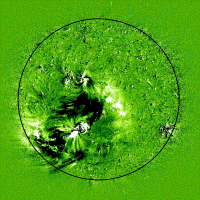
Figure 18: Yes, Earthwards |
With SOHO's help, forecasts of severe space weather moving towards our planet are greatly improved so that engineers can be alert to the risk. From its vantage point, SOHO has an excellent view of the blasts of gas, which grow far larger than the Sun. If a mass ejection is seen as a halo around the Sun it may be heading straight for the Earth or it may be going away. To avoid false alarms, scientists looked for symptoms on the Sun's visible face associated with an earthwards mass ejection.
They found a marker for mass ejections in the Sun's lower atmosphere with SOHO's EIT telescope. It reveals spectacular shock waves propagating across the solar disk as a recoil effect from a mass ejection. If SOHO reports both a halo outburst and the corresponding signature on the face of the Sun, then space weather forecasters can more confidently alert the world to the risk of a magnetic storm.
Mankind's dependence on technologies vulnerable to solar disturbances has dramatically increased over the last decade. Occasionally solar flares send energetic particles - mainly protons - towards the Earth, too. They threaten orbiting astronauts and can seriously damage satellites. One of SOHO's great advantages over previous attempts to study solar proton events is that it can relate upheavals seen in the Sun's atmosphere to the energetic particles showing up in SOHO's own detectors, called COSTEP and ERNE.
 |
|
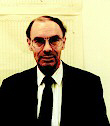
Jarmo Torsti |
9. The Sun contends with a breeze from the stars
 |
|
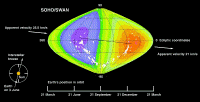
Figure 19: SOHO (ESA & NASA) SWAN |
Like a high-tech windsock the SWAN instrument in SOHO displayed the direction and speed of hydrogen atoms streaming through the Solar System, in a chart of the whole sky. The interstellar gas glows with ultraviolet light, and the motions change the measured wavelength. SWAN also sees the hydrogen atoms disappearing because the solar wind breaks them up.
"The solar wind destroys hydrogen atoms passing close to the Sun," said Jean-Loup Bertaux of the CNRS Service d'Aéronomie in France, who is in charge of SWAN. "Downwind we see distant survivors, whose speed is less affected by the Sun's gravity."
Happy endings to SOHO's misadventures
On 25 June 1998, SOHO vanished in space. Wrong commands sent during a maintenance manoeuvre left it tumbling and freezing, with its solar panels not facing the Sun. In a heroic struggle over many weeks, engineers regained control. It took almost 100 000 commands from the ground, plus patient thawing of 50 kg of frozen hydrazine fuel, before SOHO returned to work on 5 November. Amazingly all twelve scientific instruments on the spacecraft functioned normally, even though some had been chilled to -120 °C and others heated to 100 °C.
Trouble struck a second time on 21 December. SOHO went automatically into a self-protection mode when the last of its three gyroscopes failed. Two had been lost in the earlier misadventure. Without a fundamental aid to orientation, the spacecraft continually fired onboard jets to keep its sensors pointed towards the Sun.
 |
|
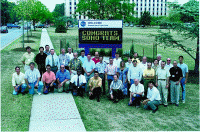
Figure 20: Group portrait |
The problem was solved. On 2 February 1999, engineers and scientists applauded as a new picture of the solar disk from the EIT telescope appeared on computer screens. The Sun was again shining on SOHO!
10. Why the Sun's atmosphere is shockingly hot
Nobody would have guessed it: the atmosphere of the Sun is much, much hotter than its surface. By more than one million degrees Centigrade in fact. Since 1939, when scientists first determined the temperature of the solar atmosphere - known as the corona - they were unable to come up with a convincing theory of why it greatly exceeded the "mere" 6000° of the visible surface.
 |
|
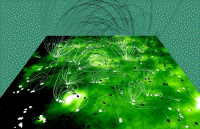
Figure 21: SOHO (ESA & NASA) MDI and EIT |
Nearly 60 years later, SOHO solved the mystery. Once again the MDI acronym (short for Michelson Doppler Imager) is the code needed to decipher the secrets of our nearest star. With MDI, scientists gathered data showing that huge numbers of small, closely intertwined magnetic loops continuously emerge from the Sun's visible surface, clash with one another and dissolve within 40 hours.
 |
|
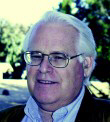
Alan Title |
The loops seem to form a tight pattern that scientists call a magnetic carpet. Their interaction generates electrical and magnetic short-circuits and releases enough energy to heat the corona to temperatures hundreds of times higher than those of the solar surface.
"We now have direct evidence for the upward transfer of magnetic energy from the Sun's surface toward the corona above," said Alan Title, who led the research at the Stanford-Lockheed Institute for Space Research, in Palo Alto, California.
Solar space fleet
 |
|
ISTP logo |
The launch in 2000 of the four satellites of the Cluster II mission will coincide with intense activity in the Sun, expected to peak in 2001. Added to Ulysses and SOHO they make six spacecraft in all, built in Europe for ESA-NASA solar projects. Other related satellites come from Sweden and Denmark as national ventures.
Europe thus makes a formidable contribution to the International Solar-Terrestrial Physics Programme. The USA, Russia and Japan also provide satellites, creating a large solar space fleet. It will monitor the active Sun and the solar wind, tracking their effects into the Earth's space environment. Ground stations all around the world will observe solar effects in the upper atmosphere, and magnetic storms and particle counts at the surface. Here too Europe's role is conspicuous, including superbly equipped stations in high latitudes, where solar effects are most severe.
 |
|
Eigil-Friis Christensen |
"Never was there such intensive effort to observe the Sun's actions, with so many ground stations and spacecraft," said Eigil-Friis Christensen, director of the Danish Space Research Institute and instigator of Denmark's Ørsted satellite. "We can expect an extraordinary rate of discoveries in the next few years, helping us to understand how changes in the Sun affect us all."
11. Rivers of gas hidden beneath the Sun's surface
Solar physicists performed the equivalent of sonograms of the Sun. By detecting sound waves, they explored the interior. Three instruments in SOHO register the waves, either in vertical motions (MDI and GOLF) or in brightness changes (VIRGO). By applying techniques similar to those used by seismologists on Earth, the scientists deduce layering, motions and temperatures inside the Sun.
 |
|
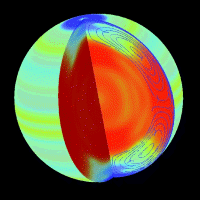
Figure 22: Flow towards poles. SOHO (ESA & NASA) MDI |
The MDI instrument, measuring vertical motions of the Sun's surface every minute at a million different points, generated stunning images and charts of the subsurface region called the convection zone. Hot gas bubbles to the surface, cools and sinks. It rotates around the Sun's axis. And the entire upper part of the convection zone, down to a depth of at least 24 000 km, moves slowly but steadily from the equator to the poles. At a flow rate of about 80 kmh-1 the journey takes a little more than a year.
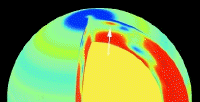
By detecting the internal rotations with unprecedented precision, MDI detected a 25 000 km-wide jet stream moving 10 percent faster than the surrounding areas. These discoveries should help to explain why the Sun varies so much in activity through its 11-year cycle, and the sunspots that come and go.
 |
|
Figure 23: Jet stream. SOHO (ESA & NASA) MDI |
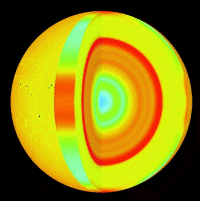
Concentric layers in a cutaway image show oddities in the speed of sound deep inside the Sun, as gauged by MDI and VIRGO. In red coloured layers, sound travels faster than predicted by the theorists. The temperature is higher than expected.
"Jet streams in the Earth's atmosphere have a tremendous effect on the weather here, so we have to wonder what a similar flow does inside the Sun," said Douglas Gough of Cambridge University, UK. "Frankly, I don't know. Ask me again in 2001 when we've seen what happens at the peak of solar activity."
 |
|
Figure 24: Differences from expected temperatures. SOHO (ESA & NASA) MDI, A. Kosovichev image from MDI and VIRGO data |
The conspicuous red layer, about a third of the way down, denotes elevated temperatures where the turbulent outer region meets a more stable region inside it. The dynamo that drives sunspot activity may operate here. The blue colouring of the core implies that the thermonuclear reactions powering the Sun could be underperforming at present, with a temperature perhaps 0.1 percent cooler than the expected 15 million °C.
"Many more fundamental discoveries about the Sun's interior are on the waiting list to be confirmed," said Roger Bonnet, ESA's Director of Science, who is a solar physicist himself. "But they need time, and this is one reason why we fought so hard to continue SOHO until the next solar maximum."
12. Astounding quakes and tornadoes on the Sun
Scientists using the Michelson Doppler Imager (MDI) observed a seismic wave caused by a magnetic explosion associated with a solar flare. The energy released was 40 000 times greater than that of the San Francisco earthquake in 1906.
 |
|
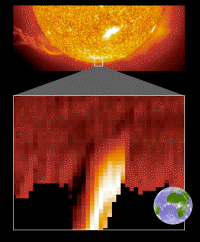
Figure 25: Tornado near the Sun's south pole. SOHO (ESA & NASA) CDS on EIT background |
A high-energy electron beam heated the outer surface of the Sun, spewing the solar plasma upwards at supersonic speed. A downward recoil effect sent a wave propagating inside the Sun. On the surface the flare caused a circular ripple, like a stone thrown into a pond. A 3-km-high wave rushed out at 180 000 kmh-1, rattling the Sun's surface as far as 120 000 km from the epicentre. Nothing like that was ever seen before the advent of SOHO.
With SOHO's CDS spectrometer, other scientists spotted gargantuan tornadoes sweeping especially the polar regions of the Sun. The twisters blow at more than 50 000 kmh-1 with gusts reaching speeds ten times higher.
"We see the hot gas in the tornadoes spiralling away from the Sun and gathering speed," said David Pike of the Rutherford Appleton Laboratory, UK, co-discoverer of the solar tornadoes with Helen Mason of Cambridge University. "These spectacular events in the Sun's atmosphere must have widespread effects."
Interplanetary ingenuity
 |
|
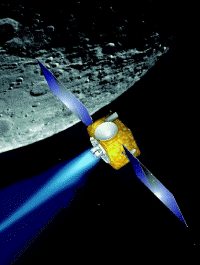
Figure 26: SMART-1 (Swedish Space Corporation) |
Europe votes for easier space exploration. On its trip to the Moon and beyond in 2001-2002, ESA's SMART-1 will demonstrate a solar-electric rocket motor that offers acceleration to far-flung destinations.
"Ingenuity in our deep-space missions enables us to make discoveries in spite of NASA's much larger interplanetary programme," said Martin Huber, head of ESA's Space Science Department. "By choosing targets and methods carefully, Europe can do very well in the Solar System."
The neglected planet Mercury may be the preferred target for ESA's first major interplanetary project using electric propulsion. Meanwhile, in 2003 Rosetta will set off to intercept Comet Wirtanen for the closest investigation ever made of a comet.
 |
|
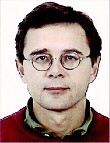
Peter Rathsman |
"Europe won its independence in launchers with the Ariane rockets," said Peter Rathsman of the Swedish Space Corporation, prime contractor for SMART-1. "Now it's time to find our independent way to electric propulsion for deep space."
Mars Express, launched later that year, will make a distinctive European contribution to the exploration of the Red Planet. In 2004 ESA's Huygens probe will parachute onto Titan, the moon of Saturn that preserves, in deep freeze, chemical secrets of life's origins.
 |
|
Klaus Torkar |
"To catch and examine a comet's dust far away in space is not just fascinating science," said Klaus Torkar of Austria's Space Research Institute at Graz, who works on the MIDAS microscope for Rosetta. "We find that space exploration excites students at the universities in our neighbourhood too. It stimulates their wish to learn and stretches their imagination."
13. Identified: the great exploding star of 1987
The event of the century for astronomers was the cataclysmic explosion of a massive star. Although such supernovae are crucial in cosmic history, and the source of the Earth's gold and uranium, none had been seen at close range with modern instruments. Stargazers spotted Supernova 1987A in February 1987, in the Large Magellanic Cloud in the southern sky. When the news broke, the very first space telescope to turn towards Supernova 1987A was the astronomical satellite IUE.
 |
|
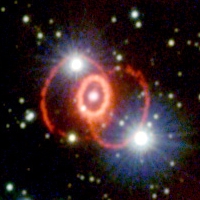
Figure 27: HST (NASA & ESA) WPC2; P. Challis (CfA) |
As the supernova faded rapidly in the ultraviolet, IUE's experts could say, years before other observers, exactly which star blew up. It was a blue star, not red as expected. The satellite registered ultraviolet signatures of newly-made chemical elements released by the explosion.
The flash lit up a distant ring of gas surrounding the star, and IUE recorded an echo of the light, a month after the explosion. In 1990 the Hubble Space Telescope began examining the scene. The European Space Agency's Faint Object Camera on Hubble detected a cloud of debris and measured its expansion rate. It also imaged the ring of gas responsible for IUE's echo from the supernova. Later, NASA's wide-field cameras examined the ring, which is shown coloured yellow in the accompanying image.
 |
|
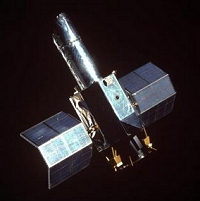
Figure 28: IUE |
"From IUE's light echo and the ring measured with Hubble, we could tell how far away the supernova was," said Nino Panagia, an ESA scientist from Italy working at the Space Telescope Science Institute. "In 1991 we put Supernova 1987A at a distance of 167 000 light-years. With better pictures we confirmed that result, and reduced the uncertainty to as little as two percent."
IUE, or International Ultraviolet Explorer, was a NASA-ESA-UK venture. It analysed ultraviolet light from the stars. This is blocked by the Earth's ozone layer but often carries storm signals of cosmic upheavals. Launched in 1978, IUE operated until 1996, making it the longest-lived astronomical spacecraft ever.
 |
|
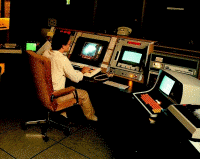
Figure 29: IUE operations at Villafranca, Spain |
At Villafranca, Spain, guest observers were able to oversee IUE's science operations at ESA's ground station. The user-friendly spirit survives in interactive archives at Villafranca. They give astronomers easy access to re-processed results from 104 000 ultraviolet observations, ranging from auroras on Jupiter to eruptions in distant galaxies and quasars.
 |
|
Ana Ines Gomez de Castro |
"It was a wonderful way to do space astronomy," said Ana Ines Gomez de Castro, a Spanish expert on young stars. "To be in the IUE room at Villafranca was like working in the control room of a ground-based telescope but with the ultraviolet Universe in plain view."
14. The size of a black hole's dinner-plate
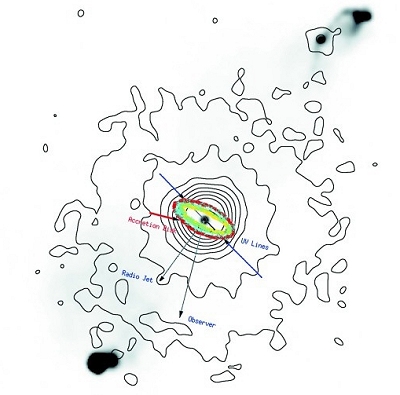
To explain eruptions seen in galaxies, theorists blamed giant black holes. Observations tallied with, but did not prove, the idea that a black hole eats gas from a flat, incandescent dinner-plate surrounding it, called an accretion disk. In 1997 a team led by Willem Wamsteker of ESA's Space Science Department made conjecture a reality. They announced that the accretion disk in Galaxy 3C390.3 was one-fifth of a light-year across, and 1500 times wider than the black hole at its centre.
 |
|
Figure 30: Accretion disk in Galaxy 3C390.3. Diagram (not to scale) on X-ray and radio images from Harris et al. (ApJ. 499, L149) and 1452 Mhz VLA |
IUE examined Galaxy 3C390.3 thirty-nine times over fourteen years. The scientists also consulted observations by five X-ray satellites. Whenever the black hole consumed a larger morsel than usual, the galaxy flared up, but light took more than a month to reach the edge of the accretion disk. This delay measured the disk's width. From motions of gas, the scientists calculated the fate of an unlucky star captured by the black hole. Shredded by the intense gravity, its gas would swirl twice around the black hole before disappearing into its maw after 150 years.
"Results like this show that IUE's data will continue to give new astronomy for decades to come," Willem Wamsteker commented. "Future generations of astronomers will look back through our eighteen years of unique observations with questions that we haven't even thought of yet."
Golden age of high-energy astronomy
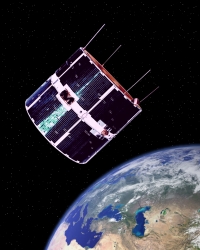
With its COS-B satellite launched in 1975 ESA pioneered gamma-ray astronomy and put European astronomers at the forefront of the field. Gamma-rays are even more energetic than X-rays. Exploding stars, black holes and other strange objects are among the sources of this powerful radiation.
 |
 |
|
Figure 31: COS-B 1975 |
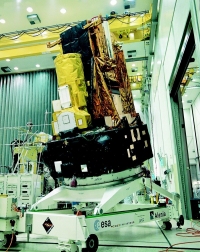
Figure 32: INTEGRAL 2001 |
COS-B was followed by the Russian-French mission GRANAT and NASA's Compton Gamma Ray Observatory, both of which involved some of the COS-B teams. ESA now has INTEGRAL, the INTErnational Gamma-Ray-Astrophysics Laboratory, which will use advanced detectors unavailable to the COS-B pioneers. Launch by a Russian Proton rocket from Baikonur is scheduled for 2001.
 |
|
Brian Taylor |
"With its enormous gain in sensitivity, spectral and image quality over its forebears, INTEGRAL will revolutionise the field in probing to the heart of the most violent events occurring in the cosmos", said Brian Taylor, head of ESA's Astrophysics Division at Noordwijk in the Netherlands. "INTEGRAL together with the X-ray astronomy satellite XMM promises a golden age for high-energy astrophysics at the start of the new millennium."
15. A vampire star closes in on its victim
The European Space Agency's first X-ray space observatory, launched in 1983, reached 192 000 km out into space. On its highly eccentric four-day orbit, Exosat made observations for up to 76 hours without interruption by the Earth's radiation belts. It could see cosmic X-ray sources flickering.
 |
|
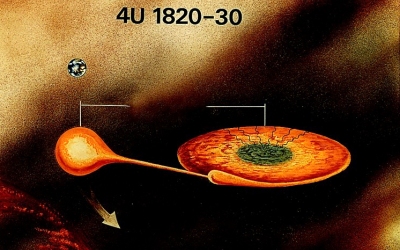
Figure 33: Artist's impression of 1820-30 |
One startling revelation was of two stars moving around each other in an incredible 11 minutes, the shortest known revolution period in astronomy. In XB 1820-30, lying 20 000 light-years away in a dense star cluster in the Sagittarius constellation, the two stars would fit entirely into the distance between the Earth and the Moon, despite their combined mass of nearly twice our Sun.
Astronomers believe that a neutron star, about the size of Mount Everest but so dense that five hundred million tons of it would fit in a teaspoon, is feeding on a white dwarf star. The Earth-sized white dwarf is distorted into an egg-like shape by the intense gravitational field, its matter being sucked from it and heated to millions of degrees as it falls into the neutron star. The resulting X-rays are ten billion times more intense than those from our Sun.
 |
|
Luigi Stella |
"Before Exosat no one had identified such an ultra-compact pair of stars," said Luigi Stella of the Astronomical Observatory of Rome, a member of the discovery team. "Perhaps the system was formed through the head-on collision of the neutron star with another star in the cluster. This helps us to understand why some stars have a bizarre and violent history."
And for the next trick with X-rays...
 |
|
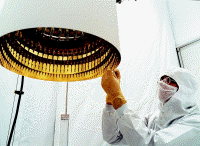
Figure 34: One delicate mirror... |
 |
|
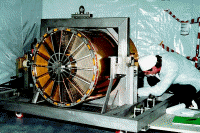
Figure 35: ...but 58 make a stout module... |
 |
|
Figure 36: ...that's brilliant in optical tests! |
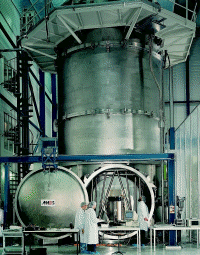
Making mirrors was one of the greatest challenges in the development of ESA's new X-ray satellite, XMM, which was launched December 10, 1999. After a year of trial and error, a process was devised which ensured that XMM would carry into space the best X-ray telescopes ever offered to the world's astronomers. Three mirror modules have a total area of 120 m² of high-precision optics!
"We had to nest 58 mirrors in a module, each with extreme specifications," said ESA's project manager Robert Lainé. "Critics thought we were too ambitious."
Each mirror shell, 60 cm long, was moulded on a nickel-surfaced mandrel made in Germany. Mandrels of decreasing diameters were shaped to an accuracy of a thousandth of a millimetre and polished to a smoothness a thousand times better.
The actual mirrors were formed in Italy, by deposition of a gold film, and backed with a millimetre of nickel. The flimsy shells were then eased ever so delicately off the mandrels. They could easily sag under their own weight and be deformed. The mirrors were packed together like Russian dolls, barely three millimetres apart and bonded on a support structure, becoming rigid enough to survive the conditions at launch and in space.
From five modules produced, tested and calibrated, the programme selected three with the best performance, to fly on XMM.
16. Star-gas trembles as it falls to its doom
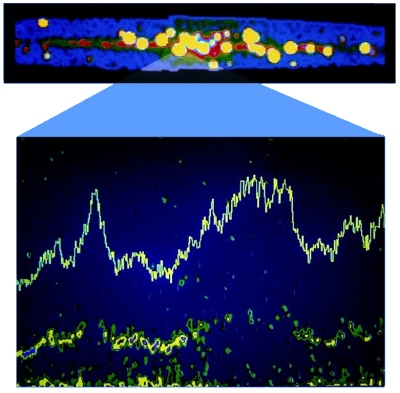
Astronomers wanted Exosat to confirm the presence of hungry neutron stars in double-star X-ray sources, by detecting regular pulsations like those seen in pulsars, which are neutron stars in other settings. Despite a very detailed programme to detect periodic flashes, none were found. But the astronomers were rewarded with a surprising new phenomenon: quasi-periodic oscillations in X-ray stars.
 |
|
Figure 37: X-ray stars near the Galactic Centre, and GX 5-1 variations |
Instead of a fixed "heartbeat" Exosat revealed sources that appeared to be constantly trembling. In the radiation emitted by a well-known X- ray star, GX 5-1, the flash of one narrow pulse is replaced by a flickering effect over a range of X-ray energies. These oscillations are now known to be common in many double-star X-ray sources. Too variable to be due to the spinning of a star, the oscillations seem to be a symptom of gas from a victim star disappearing, as it is devoured by a neutron star or a black hole.
Exosat made 1780 X-ray observations during its three-year mission, ending in 1986. At the century's end, its results are still yielding fresh insights. ESA's new XMM space observatory will delve even further into the mysterious X-ray sources.
ESTEC: Dreams into reality
 |
|
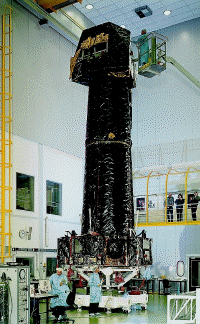
Figure 38: XMM spacecraft at ESTEC |
Engineers and scientists collaborate at ESA's science and technology centre at Noordwijk in the Netherlands. Teams from the Scientific Projects Department of ESTEC appraise the technology and systems for future spacecraft. When missions are approved, the project teams work with Europe's aerospace industry to implement them. Facilities for technological development and spacecraft testing are available at ESTEC.
Based at the same campus is ESA's Space Science Department. It appoints a Project Scientist to coordinate the input to each mission from Europe's universities and research institutes. The enthusiasm of academic scientists has to be matched to the stern requirements and deadlines of the project management.
 |
|
John Credland |
"We turn dreams into reality," said John Credland, head of Scientific Projects at ESTEC. "Aspirations of space scientists all across Europe have to be translated into affordable high technology. We've always depended on Europe's aerospace industry to build excellent spacecraft for us. Now we are giving the industry a greater share in managing the interfaces of ESA's science projects."
17. A riddle solved: older Universe, younger stars
Europe gave an extraordinary gift to the world's astronomers in 1997. ESA's Hipparcos Catalogue told them the positions and motions of 120 000 stars, far more accurately than they ever knew before. It was the product of a unique space mission, using a satellite to fix the stars and so to improve mankind's grasp of the Universe.
 |
|
Michael Feast |
"Hipparcos cured a headache for cosmologists," said Michael Feast of Cape Town University, South Africa. "We now judge the Universe to be bigger and therefore older, by about a billion years. The oldest stars are much younger than supposed, by about four billion years. If the Universe is about 12 billion years old, everything fits nicely."
 |
|
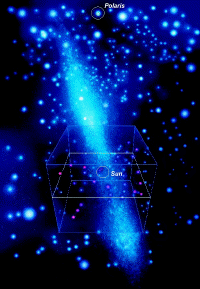
Figure 39: Solar neighbourhood |
Scientists now possess, for the first time, a good three-dimensional picture of the bright stars in our neighbourhood. Hipparcos measured the distances of many stars, which were previously a matter of guesswork. For example Polaris, the Pole Star, is 430 light-years away.
Hipparcos hit the headlines in 1997 when it showed that the chief measuring rod for the Universe was wrongly marked. Bright blue stars called Cepheids, of which Polaris is one, vary in luminosity in predictable ways. Astronomers use them to gauge distances of galaxies and the scale of the cosmos. But Hipparcos revealed them to be farther away than previously supposed. This made the Universe about 10 percent older.
Also farther away than expected are the oldest known stars, the so- called halo stars. The change in distances cut their ages by a few billion years. Combined with the change in the cosmic scale, this solved a riddle in astronomy. Before Hipparcos the old stars seemed to predate the Universe. That was as nonsensical as mountains older than the Earth!
18. New puzzle: key stars are closer than expected
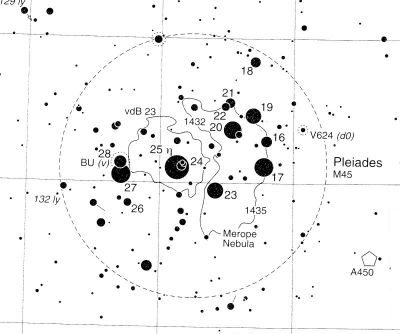
Visible to the naked eye in the constellation of Taurus, the Pleiades have a special place in the science of the stars. Heavy stars burn up faster and grow old more rapidly than less massive stars. As all the stars of the Pleiades cluster formed at the same time, scientists can see how the mass of each star affects its luminosity, colour and ageing. Theories of stellar evolution, worked out using the Pleiades and other clusters of stars, under-pin all efforts to understand the Universe and to predict, for example, how long the Sun will survive.
 |
|
Figure 40. Pleiades in Millennium Star Atlas (Sky Publishing Corporation and ESA) |
But when Hipparcos measured the distance of the Pleiades, the theories looked wrong. At 385 light-years, the star cluster is 10 percent closer than previously thought. The stars are 20 per cent less luminous - a huge discrepancy with the standard theories. Scientists reacted to the Hipparcos result with words like "amazement", "alarm" and even "nightmare".
Hipparcos scientists can find no reason to think that the measurement is faulty, so the theorists are left scratching their heads about how to put matters right.
 |
|
Floor van Leeuwen |
"Some colleagues are so unhappy about the unexpected distance of the Pleiades, they insist that Hipparcos is wrong," said Floor van Leeuwen of Cambridge University, UK. "After checking it in several ways, I'm sure Hipparcos gave the right answer. So don't use old theories to 'correct' new data. Let's develop better theories."
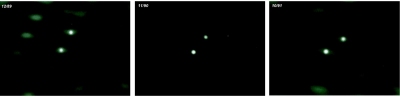
Hipparcos was not conceived as an imaging telescope. It measured angles between points of light in the sky. But by combining repeated observations from different phases of the satellite's operating life, Swedish astronomers made the succession of images shown below.
Two stars shift their positions as they orbit around each other. The precision is astonishing. The stars are 34 light-years away in the Hydra constellation. They lie as close together as do the Sun and the planet Saturn. Their separation in the sky is only 1/5000°. Yet the Hipparcos results show them plainly circling, and also moving together towards the east (left) in the course of two years.
 |
|
Figure 41. C.F. Quist et al. using data from Hipparcos (ESA) |
Double stars are very useful in enabling astronomers to gauge the masses of stars. In this case the mass of the upper star is 0.41 times the mass of the Sun, and that of its companion is 0.42.
Hipparcos observed 24 000 double stars, of which 10 000 were not previously known to be double. The mission also investigated changes in luminosity of 8 000 new variable stars, in addition to 4 000 known variables - thus greatly improving the knowledge of how variable stars behave.
"Astronomers have always lived by their wits," said Lennart Lindegren of Lund Observatory, Sweden. "It was never easy to extract information from those small and distant lights in the sky. Now we're glad to show our colleagues some new tricks to make the Hipparcos results even more useful."
19. Fixed: an amazing star that flashes gamma-rays
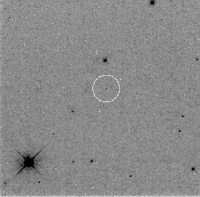
| Star data from Hipparcos, and images from ground observatories and the Hubble Space Telescope, fixed the position of a faintly visible neutron star, Geminga. It flashes gamma-rays and X-rays towards the Earth 252 times a minute, with the regularity of an atomic clock. |
| |||
|
||||
|
"We needed Hipparcos to finish a long and complicated task of tracking down Geminga," said Patrizia Caraveo of the Institute of Cosmic Physics in Milan, Italy. "Never before was so faint an object pinpointed with such accuracy." | ||||

To compensate astronomers for an embarrassment about the Pleiades, Hipparcos makes them far more confident about the Hyades. This is a second cluster of stars in the Taurus constellation that looms large in star theory. Experts from ESA, and from Leiden (Netherlands), Paris-Meudon and Côte d'Azur (France) and Lausanne (Switzerland), analysed Hipparcos data on more than 200 stars in the Hyades cluster.
|
|
|
Figure 43: Hyades in Millenium Star Atlas (Sky Publishing Corporation and ESA) |
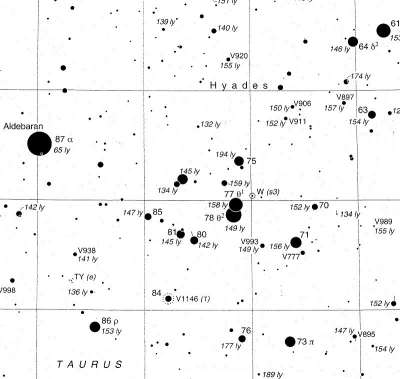
Astronomers were unsure about the distance of the Hyades, before Hipparcos. Now they know that the centre of the cluster is at 151 light-years. The uncertainty is less than one light-year. The cluster moves across the sky, and Hipparcos also plots movement of stars within the Hyades, in a 3-D motion picture.
|
|
|
Figure 44: Hipparcos |
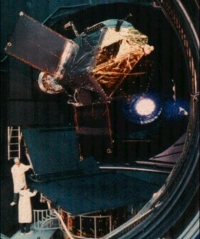
Gravity has held the stars together since their birth 625 million years ago, when only primitive animals lived on Earth. But Hipparcos reveals that some stars are now quitting the Hyades tribe.
"The Hyades cluster has almost assumed the role of the Rosetta Stone of astronomy," said Michael Perryman of ESA's Space Science Department at Noordwijk in the Netherlands. "It allows us to decipher many mysteries of stars. Uncertainties in the observations left it muddy and hard to read with confidence. Let's say we've now cleaned this Rosetta Stone to the point of complete legibility."
20. The Milky Way: it's floppy and it changes shape
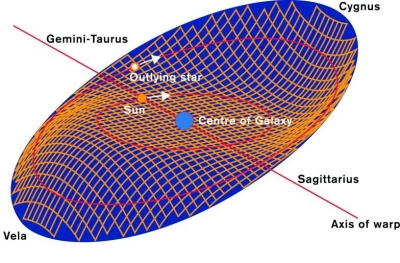
The band of light across the night sky, the Milky Way, is the flattened disk in which many stars including the Sun orbit around the centre of our Galaxy. From Hipparcos results on many distant outlying stars, astronomers from Turin Observatory, Italy, and Oxford University, UK, deduce that the disk is slightly warped, like the brim of a hat. What's more, the distant stars are travelling in unexpected directions which, if continued, will change the shape of the Milky Way.
 |
|
Figure 45: The warp in the Milky Way (Osservatorio Astronomico di Torino, vertical scale x 10) |
"The extraordinary accuracy of Hipparcos convinces us that distant stars have altered course," said Richard Smart of Turin Observatory. "If we knew why, we'd be a lot wiser about the unseen hand of gravity at work in our Galaxy and others."
The harvest of discoveries from Hipparcos has only just begun, as ESA's gift to the world's astronomers opens a new era in their research. Besides the 120 000 stars of the main Hipparcos Catalogue, charted with the highest precision, the scientific team also produced the Tycho Catalogue in which a million stars are detailed with lesser but still remarkable accuracy. Aptly named is the Millennium Star Atlas, based on the Hipparcos and Tycho Catalogues, which is the finest-ever product of celestial cartography.
Scanning the Hipparcos and Tycho Catalogues is made easy by provision of the data on the Internet and on CD-ROMs. Celestia 2000 is a single CD-ROM devised for amateurs as well as professional astronomers to consult on personal computers. For information on how to obtain the products at modest cost, visit: http://astro.estec.esa.nl/Hipparcos/.
ESOC: Darmstadt's role in ESA's Science Programme
 |
|
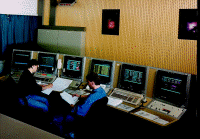
Figure 46: Hipparcos dedicated control room |
On the outskirts of historic Darmstadt in Germany, expert teams are in daily touch with spacecraft in orbit, at ESA's European Space Operations Centre. Worldwide networks of ground stations, permanent or ad hoc, provide the links. Since 1968, ESOC has controlled 17 scientific spacecraft and a similar number of applications satellites.
 |
|
David Dale |
"We've always used rather small teams," said David Dale, ESA's director of technical and operational support. "Yet our successes in spacecraft control, in good times and in emergencies, are enviable. Bringing ESOC under a single directorate with our science and technology centre at ESTEC consolidates the teamwork we achieved over many years."
21. The first naked black hole in a galaxy
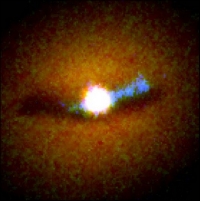
In 1997, a scientist examining Hubble images at the European Southern Observatory at Garching, Germany, was elated. Philippe Crane discovered the very first plain view of a giant black hole powering a stormy galaxy, not masked by the usual swirl of obscuring dust.
 |
|
Figure 47: Core of Galaxy NGC 6251. HST (NASA & ESA) FOC and WFPC2 P. Crane |
Galaxy NGC 6251 lies 300 million light-years away in the Ursa Minor constellation. Even at that great distance, ESA's Faint Object Camera on Hubble saw fine detail down to 50 light-years, in the core of the galaxy. Crane and his colleague Joel Vernet were rewarded with an amazing scene.
A blaze of ultraviolet light came directly to the camera from the immediate vicinity of the black hole. This stupendous lamp also lit a nearby segment of a warped disk of dust.
"It blew my mind away," Philippe Crane commented. "This is a completely new phenomenon revealed by the Hubble Space Telescope - thanks to the extremely high resolution in the ultraviolet given by ESA's Faint Object Camera."
Finding the mysterious black holes helps to confirm the basic physical laws of the Universe, and to explain how galaxies evolve, including the Milky Way where we live.
The most famous space telescope of them all is Hubble, a project of international cooperation between NASA and the European Space Agency. NASA's role is well known, but how many people appreciate Europe's contribution?
ESA developed the Faint Object Camera, one of the main imaging instruments, and provided the solar panels powering Hubble. ESA staff based in the USA and Germany help to plan and interpret the observations.
|
|
|
Figure 48: Hubble after 1993 refurbishment (NASA) |
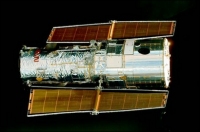
When Hubble was launched in 1990, the telescope was defective. European astronomers taught their American colleagues how to "deconvolute" poor images and extract information. By their upbeat attitude during the difficult years, they made possible a stream of early discoveries and consolidated Europe's role in the programme.
A memorable space shuttle mission in December 1993 corrected Hubble's eyesight. NASA's astronauts were assisted by ESA's Swiss astronaut Claude Nicollier, and Europe was ready to help to reap the benefits.
Because of ESA's contribution, scientists in Europe are guaranteed 15 percent of Hubble's observing time. By submitting excellent proposals, the Europeans have always exceeded that allocation by a non-trivial margin, and have made a fine intellectual contribution to Hubble's scientific successes.
22. A long-sought fossil gas found at last
The first big find with the refurbished Hubble came early in 1994 from ESA's Space Science Department at Noordwijk in the Netherlands. There Peter Jakobsen led a team hunting primeval helium gas. In the theory of the Big Bang, helium was a key product and it supposedly influenced the subsequent history of the Universe.
 |
|
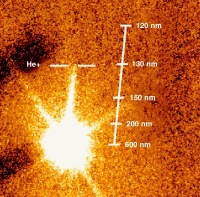
Figure 49: Helium cut-off in ultraviolet. HST (NASA & ESA) FOC P. Jakobsen et al. |
The helium should exist far out in cosmic space and reveal its presence by blocking much of the ultraviolet light from quasars in extremely active and distant galaxies. But hydrogen in intervening clouds usually frustrates the attempt to see distant helium.
The team found a chink in the clouds in front of Quasar 0302-003. A prism in the Faint Object Camera then created a simple spectrum. It revealed the long-sought helium by an abrupt cut-off in the spectrum at 130 nanometres, seen in the picture. The discovery of the helium and its proven ionization (by the loss of an electron) were seen as breakthroughs in cosmology.
"It was like trying to spot stars through breaks in the clouds," Peter Jakobsen explained. "In our case the cloud cover spans most of the observable Universe."
 |
|
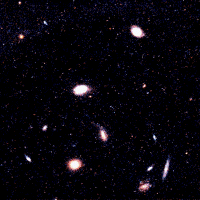
Figure 50: Red and blue stars in the Spindle galaxy. HST (ESA & NASA) WFPC2 medium deep survey |
At Cambridge University, Rebecca Elson hunts "fossil stars" that formed when the Universe was young. They lurk in faint haloes that surround galaxies, or in compact swarms called globular clusters. In Hubble images of nearby galaxies, Elson noticed that some fossil stars were the wrong colour. Being redder than others in the same galaxies, they might be more enriched with metals, and were perhaps born later than their bluer companions.
She confirmed two eras of ancient star formation, in two distinct sets of globular clusters in M87, a bloated, stormy galaxy with a spectacular jet coming from it. In the isolated and apparently normal Spindle Galaxy, she found two similarly distinct populations in halo stars. The redder, perhaps younger, stars may signal a catastrophe - possibly a major collision with another galaxy.
The history of stars and galaxies helps us in understanding how our own Milky Way Galaxy established and preserved the conditions for life.
 |
|
Rebecca Elson |
"Working with Hubble images is a great privilege," Rebecca Elson said. "What fun, to see fine details in the Universe that no one ever saw before! And we always have to be ready for the surprises that teach us something new."
At Basle University in Switzerland, Gustav Tammann uses the Hubble Space Telescope to measure the Hubble Constant - the rate at which the Universe expands.
Sixty years ago another Swiss astronomer Fritz Zwicky noted that certain supernovae, stellar explosions seen in other galaxies, were "standard candles" that could measure relative cosmic distances. In 1979 Tammann proposed that the Space Telescope should fix the distances of the nearer galaxies showing the right kind of supernovae, by looking for variable stars (Cepheids). The more remote supernovae would then tell the distances of their host galaxies, and the galaxies' speeds would reveal the expansion rate.
 |
|
Gustav Tammann |
Two teams of astronomers began working on this task when Hubble was launched in 1990. Tammann himself enrolled in one of them. At first, the teams' answers were contradictory, but he was undaunted.
"We're approaching a decisive moment in cosmology," Gustav Tammann commented in 1999. "I've waited twenty years for Hubble's verdict on Hubble's Constant, so I can be patient till we have a consensus. Our own observations are wonderfully consistent."
23. Nature's own lenses extend Hubble's range
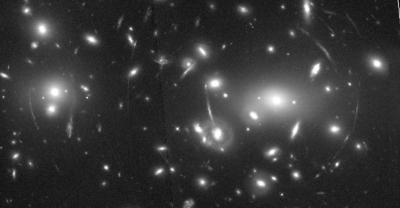
Curious arc-like streaks appear among the cluster of galaxies called Abell 2218, as seen by the Hubble WFPC2 camera. The streaks are far more distant galaxies, up to eight billion light-years away. They would normally be too faint to see, but the strong gravity of the cluster of galaxies acts as a natural telephoto lens, focusing their light.
 |
|
Figure 51: HST (NASA & ESA) WFPC2 W. Couch & R. Ellis |
In 1993, a team led by the British astronomer Richard Ellis found lensed galaxies in another cluster (AC 114) using Hubble. Two years later, in the scene shown above, the team found more than a hundred features that are gravitationally imaged.
The natural lens is clumsy. Its images are distorted and multiplied. But Jean-Paul Kneib, a French scientist in Ellis's team, used the distortions to deduce the distances of the imaged galaxies.
European Coordinating Facility
To enable European astronomers to make the best use of Hubble, ESA joined with the European Southern Observatory (ESO) in creating the Space Telescope European Coordinating Facility. It is located at ESO's headquarters at Garching in Germany.
Garching is in daily touch with Baltimore, Maryland, where the Space Telescope Science Institute oversees Hubble's scientific operations. Fifteen ESA scientists work full-time in Baltimore.
The expert team at ST-ECF Garching helps astronomers to propose observations to be made with Hubble.
ST-ECF also holds at Garching a complete copy of the Hubble archives. With more than 200 000 images and spectra now freely available to all comers, European scientists are beginning to find the archives a gold mine.
 |
|
Piero Benvenuti |
"The Space Telescope is a very complex machine," remarked ESA's Piero Benvenuti, who is charge of the Garching facility. "Careful planning of the observations is not only required, but can considerably enhance the science outcome. Between 1990 and 1998 we offered help to over 400 successful proposals from Europe, leading to almost 20 000 observations made so far."
24. The long history of the chemical elements
At Hamburg Observatory, Germany, Dieter Reimers leads a team of astronomers who want to know how and when the Universe acquired stocks of chemical elements, heavier than the primeval hydrogen and helium. With instruments on the ground and in space they trace the origin, through cosmic time, of elements like carbon, silicon and iron, from which planets and living things can be built.
 |
|
Dieter Reimers |
"We see quite rapid element-making when the Universe was young," Dieter Reimers said. "Then the stocks built up progressively through time, by the alchemy of successive generations of stars."
Supersight for the 21st century
 |
|
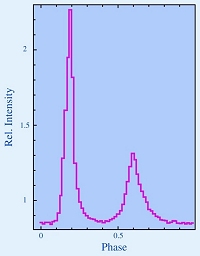
Figure 52: Light from Crab pulsar. From ESA STJ camera at WHT (UK, La Palma) |
A foretaste of futuristic astronomy came in 1999, when a superconducting camera looked for pulsars - pulsating neutron stars - with the UK's William Herschel Telescope in Spain's Canary Islands. This was the first astronomical test for a novel light detector developed by ESA. Ideal for seeing the dim, quick flashes of the pulsars, or other faint objects like very distant galaxies, such ultra-sensitive cameras may become standard equipment for the great observatories.
ESA's Space Science Department at ESTEC leads the world with its superconducting sensors called STJs. Cooled to a temperature below -270°C to achieve superconductivity, STJs can serve a huge range of wavelengths, from X-rays to infrared light.
When even a single particle of light (photon) hits an STJ it gives a precisely timed and strong signal, by releasing thousands of electrons. The electron count depends on the wavelength, so an STJ camera provides highly accurate colour information too.
 |
|
Didier Martin |
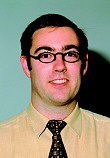
"We're thinking about world-beating detectors for what comes after the Hubble Space Telescope, and for X-ray astronomy missions after XMM," said Didier Martin, a Belgian physicist-engineer in the Astrophysics Division. "On the ground, we use liquid helium to cool a camera to the low temperature we need. A mechanical cooler would be preferable in space, so we're also working to tame the vibrations that could spoil the view."
25. Water, water everywhere
The Universe has a different face depending on which instrument pictures it. When seen by visible light in the Hubble Space Telescope it displays neither the youngest stars nor those reaching the final stages of their lives. All cold objects and those hidden within opaque clouds of dust will be missed. They are for the eyes of infrared space telescopes only. A new face of the Universe started to show up when the US-Dutch-British IRAS satellite inaugurated infrared space astronomy in 1983. It was, however, just a foretaste of what was to come.
 |
|
Figure 53: ISO |
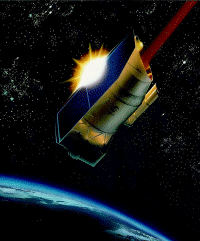
The European Space Agency's Infrared Space Observatory (ISO) was launched in November 1995 and operated until April 1998. It delved much deeper into the dusty and cool Universe, looking for answers to the secrets of how galaxies, stars and planets formed, and where the crucial ingredients for life come from.
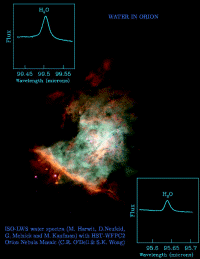
The water that we drink and which fills the world's oceans comes from the stars, and ISO saw water throughout the Universe, even in places where it was not thought to be present. These findings help in understanding how life appeared on Earth, and encourage expectations that living things exist elsewhere.
 |
|
Figure 54: ESA/ISO LWS spectra M. Harwit et al., on HST (NASA & ESA) WFPC2 mosaic |
ISO also detected large amounts of water vapour in the higher atmospheres of all the giant planets of the Solar System. This discovery was unexpected, and it implies that the planets have a continuous supply of cosmic water.
"The water comes simply from the interplanetary dust, which in turn is full of scattered grains from comets," said Helmut Feuchtgruber of the Max-Planck-Institut für Extraterrestriche Physik in Garching, Germany.
|
|
| |||
|
| ||||
|
"Water vapour makes Titan much richer", Athena Coustenis commented. "It will help us to understand the organic chemistry that took place also in the young Earth, since we are seeing a mixture of elaborate organic molecules closely resembling the chemical soup out of which life emerged." | ||||

26. The cosmic cookery book for planets and life
 |
|
Figure 56: Comet Hale-Bopp and olivine signature (ESA/ISO SWS spectrum, ISOCAM image) |
Molecules scattered in the surroundings of the stars, or found in comets and the atmospheres of planets, hoard many secrets. How did the Solar System form? Why and how did life begin on the Earth? May life exist elsewhere? But knowledge of the chemistry of the Universe has been full of gaps till now.
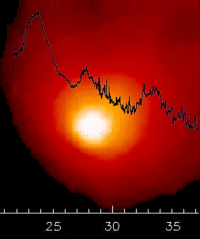
ISO's ability to detect a whole variety of molecules was unprecedented and its results are now filling the blank pages of the cosmic cookery book. For instance, ISO found clear links between stars, comets and the Earth's origin. Comets are remnants of the raw materials that built the Solar System, and in the bright Comet Hale-Bopp ISO found the mineral olivine, one of the main constituents of the Earth's interior. Olivine was also detected by ISO in the dusty disks surrounding young stars, which are thought to be planetary systems in formation.
 |
|
Christoffel Waelkens |
"We are reconstructing with great detail the history of the Solar System," said Christoffel Waelkens of the University of Leuven in Belgium. "And we are linking it to other systems that are now in a critical evolutionary phase."
What about life, and the carbon chemistry on which it depends? ISO saw complex carbon-rich molecules in many places of the Universe - in interstellar space in our own Galaxy, the Milky Way, and even in other galaxies.
 |
|
Figure 57: Carbon-rich chemicals surround a star (ESA/ISO ISOCAM R. Siebenmorgen et al.) |
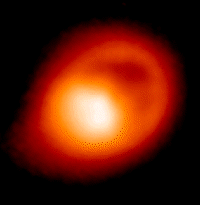
One example is the huge bubble of organic matter that Ralf Siebenmorgen of the ISO Data Centre at Villafranca, Spain, found surrounding a young star in the Chamaeleon constellation. It is a kind of shell-like structure never detected before, made mainly of large molecules with hundreds of atoms of carbon and hydrogen. In principle these molecules could provide building blocks for living organisms.
Closer to home, carbon molecules found by ISO in the atmosphere of the planet Saturn included the first detection of benzene. With a simple ring-shaped molecule, benzene is best known on the Earth as a solvent, but it is the parent of a huge range of molecules used by living organisms.
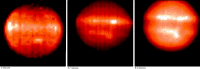 |
|
Figure 58: Jupiter at different wavelengths (ESA/ISOCAM Th. Encrenaz et al.) |
The appearance of the giant planet Jupiter changes completely at different infrared wavelengths, as observed by ISO. The differences give the experts new information about the chemical composition of the atmosphere and how Jupiter's weather works.
27. Many young stars are ready to build planets
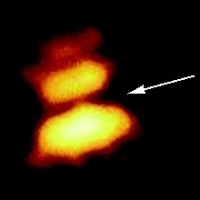 |
|
Figure 59: A dust disk where ISO found olivine signature. Red Rectangle imaged by ISO/MPG 2.2 microns (visible light) |
Is the Solar System a unique pearl in the Universe, the only example of planets orbiting a star? Definitely not. While other astronomers detect unseen planets by their effect on the motion of their parent stars, ISO teams see favourable circumstances for planet-making. The left-over gas and dust that swirls around many new-born stars evolves into a so-called protoplanetary disk which glows with infrared light.
Planets can form from the dust grains. When the process is over, only a thin ring of debris remains. Although no telescope has been able so far to image any alien planet, ISO has detected many of these thin debris disks, which astronomers believe are made of small bodies like comets.
 |
|
Harm Habing |
The first proven connection between an alien planet and a thin debris disk came when Carsten Dominik, also at Leiden, found a debris disk surrounding a star where a planet had already been detected by other means. The star is Rho Cancri in the Cancer constellation, and a planet about the size of Jupiter is orbiting around it at a very close distance.
"The disks tell us that the system at least made small bodies, so it is likely that it also made planets," said Harm Habing of Leiden University in the Netherlands. "Our statistical study reveals that 50 percent of all young stars have these debris disks. ISO is breaking the ground for projects that will go in search of planets, even Earth-like planets, in the far future."
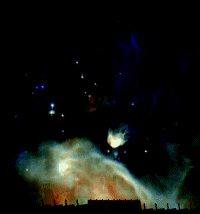 |
|
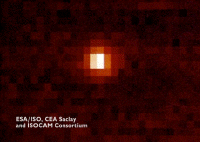
Figure 60: Young stars revealed in Rho Ophiuchi (ESA/ISO CEA Saclay and ISOCAM Consortium) |
The birth of the Sun was a key event in our cosmic history, and astronomers learn more about it by studying star formation that continues today. Paradoxically, the process begins in extremely cold conditions.
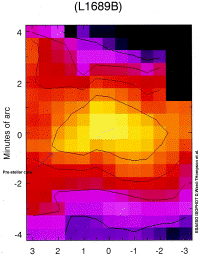 |
|
Figure 61: Pre-stellar core (ESA/ISO ISOPHOTO D. Ward-Thompson et al.) |
In egg-like objects called pre-stellar cores, ISO astronomers have detected the earliest stages of star formation. The cosmic eggs are hidden within large dust clouds. By the time the dust disperses and the object inside hatches as a plainly visible star, the main event of star formation is over.
Only radio waves and far-infrared rays can escape from the dust clouds to reveal the earlier stages. An international team led by Derek Ward-Thompson of the University of Wales, Cardiff, UK, obtained the first infrared images of several pre-stellar cores, with cold shells of dust at minus 260°C.
28. A high-speed chain reaction forms new stars
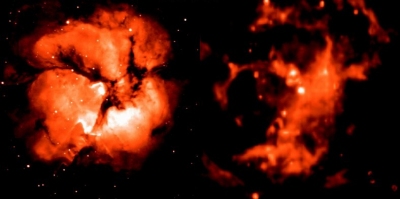 |
|
Figure 62: Trifid nebula by visible light (left) and by infrared light (right) (ESA/ISO ISOCAM J. Cernicharo et al.) |
Ever since a bright, massive star was born in the centre of the Trifid Nebula 100 000 years ago, it has spectacularly illuminated the dust and gas in this well-known cloud in the Sagittarius constellation. But much more has happened in the nebula in the intervening years. The energy emitted by the central star changed the physical and chemical conditions in its environment, and has provoked the quick and nearly simultaneous birth of a second generation of massive stars.
 |
|
José Cernicharo |
Such a chain reaction in star formation has long been postulated, but ISO saw it with unprecedented detail. Infrared light revealed several very young stars 17 to 60 times heavier than the Sun. Such massive stars will mature rapidly and burn fiercely, so they are likely to cause more star formation, continuing the chain reaction in the Trifid Nebula.
"These sources range from dense cores, apparently still inactive, to more evolved sources undergoing violent episodes of mass ejection," explained José Cernicharo of the Instituto de Estructura de la Materia, Madrid, Spain. "We also see all the clear signs of star formation, such as great condensations of very cold dust - at minus 250°C - evolving towards the proto-stars."
An engineering triumph
From November 1995 until May 1998, all through its operational life in orbit, ISO was one of the coolest objects in the universe. The large cryostat on board the satellite, filled before launch with more than 2000 litres of superfluid helium, kept the telescope and instruments close to the absolute zero of temperature, minus 273°C. This was essential for an infrared space telescope that had to sense the heat of a cool object a billion light-years away. It also had to point at objects in the sky as accurately as tracking a man at a distance of 1000 kilometres. ISO was a technological challenge for the 35 companies, headed by Aerospatiale, that built the satellite. ISO's four scientific instruments also pushed technology to its limits. The infrared camera ISOCAM, the photo-polarimeter ISOPHOT and the spectrometers SWS and LWS were built by multinational teams with leaders in France, Germany, the Netherlands and the UK, respectively.
The supply of liquid helium needed to keep ISO chilled set a limit to its operating life. Thanks to excellent engineering and a fortuitous combination of circumstances at launch, the helium lasted over 28 months, much longer than the 18 months required, and made possible about 30 percent more observations.
"It was a very demanding and collaborative effort," said Hans Steinz, ESA's Project Manager for ISO. "But it was a total success as evidenced by the enthusiasm of user scientists, and ISO's technology will be used to build still better space telescopes."
"During the original planned lifetime, the giant star-forming regions in the constellations of Taurus and Orion were inaccessible to ISO," commented Martin Kessler, ISO's Project Scientist. "The extended life brought them into view and gave astronomers an eagerly-awaited chance to unlock some of their secrets."
29. Frenzied star-making in infrared galaxies
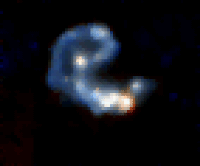 |
|
Figure 63: Antennae galaxies by infrared light (ESA/ISO ISOCAM L. Vigroux et al.) |
The Antennae, 60 million light-years away, are galaxies in collision. The encounter has triggered star formation within dense dust clouds, transparent to ISO's infrared eye. Laurent Vigroux and Felix Mirabel of CEA-Saclay, France, discovered that the most active star-forming regions in the Antennae are visible only in the infrared. They went undetected before ISO.
What struck astronomers, when they first saw the whole infrared sky with the IRAS satellite in 1983, was that the most luminous objects were certain galaxies that looked faint by visible light. They were very dusty, so that starlight was dimmed while intense infrared emission came from cool dust. Needing a name, astronomers called them "ulirgs", meaning ultra-luminous infrared galaxies. But the experts could not agree about their nature - until ISO settled the issue.
 |
|
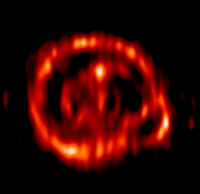
Figure 64: An ulirg - Arp 220 (ESA/ISO ISOCAM) |
The strange beasts are scenes of collision and merger between two galaxies. Some astronomers imagined that the collision created the ulirg by activating a giant black hole. Others thought that the shock of the collision provoked a frenzy of star-making, called a starburst.
 |
|
Reinhard Genzel |
Are the ultra-luminous objects hideouts for monsters or nests for new-born stars? After analysing as many as 60 ulirgs with ISO, a team led by Reinhard Genzel and Dieter Lutz of the Max-Planck-Institut für Extraterrestrische Physik at Garching, Germany, favoured the latter option. Penetrating the dust enshrouding the galaxies they found, not evidence for black-hole activity, but characteristic chemical signatures of starbursts.
"This is the first time we can prove that most if not all of the luminosity in the ulirgs comes from star formation," Reinhard Genzel said. "To understand how, and for how long, such vigorous star formation can occur in these galaxies is now one of the most interesting questions in astrophysics".
 |
|
Figure 65: Dust rings in Andromeda nebula (ESA/ISO ISOPHOT M. Haas) |
Amazing rings in the nearby Andromeda Galaxy, M31, are among the surprises from ISO. Instead of the typical starry spiral seen by visible light, ISO shows several rings of very cold dust, at about minus 260°C, invisible to optical telescopes.
"Seen in the far infrared, M31 is a multiple ringed galaxy rather than the classical spiral type found in the optical," noted Martin Haas of the Max-Planck-Institut für Astronomie, Heidelberg, Germany.
30. A population explosion of stars, long ago
"One of the major ISO results comes from the deep surveys," said Catherine Cesarsky of CEA-Saclay, France. "They show that most of the star formation in the universe has been so far hidden by the dust".
Looking far into space also means looking far back in time. ISO's deep surveys detected the faintest and farthest objects ever seen at infrared wavelengths. The results reveal an early universe much more violent than expected, with three to four times more stars being formed than the rate inferred from observations by visible light. ISO reached the epoch when the Universe was about one third of its present age. It discovered new populations of infrared galaxies producing stars 100 times faster than our own Galaxy, the Milky Way.
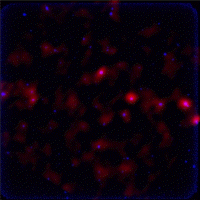 |
|
Figure 67: Starbursts in distant galaxies observed by ISO (red) and by ground-based infrared observation (blue). Credits: ISOCAM, Univsersity of Hawaii and Y. Taniguchi et al. |
"The intense stages of star formation are often associated with merging and interacting galaxies," said Jean-Loup Puget of the Institut d'Astrophysique Spatiale, near Paris. "This process, considered crucial in the evolution of galaxies, can now be traced to the past through infrared observations."
Thus a key aspect of ISO's legacy is the news that infrared space telescopes will help to solve the problem of how galaxies were born and grew up. Here is a major goal for FIRST, the Far Infrared and Submillimetre Telescope due to be launched by ESA in 2007.
ISO opens its gold mine of data. Many more astronomical surprises are still hidden within nearly 30 000 observations obtained by ISO. They are now being made accessible to all scientists via the archive at the ISO Data Centre (IDC) in Villafranca, Spain. Astronomers can request the data easily through the IDC website, and ask for expert support in Villafranca or any of the National Data Centres in Groningen (Netherlands); Garching and Heidelberg (Germany); Orsay-Saclay (France); Rutherford (UK); and Pasadena, California.
A respected role in world astronomy
The newly appointed Director General of the European Southern Observatory, ESO, is Catherine Cesarsky from France. She was the principal investigator responsible for the camera in ISO, ESA's Infrared Space Observatory. Now she will preside over the completion of ESO's Very Large Telescope in Chile.
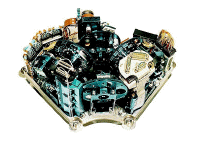 |
 |
|
Figure 68: ISOCAM |
Figure 69: Very Large Telescope (European Southern Observatory) |
Cesarsky personifies the new wave in European astronomy, which is multinational and multi-wavelength. To make new discoveries, astronomers need huge optical and radio telescopes on the ground, and clever satellites to observe the many wavelength bands blocked by the Earth's air.
 |
|
Catherine Cesarsky |
"Fifteen years ago, astronomers in Europe felt like poor relations," Catherine Cesarsky noted. "The USA had a monopoly of major observing facilities, both on the ground and in space. Now that has changed, thanks to Europe-wide efforts. ESO is completing the world's best ground telescope. Meanwhile ESA too has won a respected role in world astronomy, in particular with ISO. But we'll be secure in that role only with continuous innovation. That means new concepts for facilities and instruments on the ground, new space missions like XMM, Integral, FIRST and Planck, and also serious participation in the Next Generation Space Telescope. We can be sure that our American colleagues won't stand still!"