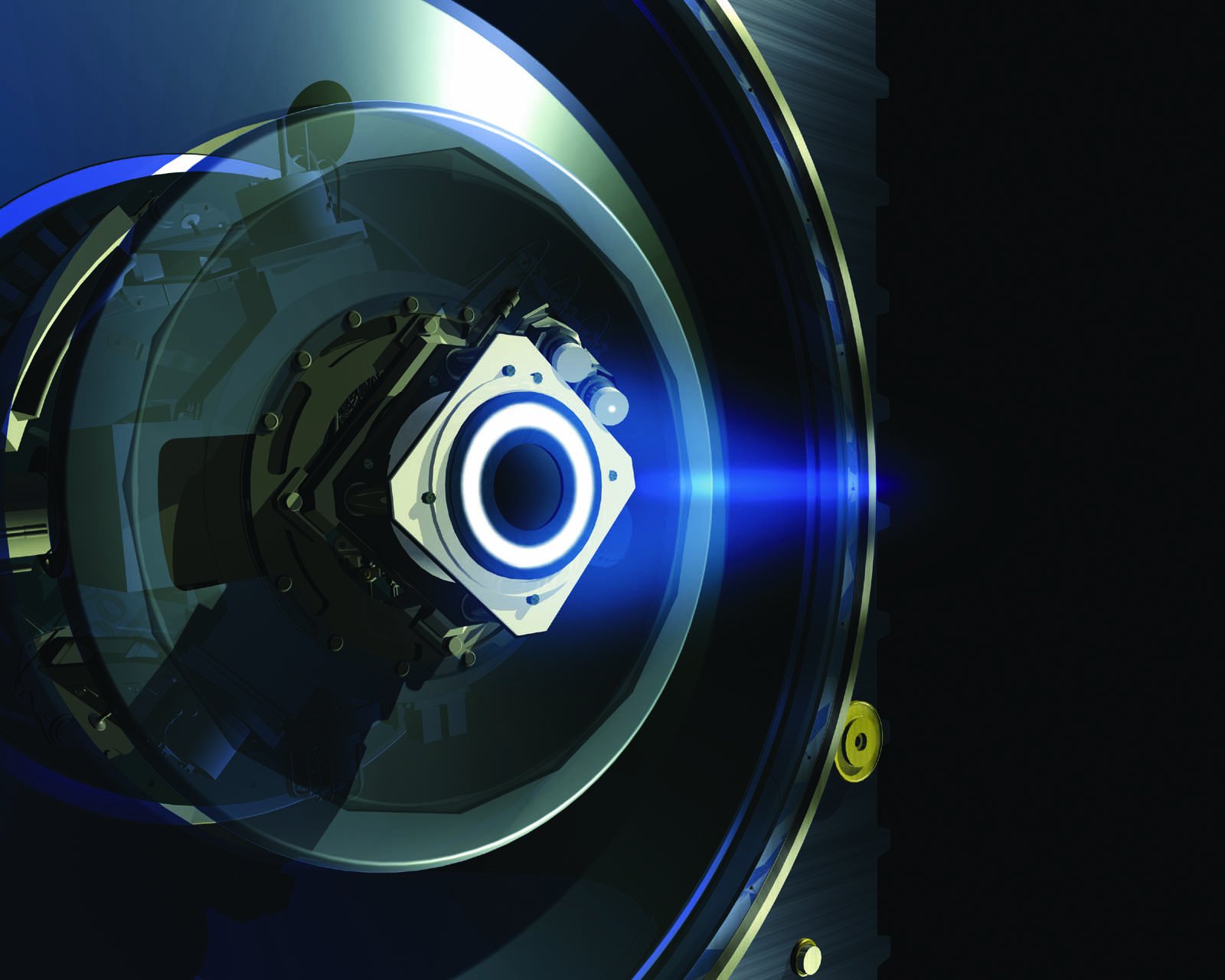
How an ion engine works
 Copyright: ESA 2002. Illustration by Medialab.
Show in archive: true
Electrons attracted into the discharge chamber collide with xenon atoms from the propellant gas supply, making charged atoms (ions). Current-carrying coils, inside and outside the doughnut-shaped discharge chamber, sustain a magnetic field oriented like the spokes of a wheel. By the Hall effect, ions and electrons swerving in opposite directions in the magnetic field create an electric field. This expels the xenon ions in a propulsive jet. Other emitted electrons then neutralize the xenon, producing the blue jet.
Copyright: ESA 2002. Illustration by Medialab.
Show in archive: true
Electrons attracted into the discharge chamber collide with xenon atoms from the propellant gas supply, making charged atoms (ions). Current-carrying coils, inside and outside the doughnut-shaped discharge chamber, sustain a magnetic field oriented like the spokes of a wheel. By the Hall effect, ions and electrons swerving in opposite directions in the magnetic field create an electric field. This expels the xenon ions in a propulsive jet. Other emitted electrons then neutralize the xenon, producing the blue jet.
Last Update: 1 September 2019