
Instruments
Overview
There are three scientific instruments aboard XMM-Newton:
European Photon Imaging Camera (EPIC)
At the prime focus of each of the spacecraft's three telescopes, behind a six-position filter wheel, is a European Photon Imaging Camera (EPIC). With silicon chips that can register extremely weak X-ray radiation, these advanced Charge-Coupled Device cameras (CCD) are capable of detecting rapid variations in intensity, down to a thousandth of a second and less!
Reflection Grating Spectrometer (RGS)
For a complementary analysis of the spectrum, two of the three telescopes have a grating structure on their mirror module that reflects about 40 per cent of the incoming rays to a secondary focus, with its own CCD camera. This Reflection Grating Spectrometer (RGS) "fans out" the various wavelengths, thus indicating, in more detail than EPIC, the exact condition of individual elements, such as oxygen and iron.
Optical Monitor (OM)
The third instrument aboard XMM-Newton is a conventional but very sensitive optical/UV telescope, the Optical Monitor (OM). It can observe simultaneously the same regions as the X-ray telescopes, but at ultraviolet and visible wavelengths. This gives astronomers complementary data about the X-ray sources. The 2-metre long telescope is mounted on the mirror support platform of XMM-Newton alongside the X-ray mirror modules. In orbit, this 30 cm diameter telescope is as sensitive as a four-metre diameter instrument on the Earth's surface.
European Photon Imaging Camera (EPIC)
The main focal plane instrument on XMM-Newton, providing imaging and spectroscopy, is the European Photon Imaging Camera (EPIC). The three EPIC cameras offer the possibility to perform extremely sensitive imaging observations over the telescope's field of view (FOV) of 30 arcmin and in the energy range from 0.15 to 15 keV with moderate spectral (E/∆E ~ 20-50) and angular resolution (PSF, about 6 arcsec FWHM).
All EPIC CCDs operate in photon counting mode with a fixed, mode dependent frame read-out frequency, producing event lists; that is tables with one entry line per received event, listing (among others) attributes of the events such as the position at which they were registered, their arrival time and their energy.
Another associated experiment on board XMM-Newton is the EPIC Radiation Monitor (ERM). The main function of the ERM is the detection of the radiative belts and solar flares in order to supply particle environment information for the correct operation of the EPIC camera. In addition, the ERM provides detailed monitoring of the space radiative environment constituting a reference for the development of detectors to be used in futures missions.
The EPIC consortium is made up of ten institutes in four nations: the United Kingdom, Italy, France and Germany.
Charge-coupled devices (CCD)
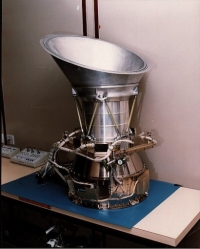
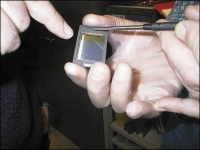
EPIC consists of three cameras, at whose heart are charge-coupled devices (CCD) which register and record the energy of incoming X-ray photons. Two of the cameras employ metal oxide semi-conductor (MOS) CCDs, developed jointly by Leicester University and English Electric Valve (EEV, Chelmsford, UK) while the third uses a new type of CCD (pn) and was built by the Max Planck Institute of Extraterrestrial Physics in Garching and the Astronomical Institute in Tübingen, both in Germany.
 |
 |
|
Above: One of the MOS CCD's Left: The EPIC-MOS camera engineering and qualification model |
The MOS detectors register photons in the 'soft' portion of the X-ray spectrum with good energy resolution. With only a 40-micron sensitive depth of silicon, the detectors are less responsive to high energy or 'hard' X-rays. This upper part of the spectrum is covered better by the EPIC 'pn' CCD, which has a 300-micron thickness. The spatial resolution of the cameras at 1.5 keV is 6.0 and 4.5 arcsec FWHM for the two EPIC MOS detectors, and 6.6 arcsec FWHM for EPIC pn.
The only preceding mission using X-ray CCDs (the ASCA satellite) proved its efficiency to detect hard X-rays, but also highlighted its vulnerability to radiation damage. In order to protect all the detectors, the three cameras are well shielded with a 3 cm-thick piece of aluminium. One position on each camera filter wheel can also occult the sensitive detector. All the cameras have a large radiator that cools down the CCDs to their nominal operating temperature of -100 °C. In November 2002, the temperature for the MOS detectors was lowered to -120 °C to move important detector characteristics back to the values which they had earlier in the mission, improving the performance.
Each EPIC-MOS CCD consists of seven silicon chips, which are made up of a matrix of 600 × 600 pixels. Each CCD reads out in a couple of seconds and the image data is processed and compressed electronically in the instrument electronic boxes, so as to be compatible with the spacecraft's telemetry, sending the data back to the Earth ground stations.
New technology 'pn' detector
 |
|
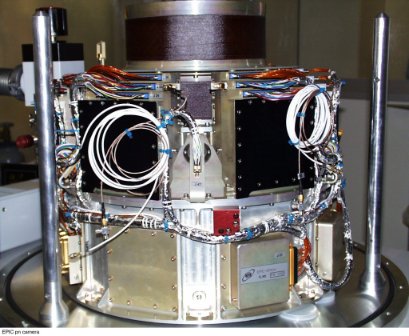
EPIC PN camera |
The development of the 'pn' detector was a seven-year effort by the semi-conductor laboratory of the Max Planck Institute for Extraterrestrial Physics, followed by over two years of integration work and testing on the camera itself. The result is an EPIC pn detector with a single chip, whose design represents a radical departure from the integrated circuit conception of current MOS CCDs.
The silicon wafer has been manufactured 'in-house' with extreme precision to maintain the very high resistivity of the 300 micron-thick double-sided processed silicon detectors. This fact is responsible for the efficient detection of the high energy X-rays.
As the pn-CCD is illuminated from the rear side, which does not have insensitive layers or coatings, the X-ray detection efficiency is extremely high and homogeneous from the very low to the highest XMM-Newton energies (over 90 per cent from 0.5 to 10 keV). The parallel readout of 768 independent channels enables the camera to be operated quickly: less than 80 ms are needed to acquire one picture or frame. Special readout modes allow the observation of transient objects with a time resolution of only 40 ms.
In contrast to the MOS camera, the pn detector has a 400 × 384 pixel matrix of 6 cm × 6 cm, monolithically fabricated on a ten centimetre high purity silicon wafer. The 36 cm² sensitive area made it the largest X-ray CCD detector built for space at the time, and it remained so for many years.
Useful links
EPIC Institutes
ITESRE/CNR, Bologna
Instituto di Astronomica, Palermo
SAp/CEA, Saclay
CESR, Toulouse
MPE, Garching
IAA, Tuebingen
School of Physics, Birmingham University
Reflection Grating Spectrometer (RGS)
Privileged visitors to the ESTEC clean rooms during the final integration of XMM-Newton noticed that after the installation of the flight-model mirror modules, there appeared to be something missing. Only two of the three mirror modules project out of the support platform. The lack of symmetry stems from the fact that only two of the mirror modules are equipped at their exit with reflection grating arrays. With the associated cameras, they are part of the Reflection Grating Spectrometer (RGS) component of the XMM-Newton mission.
Dispersive spectroscopy fans out X-ray photons much as a prism does with visible light. It was a relatively new technique at the time and XMM-Newton is the first ever X-ray space observatory to be equipped with reflection gratings operating in the X-ray band of the electromagnetic spectrum.
Early X-ray missions carried Bragg-crystal spectrometers; later missions like EXOSAT (1983) used transmission gratings. XMM-Newton is the first mission to use the latest technology which makes it possible to produce large reflection grating plates, giving simultaneously a high spectral resolution and throughput.
Reflection grating
 |
|
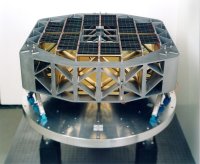
One of XMM-Newton's two reflection grating arrays |
A reflection grating is a mirror with tightly controlled grooves on it, in the case of RGS about 645 grooves per mm, equivalent to 65 grooves in the width of an average human hair! X-rays reflected off the top and the valley of the grooves interfere with each other and cause a spectral image whereby X-rays of different wavelength (or energy) are reflected under slightly different angles.
The two reflection grating arrays (RGA) on XMM-Newton are each composed of 182 such grating plates. Each plate consists of a silicon carbide substrate coated with a thin (2000 Å) film of gold. Measuring 10 × 20 cm, they were produced by a replication process from a mechanically ruled master. The grating plates, with stiffening ribs on their rear side, are integrated onto a beryllium support structure.
 |
|
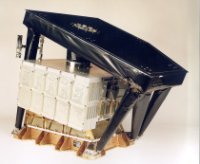
One of the RGS cameras tucked behind its cooling radiator. The opening in the black radiator shows the connection to the cold finger that cools the inside of the camera. |
The RGS cameras are composed of a strip of nine MOS CCDs developed by the EEV Ltd. Chelmsford (UK), and under the guidance of the Sensor Technology Development group at SRON Utrecht. These back-illuminated CCDs are operated in single photon counting and frame transfer mode, and for each photon they very accurately measure its position on the detector and its energy. From the photon positions the high resolution X-ray spectrum as diffracted by the grating array is determined. Combining the energy and position information allows to separate the contributions from the various overlapping grating orders.
To reduce background noise, the cameras are operated nominally at -80°C, and they can operate down to -120 °C. This temperature is provided by the coldness of space captured by two passive radiators on the outside of the spacecraft.
 |
|
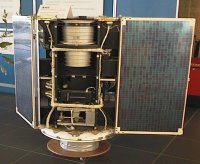
The thermal model of the Dutch ANS X-ray satellite, which started non-solar experimental X-ray astronomy in the Netherlands, and was launched in 1974. |
X-ray Spectrography
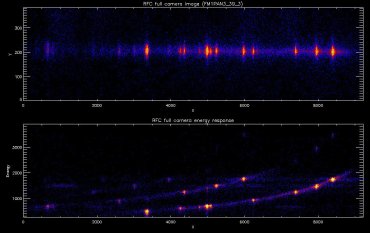
The spectral data provided by the CCDs of the RGS cameras is typically presented as a curve displaying the presence, seen as peaks or lines, of certain elements (such as iron, oxygen, silicon) in the X-ray source under observation. For astrophysical sources, the positions and sizes of the peaks in the spectrum are a measure of the temperature and the relative abundance of the different elements, respectively. The data can also provide clues as to the density of the emitting gas. The main ('first spectral order') curve will be accompanied by a second or third order curve, produced by the reflection grating assembly.
 |
|
A sample RGS spectrum obtained at the long-beam facility at the Panter test facility. The upper graph shows the presence of different elements; the lower one shows the first and higher order spectra, separated from one another by the intrinsic resolution of the CCDs. |
The wavelength band chosen for RGS (5 - 35 Å) contains the K-shell transitions of oxygen, neon, magnesium, aluminium, silicon, as well as the L-shell transitions of iron. Each time one of these transitions takes place in the atom, a distinct amount of energy is released, in the form of a photon. So, different atomic transitions generate photons with different energies, which in turn show up as different spectral lines in the X-ray spectrum.
Spectral features
Detailed study of these spectral features allows the physical characteristics (density, temperature, ionisation state, element abundances, mass motions and redshift) of the emitting region and its surrounding environment. XMM-Newton makes it possible to study these spectral features in many types of astrophysical objects like stellar coronas, binary star systems, supernova remnants, clusters of galaxies and distant active galactic nuclei.
X-ray spectroscopy can also be useful to astronomers investigating gamma-ray bursts, which can also be observed at X-ray wavelengths. Like the 'after-glow' observations made by the BeppoSAX satellite (Italy-Netherlands 1996), XMM-Newton is also able to contribute to an understanding of these phenomenally powerful and mysterious bursts of gamma rays.
Useful links
RGS Institutes:
Mullard Space Science Laboratory (MSSL), UK
Paul Scherrer Institute (PSI) in Villigen, Switzerland
Columbia University, NY, USA
Optical Monitor (OM)
The first ever X-ray space observatory with an optical and ultraviolet capacity
 |
|
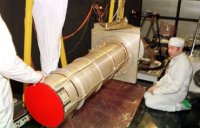
The entire OM telescope at MSSL |
A 15-strong team at the Mullard Space Science Laboratory (MSSL), led by principal investigator Keith Mason, started working on the XMM-Newton project in 1989. As leaders of the Optical Monitor multinational consortium of research institutes, they have been responsible for providing the multi-wavelength capacity of the XMM-Newton space observatory, which is unique in its ability to view simultaneously regions of the sky in the visible, ultraviolet and X-ray ranges.
"XMM-Newton was conceived from the start with this optical telescope. Previous missions had demonstrated the need. EXOSAT, for instance, had no such instrument and attempting to get simultaneous data in the visible range using ground based observatories had a very small success rate," explains Keith Mason.
The telescope, detectors and canister tube were largely produced in-house in the laboratory's engineering workshops, partners in Belgium and the United States providing, respectively, the power supplies and the data processing units.
How does the Optical Monitor work?
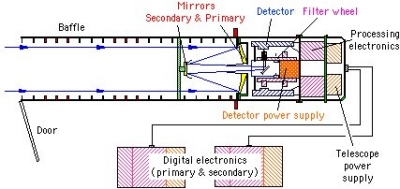
The Optical Monitor telescope is mounted on the mirror support platform of XMM-Newton alongside the X-ray mirror modules. Designed and developed at MSSL, the Optical Monitor is an improved Ritchey-Chrétien telescope (a telescope design that gives a high-quality image over a relatively wide field of view) with a 30 cm aperture, and has a sensitivity for imaging comparable to a 4-metre instrument on the Earth's surface. It provides coverage between 170 nm and 650 nm of the central 17 arcmin square region of the X-ray field of view, permitting routine multiwavelength observations of XMM-Newton targets simultaneously in the X-ray and ultraviolet/optical bands.
 |
|
Schematic plan of the OM Telescope |
 |
|
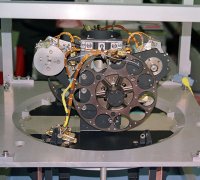
One of the two filter wheels positioned in front of the OM's CCD detectors. |
After being focused by two mirrors, the light is directed towards one of two fully redundant identical filter wheels and detector chains. In each, an ultra-compact electronic image intensifier amplifies the light signal a million times before it falls on a silicon detector chip (CCD) capable of registering 100 frames per second. Detailed imaging on the central region of a view is possible using a ×4 magnifier situated on the filter wheels, which also incorporate two grisms for low-resolution spectroscopy. Data is then processed and compressed before being sent back to Earth as part of the spacecraft telemetry.
OM main characteristics
- 2 m long telescope tube
- 30 cm Ritchey-Chrétien telescope
- Focal ratio of f/12.7 and focal length of 3.8 m
- Total coverage between 170 nm and 650 nm of a 17 arcmin square field of view
- A primary mirror of 0.3 m and a hyperboloid secondary mirror
- Two (redundant) filter wheels with 11 apertures: one blanked off, six broad band filters (U, B, V, UVW1, UVM2 and UVW2), one white, one magnifier and two grisms (UV and optical)
- Two (redundant) detectors: micro-channel plate intensified CCD with 384 × 288 physical pixels (of which 256×256 are used for science observations). Photon events are centroided, subsampling each of the 256×256 CCD pixels into 8×8 pixels
- Two (redundant) Digital Electronics Modules
The ability to observe X-ray targets simultaneously in the visible and UV is contributing to a vast increase of our knowledge of the Universe.
More OM information is available at the XMM-Newton Optical Monitor Home Page.