• → European Space Agency

    • About Science & Technology

    • For Public

    • For Educators

    • ESA

    • Science & Technology

    • IUE

    • Missions
    • Show All Missions
    • Mission Home
    • Summary
    • Fact Sheet
    • Objectives
    • News
    • Science Results
    • Galactic
    • Archive
    • Spacecraft
    • Instruments
    • Mission Operations
    • Launch and Orbit
    • Mission Research
    • Resources
    • News Archive
    • Multimedia Gallery
    • Publications Archive
    • Calendar
    • Services
    • Contact Us
    • Subscribe
    • Disclaimer
    • Bookmark and Share

    Summary

    The International Ultraviolet Explorer satellite (IUE) was a trilateral project between NASA who provided the spacecraft, telescope, spectrographs and one ground observatory, ESA who provided the solar panels and the second observatory, and the UK PPARC - formerly SERC - who provided the four spectrograph detectors.

    IUE has been the most long-lived and (by a wide margin) the most productive satellite, so far, in the history of space astronomy. For more than 18 years it made, on average, one one-hour observation every 90 minutes, around the clock. It intercepted ultraviolet light that cannot reach telescopes on the ground, studying everything from far off supernovae to approaching comets. Key observations included Halley's Comet during its 1986 visit, a supernova event in a nearby galaxy in 1987, and Comet Shoemaker-Levy crashing into Jupiter in 1994.

    During IUE's life, more than 1000 European observing programmes were conducted from Villafranca, returning more than 30 000 spectra from about 9000 targets, extending from Comets to far away quasars at the early days of the Universe and covering a brightness range of 10 orders of magnitude (extending from MV=-4 to MV=21).
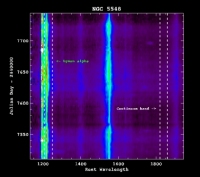
    UV spectra of NGC 5548

    IUE was the first scientific satellite that allowed 'visiting' astronomers to make real time observations of UV spectra: the impressive response time of less than one hour provided an unparalleled flexibility in scheduling targets of opportunity. This has given rise to the concept of Multi-wavelength Astrophysics, where observations with instruments on the ground and in space are co-ordinated to obtain simultaneous measurements over a wide range of the electromagnetic spectrum. The flexibility of IUE demonstrated for the first time the power of such diagnostic tools in astrophysics. IUE provided astronomers with a unique tool and requests for observing time remained two-three times greater than could be satisfied, even at the end of orbital operations.

    Until operations finally ceased on 27 September 1996, astronomers were still queuing up to use an instrument that worked non-stop since its launch and continue to work with the wealth of data now stored in the IUE final archive.


    Last Update: 22 Mar 2012

    • Shortcut URL
    • http://sci.esa.int/jump.cfm?oid=31284

    Connect with us

    • RSS
    • Youtube
    • Twitter
    • Flickr
    • Google Buzz
    • Livestream
    • Subscribe
    • App Store
    • ESA Science Twitter

    Follow ESA science

    • Copyright 2000 - 2013 © European Space Agency. All rights reserved.

    • Terms and Conditions