
Galactic
Supernova
The event of the century for astronomers was the cataclysmic explosion of a massive star. Although such supernovae are crucial in cosmic history, and the source of the Earth's gold and uranium, none had been seen at close range with modern instruments. Stargazers spotted Supernova 1987A in February 1987, in the Large Magellanic Cloud in the southern sky. When the news broke, the very first space telescope to turn towards Supernova 1987A was the astronomical satellite IUE.
As the supernova faded rapidly in the ultraviolet, IUE's experts could say, years before other observers, exactly which star blew up. It was a blue star, not red as expected. The satellite registered ultraviolet signatures of newly-made chemical elements released by the explosion.
|
HST (NASA & ESA) WPC2; |
The flash lit up a distant ring of gas surrounding the star, and IUE recorded an echo of the light, a month after the explosion. In 1990 the Hubble Space Telescope began examining the scene. The European Space Agency's Faint Object Camera on Hubble detected a cloud of debris and measured its expansion rate. It also imaged the ring of gas responsible for IUE's echo from the supernova. Later, NASA's wide-field cameras examined the ring, which is the central orange coloured ring in the accompanying image.
"From IUE's light echo and the ring measured with Hubble, we could tell how far away the supernova was," said Nino Panagia, an ESA scientist from Italy working at the Space Telescope Science Institute. "In 1991 we put Supernova 1987A at a distance of 167 000 light-years. With better pictures we confirmed that result, and reduced the uncertainty to as little as two percent."
In 1993 a supernova event occurred in the relatively near galaxy M81, in the constellation of Ursa Major, and just 24 hours after its discovery the IUE spacecraft made a spectrum of its ultraviolet light (central band). Converting it into a graph of energy (in white) astronomers judged from the overall shape of the spectrum that gas around the exploding star was radiating at a temperature of 22 500 degrees. The tall spike at the left-hand end came from nitrogen atoms heated to about one billion degrees by a shock wave from the supernova.
UV Spectroscopy
IUE dominated ultraviolet space astronomy for nearly two decades. It analysed ultraviolet light, in a wavelength range from 1150 to 3200 Ångström units, which is blotted out by the Earth's atmosphere. Operating far above the atmosphere, IUE generated spectra showing intensities at different wavelengths, coming from the selected objects in the sky. To an astrophysicist, such spectra are much more informative than images, revealing much about the mechanisms that produce and dissipate the objects' energy. Temperatures, motions, magnetism and chemical composition are all discernible in the ultraviolet spectra.
Stars
As a result, astronomers have a far better picture of the hot atmospheres of stars than they did before IUE's launch. Even the Sun, a quiet star of moderate size, possesses a very hot atmosphere emitting ultraviolet light, which is now being monitored non-stop by the ESA-NASA solar spacecraft SOHO. Some other stars, ranging from small white dwarfs to large, massive stars, give off ultraviolet emissions from their very hot surfaces. Hot and fierce winds of gas emitted from stars have a profound effect on the lives and environments of the stars, and on any companions caught up in the winds. IUE unmasked the ultraviolet behaviour of a large menagerie of different star types, which heralds profound revisions in astrophysical ideas resulting from the observations.
Galaxies
IUE's has contributed new knowledge about galaxies. These vast assemblies of stars also reveal violent behaviour in ultraviolet light. In a special campaign, a multinational team used IUE to observe the stormy galaxy NGC 5548 some 60 times in eight months.
As a result, they discovered effects of central outbursts spreading from hot regions at the very core of the galaxy to adjacent cooler regions, in a timescale of weeks. In galaxy NGC 7469, observed simultaneously by IUE and by the X-ray satellite Rossi XTE, the timescale shrank to days.
Quasars
Quasars are erupting galaxies observable at great distances, and their examination by ultraviolet light, by IUE and more recently by the Hubble Space Telescope, give special clues to the nature of the gas in the almost empty spaces between galaxies, and to the manufacture of the chemical elements within the galaxies. Quasar studies occupy an important place in the effort to understand the character and evolution of the Universe at large. Ultraviolet data on element-making suggest that massive stars, far bigger than the Sun, were more numerous when the galaxies were young.
Long Lifetime
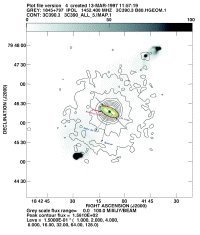
The sheer durability of IUE enabled astronomers to revisit many objects over nearly two decades and to see changes occurring with them. The prolonged study of the black hole in 3C3903.3 was a case in point. Another conspicuous example of the advantages of a long life concerns Supernova 1987A. This star was seen exploding in a nearby galaxy, the Large Magellanic Cloud, halfway through IUE's operational life.
 |
|
Black hole accretion disk in Galaxy 3C390.3. Diagram (not to scale) on X-ray and radio images from Harris et al. (ApJ. 499, L149) and 1452 Mhz VLA. |
Comets
The return of Halley's comet in 1985-1986 was a long-anticipated event, and the ultraviolet observations by IUE measured the rate at which the famous object spewed water vapour into space. But many comets appear unexpectedly, and IUE was able to examine them too, from Comet Seargent in 1978 to Comet Hale-Bopp in 1986. Astronomers have built up a comprehensive picture of comets seen by ultraviolet light at different stages of their evolution, and at different distances from the Sun. As a result, they have a much better understanding of how comets react and change during their rare visits to the vicinity of the Sun and the Earth.
IUE's long life also enabled it to observe rare and serendipitous events. The satellite was already more than sixteen years old when Comet Shoemaker-Levy 9 hit Jupiter in July 1994. The event was well anticipated, so IUE was able first to study Jupiter in a normal state, and then to see the changes in the ultraviolet spectra during and after the impacts of the comet fragments.
Astronomers Favourite
"Although IUE never had the popular appeal of the Hubble Space Telescope, it was always the professional astronomer's favourite satellite," remarks Willem Wamsteker, Dutch astronomer and ESA's project manager for IUE. "They could visit Villafranca or Goddard and supervise the operations, just as if they were at an observatory on the ground. Towards the end, they could make their observations remotely, without leaving their institutes. Historians of astronomy may well credit IUE with the big change in professional habits which made space observatories a tool, not just for a few hardware-minded specialists, but for all astronomers."
Astronomers in developing countries have been persuaded by experience with IUE that they too can participate in spaceborne observations without emigrating. ESA has helped to foster this ambition. Amateur astronomers have also shown a remarkable degree of interest in IUE results, which provide them with a valuable and important link between their activities and those of professional astronomers.
Results Summary
Comets
- the first detection of sulphur in a comet
- the first quantitative determination of water loss in a comet (some 10 tonnes per second)
Stars
- the first evidence for strong magnetic fields in chemically peculiar stars
- the first orbital radial velocity curve for a WR star allowing its mass determination
- the first detection of hot dwarf companions to Cepheid variables
- the first observational evidence for semi-periodic mass loss in high mass stars 7 the first discovery of high velocity winds in stars other than the Sun
- the discovery of starspots on late type stars through the Doppler mapping techniques
- the discovery of large scale motions in the transition regions of low gravity stars
- the discovery of high temperature effect in stars in the early stages of formation
- the discovery of high velocity winds in cataclysmic variables
- the discovery of the effect of chemical abundance on the mass loss rate of stars
- the first determination of a temperature and density gradient in a stellar corona outside the Sun
- the first detection of gas streams within and outflowing from close binary stars
- the first direct detection of galactic halos
- the first observations of extragalactic symbiotic stars
- the first uninterrupted lightcurves of stars for more than 24 hours continuously
Supernovae
- the first identification of the progenitor of any supernova in history (Supernova 1987A)
- the determination that no nova ejects material with solar abundance
- the discovery of the "O-Ne-Mg" novae, where the excess of these elements can be directly traced to the chemical composition of the most massive white dwarfs
- the discovery of a ring around SN 1987A, a leftover from previous evolutionary stages
Quasars
- the first direct determination of the size of the active regions in the nuclei of Seyfert galaxies (mini-quasars)
- the first detection of a transparent sightline to a quasar at high redshift allowing the first abundance determination of the intergalactic medium in the early Universe
Aurorae and particles
- the first detection of the existence of an aurora in Jupiter
- the first detection of photons at wavelengths less than 50 nm from any astronomical source apart from the Sun
Data
- the first astronomical and satellite facility ever, to deliver fully reduced data within 48 hours to the world-wide community of scientists
- the creation of the first world-wide astronomical reduced-data archive delivering 44 000 spectra per year (five spectra per hour) to astronomers in 31 countries