
Summary
 |
Gravitational waves are ripples in space-time predicted by Albert Einstein in his General Theory of Relativity. Detecting gravitational waves would greatly enhance our knowledge of General Relativity and allow scientists to detect the impact of astronomical events which are thought to cause a minuscule distortion on the fabric of space itself. Whilst ground-based detectors are already being used to try to identify high-frequency gravitational waves, a space-based mission would try to pick up frequencies from 10-4 Hz to 10-1 Hz. This corresponds to galactic-scale events such as the coalescence of supermassive black holes.
(Update 12 February 2016: high-frequency gravitational waves, emitted by a pair of merging black holes, were directly detected for the first time with the Advanced Laser Interferometer Gravitational-Wave Observatory.)
LISA Pathfinder is designed to test one of the key ideas behind gravitational wave detectors – that free particles follow geodesics in space-time. The mission can show this more accurately than has been done in the past by tracking two test masses nominally in free fall, using picometre resolution laser interferometry. Several new technologies have been developed, firstly to isolate the test masses from external forces when they get to space, and secondly to allow for the extremely small distance measurements to be performed by an onboard interferometer.
LISA Pathfinder cannot in itself detect gravitational waves – since the impact of gravitational waves is so tiny, the test masses would need to be millions of kilometres apart rather than the 38 cm available on board LISA Pathfinder. In fact, a low-frequency gravitational wave would cause a 1 m bar to move 10-21 m to 10-24 m – orders of magnitude smaller than an atomic nucleus at 10-15 m. Using a space-based interferometer, one arm could act as a bar 5 x 10⁶ km long, making the effect of a low-frequency gravitational wave measurable.
LISA Pathfinder is designed to be the quietest spacecraft ever launched. It does not possess a typical payload structure since the spacecraft as a whole is part of the experiment. However, the payload does have two distinct parts: the LISA Technology Package (LTP), consisting of inertial sensors, interferometric readout, payload computer and diagnostic system – all provided by European companies, research institutes, and ESA; and the Disturbance Reduction System (DRS) provided by NASA and consisting of a processor running drag-free control software, and micro-Newton colloidal thrusters.
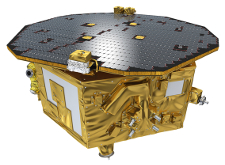 |
| LISA Pathfinder science module. Credit: ESA/ATG medialab |
The spacecraft, provided by ESA, carries a cold gas propulsion system, developed originally for the Gaia mission, and a Drag-Free Attitude Control System (DFACS). The spacecraft must keep its position around the two test masses, which should have no forces acting on them. The test masses are cubes of gold:platinum alloy and function both as mirrors for the interferometer, and as references for the DFACS.
LISA Pathfinder was launched on 3 December 2015. The transfer to its operational orbit at L1, a virtual point in space some 1.5 million km from Earth towards the Sun, was completed by 22 January 2016. The initial set-up and calibration phases took about three months, then the in-flight demonstration of the experimental technology started. The science operations are divided into two blocks: 90 days for the LTP and 90 days for DRS. First results will be made available to the science community approximately six months after LISA Pathfinder reaches its operational orbit.
LISA Pathfinder is a pioneering mission: it is the first high-quality orbiting gravitational laboratory for Fundamental Physics missions. It is conducting the first high-precision laser interferometric tracking of orbiting bodies in space; it is performing the first nanometre and sub-nanometre formation flight of bodies in orbit; and it is the first time test masses of this kind are flying freely in space at a distance of several millimetres from their surroundings with no mechanical contact to them.
The name LISA in the mission name comes from Laser Interferometer Space Antenna, an earlier concept for a spaceborne observatory for gravitational waves, and now used to describe a class of missions based on the original LISA concept. LISA Pathfinder is testing key technologies for future LISA-like space missions to study the gravitational Universe.