
Mission Operations: Overview
Launch
LISA Pathfinder was carried into orbit from Europe's Spaceport in French Guiana by an ESA Vega launch vehicle. Liftoff was at 04:04 UTC (05:04 CET) on 3 December 2015. Vega placed the spacecraft in an elliptical parking orbit around the Earth with perigee at 200 km, apogee at 1540 km and an inclination of 6.5°.
Once the final stage of the Vega rocket was jettisoned, LISA Pathfinder began a series of six apogee-raising manoeuvres powered by its own propulsion system. These manoeuvres were completed two weeks after launch.
After this, LISA Pathfinder cruised towards its final orbiting location. A month after its final burn, it jettisoned its propulsion module and settled into an orbit around the L1 Sun-Earth Lagrangian point. The entire journey, from launch to arrival at L1 took approximately six weeks.
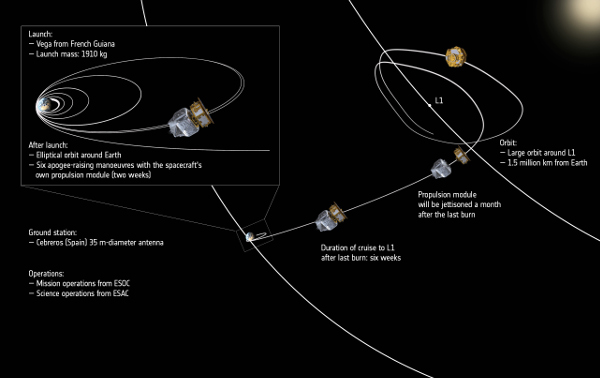 |
| LISA Pathfinder's journey through space. Credit: ESA/ATG medialab |
Operational orbit
The operational orbit for LISA Pathfinder is a
This Lissajous orbit, with period of 180 days, is unstable and periodic station-keeping manoeuvres will be required - amounting to about 1.8 ms-1 per year - which will be performed using the cold gas thrusters of the spacecraft's micro-propulsion system.
Ground segment
The LISA Pathfinder ground segment has two operational centres, both provided by ESA:
- The Mission Operations Centre (MOC) at the European Space Operations Centre (ESOC), in Darmstadt, Germany, is responsible for the Launch and Early Operations Phase (LEOP), the transfer phase, and all operations during the routine phase. The MOC is in contact with the spacecraft for eight hours per day through the ground station(s).
- The Science and Technology Operations Centre (STOC), located at the European Space Astronomy Centre, near Madrid, Spain, is the interface to the scientific community and is responsible for the payload scheduling, quick-look data analysis, data processing and archiving.
Communications with the spacecraft were performed in X-band through a network of ground stations, including Kourou, Maspalomas and Perth, during LEOP. For this the ground station infrastructure has been upgraded to include X-Band acquisition aids mounted on the LEOP stations.
During science operations, communications are performed using DSA-2, the 35-metre X-band deep-space antenna located at Cebreros, in Spain. Using this station, a communications link is established for six to eight hours per day. During each pass, the data stored on board are retrieved, spacecraft tracking is performed and the command timeline is uplinked.
Following the initial on-orbit check-out and instrument calibration, the STOC are responsible for the inflight demonstration of the LISA technology. The major task of the STOC is to plan and validate the use and related configuration of the scientific instruments on board the spacecraft, derive from the mission products the science and technology results, and feed these results back into later planned instrument activities.
LISA Pathfinder's science operations will last six months; split between 90 days for the LISA Technology Package (LTP), and 90 days for the Disturbance Reduction System (DRS). The DRS experiment will be using the European LTP sensor for its measurements.
All of the data accumulated by the LTP, and a subset of the data analysis products, will be archived by the STOC and made available to the wider scientific community. The LTP team have proprietary data rights for the first three months, after which time the archive will be in the public domain.

