
Summary
The plan was to send an armada of five space probes - two Soviet (Vega 1 and Vega 2), two Japanese (Sakigake and Suisei) and one European - towards the comet on its return to the inner Solar System in 1986. While the Japanese spacecraft made long distance measurements, the Soviet Vegas would act as pathfinders, passing close enough to locate the comet's nucleus. The information they sent back would allow Giotto to home in with great accuracy on Halley's solid heart.
Giotto was originally put forward as part of a joint U.S.-European comet mission, but the Americans pulled out, largely due to financial cutbacks. The European Space Agency (ESA) took the bold decision to proceed alone on this once-in-a-lifetime venture. There was little leeway for delays or mistakes - if this flyby opportunity was missed, Halley's Comet would disappear into the depths of the Solar System, hidden from view for the next 75 years!
 |
|
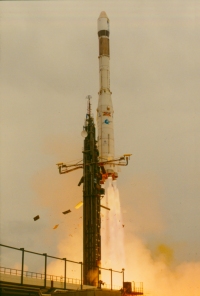
Giotto launch |
After the mission was given the go-ahead by ESA in 1980, it was put together in double quick time. Originally envisaged as part of a dual launch by a powerful Ariane 3 rocket, it was eventually launched by an Ariane 1 rocket (flight V14) on 2 July 1985.
"Giotto was the Agency's first planetary mission and was a tremendous success, both technically and scientifically," said Gerhard Schwehm of ESA's Space Science Directorate at Noordwijk in the Netherlands. "It provided a wealth of scientific results and gave scientists the unique chance to study two different comets with the same set of instruments."
Achievements
- Europe's first deep space mission
- First close-up images of a comet nucleus
- First spacecraft to encounter two comets
- First deep space mission to change orbit by returning to Earth for a gravity assist
- Discovered the size and shape of Comet Halley 's nucleus
- Made the closest comet flyby to date by any spacecraft (c. 200 km from Comet Grigg-Skjellerup)
- Discovered a black crust and bright jets of gas on the nucleus of Comet Halley
- Measured the size, composition and velocity of dust particles near two comets
- Measured the composition of gas produced by two comets
- Discovered unusual magnetic waves near Comet Grigg-Skjellerup
