• → European Space Agency

    • About Science & Technology

    • For Public

    • For Educators

    • ESA

    • Science & Technology

    • ISO

    • Missions
    • Show All Missions
    • Mission Home
    • Summary
    • Fact Sheet
    • Mission Team
    • Background Science
    • Wavelength
    • Solar System
    • Galactic
    • Extragalactic
    • Science Results
    • Solar System
    • Galactic
    • Extragalactic
    • Engineering
    • Archive
    • Spacecraft
    • Instruments
    • Mission Operations
    • Launch and Orbit
    • Mission Status
    • Status Reports
    • Science Operations
    • Data Archive
    • Mission Research
    • Resources
    • News Archive
    • Multimedia Gallery
    • Publication Archive
    • Calendar of Events
    • Services
    • Contact Us
    • Subscribe
    • Terms and Conditions
    • Bookmark and Share

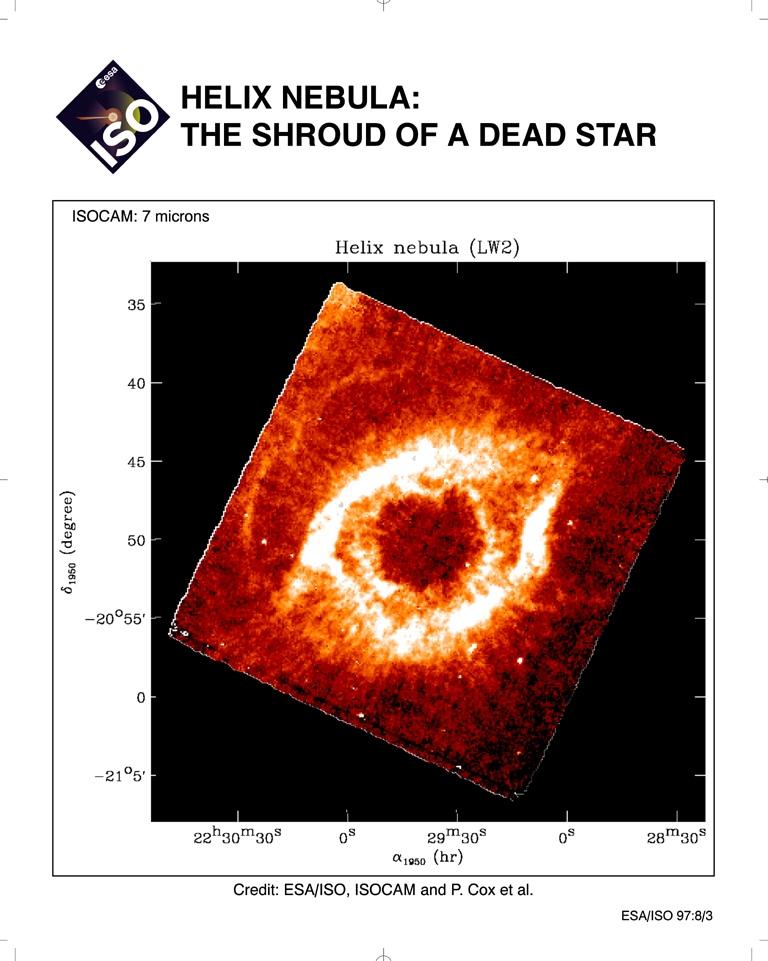
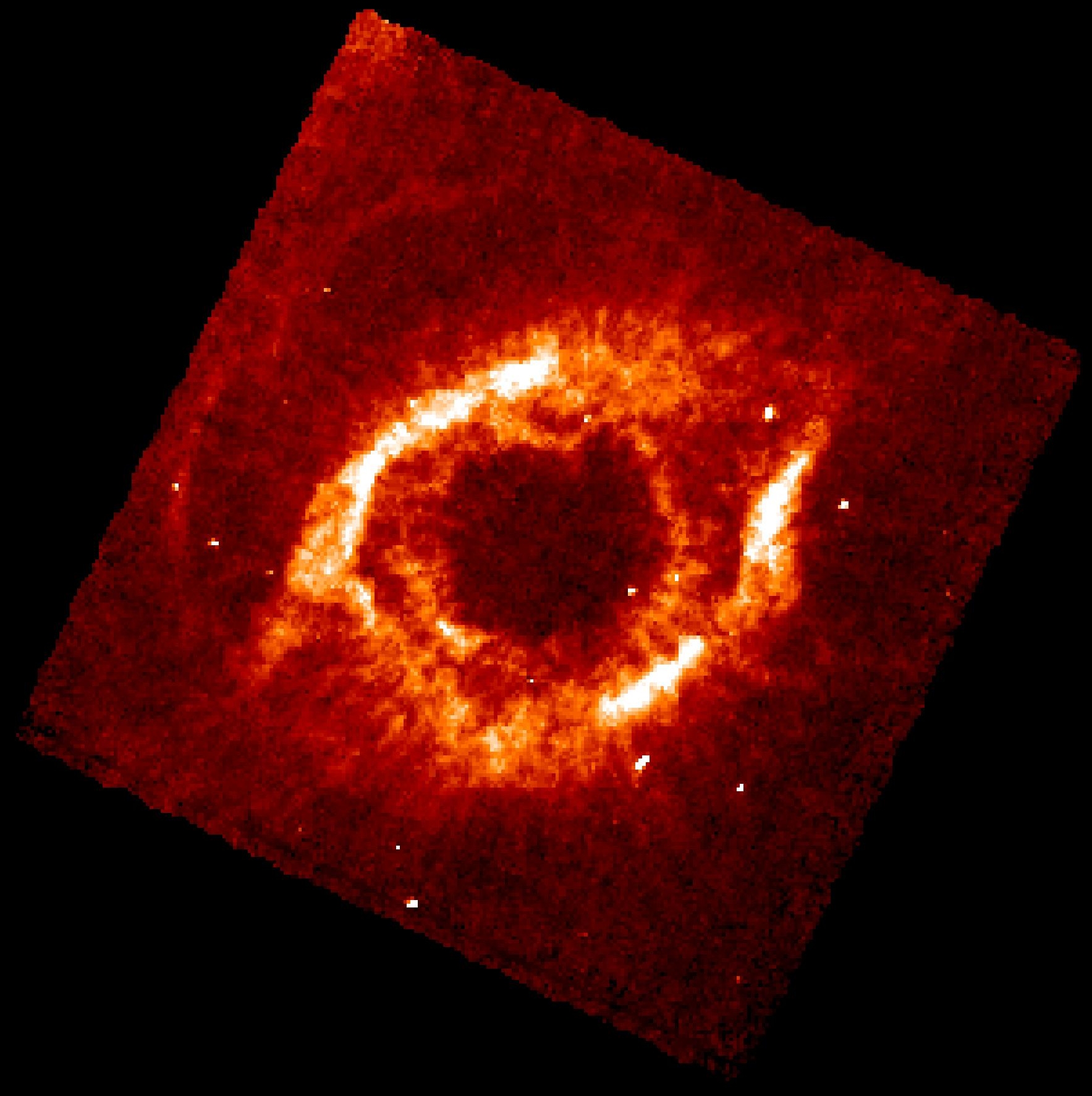
    Helix Nebula in Infrared

    Date: 14 Aug 1997
    Satellite: ISO
    Depicts: Helix Nebula
    Copyright: ESA/ISO, ISOCAM, and P. Cox et al

    Astronomers are surprised by new observations of the Helix Nebula, by ESA's Infrared Space Observatory, ISO. This beautiful object in the constellation Aquarius is a planetary nebula, the shroud of a dead star. It consists of shells of gas and dust ejected when a star of moderate size, similar to the Sun, ran out of fuel. The star blew off its outer layers, forming the nebula, and the inner part of the star collapsed to make a white dwarf star. The unexpected news from ISO is that the Helix Nebula has purged itself of much of its dust.

    Pierre Cox of the Institut d'Astrophysique Spatiale in Orsay, France, leads the ISO investigation of this object by a team of French, American, Dutch and Spanish astronomers. They expected to find dust, because it is commonplace in the outer layers of dying stars. Nevertheless ISO, using its special ability to identify dusty materials by their characteristic infrared emission, has established that the Helix Nebula contains no small dust grains. Cox and his colleagues believe that during the lifetime of the nebula (a few thousand years) the grains have been destroyed by powerful ultraviolet rays emitted by the very hot white dwarf at the center of the nebula.

    As a result, in this image of the Helix Nebula obtained by ISO's camera ISOCAM at a wavelength of 7 microns, the infrared emission comes not from dust but from molecular hydrogen gas. At first glance the image looks like pictures of the nebula in visible-light. The shells appear as rings because more of the emitting material is concentrated along tangential lines of sight. Other stars are seen as bright dots, through the nebula.

    Details revealed with special clarity in the ISO image include an outer shell, blown off from the star before its final death throes. The radial streaks are also remarkable. Notably absent is the white dwarf star at the center of the nebula. This is seen in visible light, but it is so hot that it emits very little of its radiation in the infrared.

    Planetary nebulae are so called because they looked round, like planets, to early astronomers using small telescopes. The Helix Nebula (alias NGC 7293) is the closest example, at a distance of 500 light-years.


    Last Update: 23 May 2005

    • Shortcut URL
    • http://sci.esa.int/jump.cfm?oid=32720
    • Latest selection
    • ISO Legacy Colloquium Poster
    • ISO Spacecraft
    • ISO Spacecraft
    • Image Hi-Res Versions
    • Hi-Res [JPG]
      83.13 kb.
    • Hi-Res [jpg]
      859.74 kb.
    • See also
    • INFO 25-1997: ISO Results Presented at International Astronomical Union

    Connect with us

    • RSS
    • Youtube
    • Twitter
    • Flickr
    • Google Buzz
    • Livestream
    • Subscribe
    • App Store
    • ESA Science Twitter

    Follow ESA science

    • Copyright 2000 - 2013 © European Space Agency. All rights reserved.

    • Terms and Conditions