
Plasma Regions
Solar Wind & Bow Shock
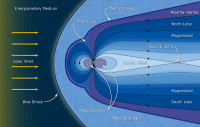 |
|
Artist's impression showing the main regions/boundaries of the Earth's magnetosphere. |
Further upstream of the bow shock, i.e. towards the Sun, Cluster is providing new measurements which contribute to a better understanding of various phenomena including: plasma turbulence and its role in the heating of the solar wind, backstreaming ions, pickup ions, and plasma bubbles (see Featured highlight below).
Cluster carries five instruments to measure the characteristics of electromagnetic waves in various frequency domains - STAFF, EFW, WHISPER, WBD and DWP - thus it is also ideally suited to provide new insight into the transmission of electromagnetic waves through the bow shock and the magnetosheath.
| Featured highlight in this region: Cluster and Double Star discover density holes in the solar wind |
 |
The Magnetopause
 |
|
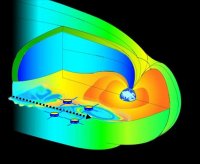
A three-dimensional cut-away view of Earth's magnetic bubble called the magnetosphere |
Although the magnetopause is usually considered as an impenetrable boundary, some plasma from the solar wind can enter the magnetosphere.
Various processes have been proposed to account for this penetration of plasma:
- Pressure pulses - when the solar wind dynamic pressure suddenly increases, leading to an indentation of the magnetopause
- Reconnection between the interplanetary magnetic field and the Earth's magnetic field
- Kelvin-Helmholtz vortices (see Featureed highlight below)
- Impulsive penetration where plasma filaments, which have a higher momentum than the surrounding solar wind plasma, impact and possibly penetrate the magnetopause.
Cluster measures the three-dimensional size and motion of the structures observed at the magnetopause and is also able to determine the local geometry of the magnetopause, which makes it possible to distinguish between these mechanisms.
| Featured highlight in this region: Cluster finds magnetic reconnection within giant swirls of plasma |
 |
Polar Cusps
 |
|
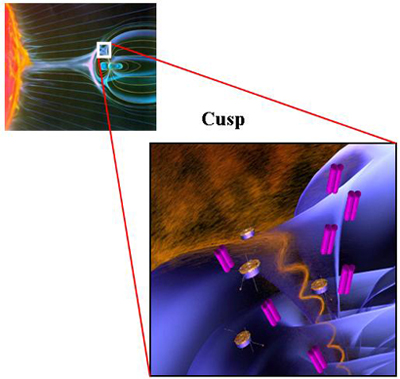
An illustration depiciting the spacecraft formation (in close-up) and the loction of the disturbance in the northern magnetic cusp. |
Cluster obtains high resolution measurements in these regions allowing full three-dimensional ion (CIS) and electron (PEACE) distribution functions to be measured. The exterior cusp is also seen as a very turbulent region with vortices in the plasma flow. Cluster measures the flow with high time-resolution and at four locations in space to determine the characteristics of these vortices (see Featured highlight below). The Cluster orbits are devised to ensure that the cusps are crossed as many times as possible in the required spacecraft configuration.
| Featured highlight in this region: From 'macro' to 'micro': turbulence seen by Cluster |
 |
The Magnetotail
 |
|
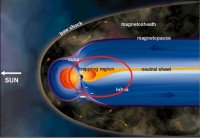
Illustration of Earth's magnetosphere (in blue) immersed in the solar wind. |
Cluster is the first space mission to study in 3D the various phenomena occuring in this region. In particular, the Cluster data have enabled a leap forward in our understanding of magnetic reconnection, mapping for the first time, with multiple spacecraft, the core region of this universal phenomenon (see Featured highlight).
| Featured highlight in this region: Magnetic heart of a 3D reconnection event revealed by Cluster |
 |
Plasma Sheet Boundary Layer
 |
|
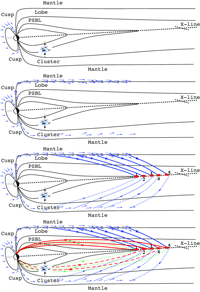
Animation of generation process of ion beams |
Electric currents are also observed in this region. They are aligned with the Earth's magnetic field, flowing towards and away from the Earth. The Fluxgate Magnetometer (FGM), one of 11 instruments on board Cluster, enables the current flowing in the vicinity of the four spacecraft to be calculated – for the first time ever - without having to make assumptions about the shape and orientation of the current sheet.
| Featured highlight in this region: Cluster explains nightside ion beams |
 |
The auroral zone
 |
|
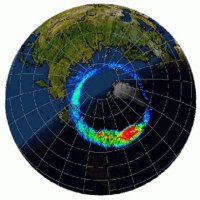
Auroral oval (in false colour) as seen from space, overlaid on top of a visible image of Earth. The red indicates the brightest aurora and blue the dimmest. The brightest aurora is found at midnight. |
The ionosphere is now believed to be an important source of plasma for the magnetosphere and, in particular, for the magnetotail. The polar wind and the nightside auroral zone contribute to the filling of the magnetosphere with plasma. Cluster has enabled measurements of these quantities using its comprehensive plasma physics package.
| Featured highlight in this region: Cluster quartet probes the secrets of the black aurora |
 |