
Space Weather
Solar Storms
Auroras, the dancing lights in the sub-polar air that fascinated our ancestors, appear when eruptions on the Sun disturb the Earth's space environment.
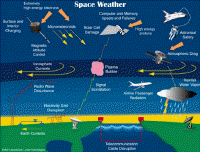
Solar storms are more troublesome to modern technology. They can endanger astronauts and satellites, and at ground level they can disrupt communications, computers, power supplies and navigation systems.
 |
|
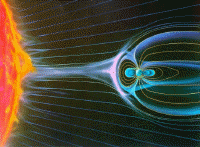
The Sun's powerful magnetic forces directly affect the Earth and the rest of the solar system |
At the speed of light, flashes of X-rays and ultraviolet rays from the Sun arrive at the Earth in 8 minutes. Hitting the atmosphere they cause disturbances in the ionosphere, which reflects radio signals. Changes in the ionosphere can interrupt short-wave radio transmissions and cause errors in navigation systems.
Also at a high speed, but following a curved path, solar protons and other energetic particles from the Sun reach the Earth in an hour or two. They can harm astronauts, damage spacecraft and if they reach the ground they can cause errors in computers.
Gusts and shocks in the solar wind due to an eruption take a few days to reach the Earth. When they arrive, they buffet the Earth's magnetic shield, the magnetosphere, causing a magnetic storm, which makes compass needles wander. The varying magnetic field can provoke damaging surges of current in long metallic structures such as power lines and pipelines. The magnetic disturbances can also dump particles from space into the upper air, where they cause auroras.
 |
|
The numerous effects of space weather (Bell Laboratories, Lucent Technologies) |
In one respect the solar storms themselves shield the Earth. They reduce the intensity of cosmic rays, energetic particles reaching the Earth from the Galaxy. Major storms can cause a big drop in the cosmic-ray count for a day or two. Over longer periods the average cosmic-ray count falls as solar activity increases during the 11-year sunspot cycle.
A multinational space fleet (ISTP, the International Solar-Terrestrial Physics Programme) is busy making better sense of the Sun's behaviour and its effects on the Earth. Six of the spacecraft have been built in Europe for joint ESA-NASA missions. These projects are SOHO (1995) which is the multi-purpose flagship of the solar space fleet, Ulysses (1990) flying over the poles of the Sun, and Cluster (2000) with four identical satellites promising the first 3D views of the non-stop battle between solar storms and the Earth's magnetic field.
Sun-Earth Relationship
 |
|
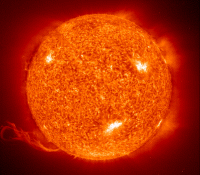
The Sun as seen by SOHO on 14 September 1997 in extreme ultraviolet light. The solar prominence, bottom left, has a temperature of some 70 000 °C. The solar corona is hotter than a million degrees Celsius |
The Sun is our nearest star. Nuclear reactions deep inside the Sun create the light and heat we need for our survival. Scientists think the Sun was born about five billion years ago. Although the Sun is consuming four million tonnes of hydrogen fuel every second, it is so large that it should continue to shine for another five billion years. By that time, it will have swollen into a red giant, causing the oceans to boil away and destroying all life on our planet.
The Sun's activity varies over an 11-year period. The number of sunspots and flares, and the radiation output, change over time. The most recent peak in its cycle of activity occurred in mid-2000 with a second peak at the end of 2001. Scientists are hoping that the two missions in ESA's Solar-Terrestrial Programme, SOHO and Cluster, will be able to tell them more about how the Sun works and how it affects the Earth. While SOHO studies explosions on the Sun and detects solar storms heading our way, Cluster will measure the effects of this activity on near-Earth space as the incoming energetic particles subject the magnetosphere to a buffeting.
Facts about the Sun
|
Distance From Earth |
149 600 000 km |
|
Diameter |
1 392 000 km (= 109 Earth diameters) |
|
Rotation Period at Equator |
24.6 days |
|
Surface Temperature |
5500 °C |
|
Core Temperature |
15 million °C |
|
Mass (Earth = 1) |
333 000 |
|
Volume (Earth = 1) |
1 300 000 |
|
Gravity (Earth = 1) |
27.94 |
How the Sun affects our planet
The Sun affects our world in many ways. A continuous stream of atomic particles - the solar wind - pours out into space from the Sun at speeds ranging from 300 to 1000 kilometres per second (1800 times faster than Concorde!). Sometimes, explosions on the Sun send millions of tonnes of gas towards the Earth. These clouds of high energy particles can cross the 150 million kilometre gulf between the Sun and Earth in a few days. The most energetic particles of all, created by solar flares, can reach Earth in just 30 minutes.
 |
|
|
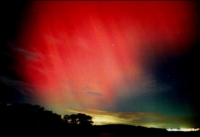
An aurora: a product of charged particles radiated by the Sun interacting with the Earth's atmosphere |
A solar Coronal Mass Ejection (CME) event as recorded by SOHO on 2 June 1998 |
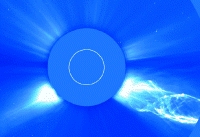
When charged particles from the Sun enter Earth's upper atmosphere, they create shimmering curtains of coloured light, known as auroras, in the polar night sky. Other effects can be much more serious:
- Solar storms affect Earth's ionosphere, causing disruption of short wave radio communications, navigation systems on ships and aircraft, and military radar systems
- Surges in long electricity transmission lines may cause power and widespread blackouts, as happened in Quebec, Canada, in March 1989 when 6 million people were left without electricity due to a huge solar-induced magnetic storm
- Damage to microchips and electrical discharges may cause satellites to stop operating, causing disruption of, for example, telephone, TV and data communication services
- Radiation levels can become hazardous to astronauts and occupants of high flying aircraft
- High energy particles hitting Earth's upper atmosphere can destroy the ozone layer, which protects us from harmful ultraviolet radiation
- Solar storms have even been blamed for increased corrosion in oil pipelines
- Solar energy output varies over the 11-year sunspot cycle. This may cause climate changes, which can affect vegetation growth and food supplies