
Science Highlights from the First Solar Orbit
Solar Wind and Magnetic Field
The general picture to have emerged from the Ulysses data regarding the global, 3-dimensional structure of the solar wind at, or near, solar minimum is that the high latitude solar wind originating from the polar coronal holes is characterized by a fast, uniform flow, with an average speed of 750 kms-1.
 |
|
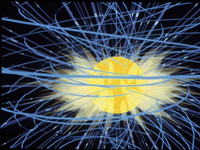
Artist's impression of the heliospheric magnetic field |
Slow to medium speed wind streams originating in the coronal streamer belt are confined to a relatively narrow range of latitudes on either side of the heliographic equator. This band, in which the majority of solar wind variability is observed, also contains the heliospheric current sheet (HCS) that separates the oppositely directed large-scale magnetic fields originating in the two hemispheres.
Although the streamer belt and HCS are approximately aligned with the heliographic equator at solar minimum, they both exhibit significant warping, thereby allowing stream interactions to occur. At the time Ulysses made its rapid pole-to-pole passage in 1994/95, the band of solar wind variability at the position of the spacecraft (1.4 AU) occupied some 43 degrees in latitude, from -22° to +21°.
The region was noticeably narrower compared with situation in 1993 when the spacecraft left the slow to medium solar wind at -35° latitude on its way to the south polar regions, consistent with the evolution of the streamer belt towards solar minimum. In addition to its higher average speed, the solar wind at high latitudes has higher proton temperature and momentum flux than low-latitude solar wind, but lower average number density.
Another key result from the first Ulysses polar passes concerns the global structure of the heliospheric magnetic field. Ulysses observations have revealed that the radial component of the magnetic field is latitude-independent, contrary to the majority of model predictions. This result implies that the HCS is the dominant factor in determining the radial field at the orbit of Ulysses, rather than the solar field at the poles.
Cosmic Rays
A fundamental question that has been answered by Ulysses relates to the presence of large-scale directional fluctuations in the polar heliospheric magnetic field. Prior to the launch of Ulysses, it was suggested that the classical picture of smooth, near-radial polar magnetic field lines would be modified by the effects of random walk of the field foot points resulting from super-granulation motion in the photosphere. This stochastic motion would lead to large-scale transverse fluctuations in the polar fields, which in turn would impede the access of cosmic ray particles to the inner heliosphere over the poles.
The data from Ulysses' first polar passes have confirmed both the existence of the field fluctuations, and the absence of large latitudinal gradients in the fluxes of cosmic ray particles. Of particular interest is the latitude distribution of the so-called anomalous cosmic ray component (ACR), generally thought to be singly-charged interstellar ions that have been accelerated to MeV energies at the solar wind termination shock. Ulysses results show a modest positive latitudinal gradient for ACR oxygen, nitrogen and neon, qualitively in agreement with models in which the acceleration takes place largely at the poles of the heliosphere, the ACR subsequently diffusing and drifting down to the equatorial regions.
Energetic Particles
In addition to latitudinal effects, the energetic particle and cosmic ray measurements made by Ulysses have revealed a striking global periodic variation. Recurrent increases in the low-energy particle flux with ~26-day period were observed up to high latitudes in the southern hemisphere. On the other hand, at energies >100 MeV, the nucleon intensities show corresponding periodic decreases. Both of these phenomena are thought to be associated with Corotating Interaction Regions (CIR) that form as a consequence of stream interactions between fast and slow solar wind flows.
CIR shocks accelerate the low-energy particles, while the magnetic field compressions associated with the stream interactions impede the access of high-energy particles to the inner heliosphere. In the light of the first comprehensive study of the 3-dimensional evolution of CIRs, the question raised by the Ulysses measurements is how do the effects of CIRs operate at high latitudes, where the CIRs themselves are no longer seen? A variety of models have been developed to explain the observations, but a consensus has yet to be reached.
North-South Comparison
An obvious question to be asked is: do the data from the first polar passes reveal significant north-south asymmetries? This is clearly one aspect where the out-of-ecliptic studies would have benefited from the simultaneous observations available with the original two-spacecraft mission. Nevertheless, the rapid pole-to-pole scan, together with the slowly changing activity conditions characteristic of solar minimum, have enabled a comparison of the two hemispheres to be made whereby, at least to first order, temporal effects can be neglected.
The above comparison reveals modest north-south asymmetries in a number of the data sets. For example, an examination of spatial gradients in solar wind parameters reveals that the average solar wind speed at latitudes greater than 40° is ~15-25 kms-1 higher in the north than in the south, qualitatively consistent with corresponding open coronal field line expansion factors computed using magnetogram data. Another solar wind asymmetry, presently not understood, is found in the radial proton temperature gradient, which is steeper in the north than in the south.
North-south asymmetries are also reported in the low-energy particle measurements. The recurrent increases in the flux of 50 keV electrons with a period of ~26 days referred to above were seen up to 80° south latitude, but not at high latitudes in the northern hemisphere. Comparison with in-ecliptic data reveals that solar and interplanetary activity persisted through 1995, implying that the lack of variations seen in the north is a spatial rather than temporal effect.
None of the models proposed to date to explain the ~26-day recurrent behaviour would predict an intrinsic north-south asymmetry, leading to the suggestion that the observations result from differences in the physical conditions in the two hemispheres. At higher energies, the cosmic ray flux observed by Ulysses, including the ACR component, was higher at a given heliographic latitude in the north than in the south by up to 50 percent.
Not all data show north-south asymmetries. For example, the magnitude of the radial magnetic field, when corrected for heliocentric distance, and the amplitude and radial gradient of the field variances, are the same in both hemispheres. Measurements from the Ulysses plasma wave experiment reveal no significant asymmetry between the solar wind electron temperature and density profiles derived from thermal noise spectroscopy for the northern and southern hemispheres. Similarly, a comparison of directional discontinuities (DDs) and tangential discontinuities (TDs) in the north and south polar wind reveals no differences in the rate of occurrence of DDs and TDs between the two hemispheres.
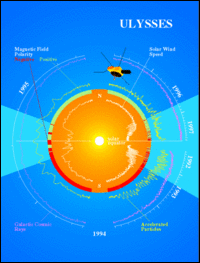 |
Polar plot showing actual measurements of solar wind speed (linear scale, approx. range 350-800 kms-1), magnetic field (polarity), energetic particles and cosmic rays (logarithmic scales, with the cosmic ray trace offset with respect to the lower-energy particles) acquired by the Ulysses experiments. Because of the elliptical nature of the spacecraft orbit, Ulysses traversed the region represented in the left-hand side of the figure much more rapidly than that on the right. This accounts for the difference in appearance of the data traces in 1995 and 1996, for example. Time ticks are shown on the outer circle for reference. |