
Science Highlights from the Second Solar Orbit
Solar Wind and Magnetic Field
 |
|
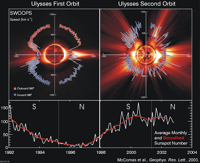
Polar plots of solar wind speed as a function of latitude for Ulysses' first two orbits. Sunspot number (bottom panel) shows that the first orbit occurred through the solar cycle declining phase and minimum while the second orbit spanned solar maximum. Both are plotted over solar images characteristic of resp. solar minimum (17 August 1996) and maximum (07 December 2000). |
Although the solar magnetic field, corona and solar wind were highly variable, the magnetic field at Ulysses (~1.5-2.5 AU from the Sun) maintained a surprisingly simple, dipole-like structure. In contrast to the situation at solar minimum, however, the equivalent magnetic poles were located at low latitudes rather than in the polar caps.
Another phenomenon of great interest was the Sun's magnetic polarity reversal that occurred during the polar passes. It was found that the process of magnetic polarity reversal is a complex one that takes place over a period of several months. The previous finding of Ulysses concerning the lack of dependence of the radial component of the magnetic field on latitude was found to be valid even in the more disturbed conditions at solar maximum. This appears to be a fundamental property.
Energetic Particles
One of the key discoveries made during the high-latitude passes at solar minimum was the unexpected ease with which energetic particles, accelerated at low-to-middle latitudes, were able to reach the polar regions of the heliosphere. This discovery prompted theorists to re-assess existing models of the heliospheric magnetic field, leading ultimately to new suggestions regarding the source of the solar wind itself. An obvious question when Ulysses returned to high latitudes at solar maximum was: do energetic particles have the same easy access when the heliosphere is much more chaotic? The observations provided an unequivocal answer: yes.
The Ulysses data confirmed the presence of large fluxes of energetic particles over the poles, and revealed that the absolute intensity of these particles is comparable to that measured simultaneously in the ecliptic near 1 AU. This has lead to the idea of the inner heliosphere near solar maximum acting as a reservoir for solar energetic particles.
Interstellar Dust
The Ulysses dust detector counted an increasing number of interstellar grains starting at the beginning of 2000. This increase followed a depletion of interstellar grains observed by Ulysses after mid-1996. This was attributed to the deflection of the interstellar dust stream by the highly ordered, solar-minimum heliospheric magnetic field. The return of interstellar dust to the solar system is thought to be the result of large-scale disturbances of the magnetic field that occur during solar maximum. The number of interstellar dust grains in the solar system is predicted to steadily increase in the period leading up to a solar maximum.