
Launch Phase
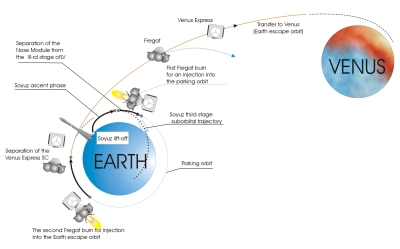
The three-stage Soyuz launcher lifted the Fregat autonomous upper stage (fourth stage) with Venus Express mounted on it into a sub-orbital trajectory.
After separation from the Soyuz third stage, a Fregat main engine burn (at an altitude of about 200 kilometres) for around 20 seconds placed the Fregat-Venus Express composite into an almost circular parking orbit. After a coast phase of about 70 minutes in the low Earth orbit, a second Fregat engine burn, lasting 16 minutes, moved the combined craft from the parking orbit onto an escape trajectory, after which the Fregat stage and Venus Express separated.
| MET | Event |
| -08h 28m 00s | Spacecraft pre-launch configuration check completed, start of launch configuration |
| -05h 00m 00s | Spacecraft to external power & in launch mode Systems checks begin on Fregat upper stage |
| -04h 24m 00s | Spacecraft readiness for LV fueling |
| -03h 49m 00s | Start of LV fueling |
| -01h 30m 00s | End of LV fueling |
| -44m 00s | Removal of service platform |
| -10m 00s | Spacecraft to internal power |
| -02m 35s | Pressurization of propellant tanks |
| -02m 00s | Umbilical drop-off |
| - 45s | Transfer to on-board power supply |
| - 20s | Ignition of booster and core engines at intermediate thrust level |
| Launch at 03:33:34 UTC 9 November 2005 | |
| +00m 08s | End of vertical ascent |
| +01m 58s | First stage boosters separate |
| +04m 14s | Soyuz fairing jettison |
| +04m 46s | Second stage cut-off |
| +05m 18s | Soyuz second stage separation |
| +08m 45s | Third stage cut-off |
| +08m 49s | Soyuz third stage separation |
| +09m 49s | Start of first Fregat burn |
| +10m 09s | End of first Fregat burn |
| +1h 20m 00s | Start of second Fregat burn |
| +1h 36m 00s | End of second Fregat burn |
| +1h 36m 30s | Spacecraft separation - start of automatic activities |
| +1h 58m 00s | First opportunity for signal acquisition at New Norcia |
| +2h 00m 00s | First Sun acquisition |
| +2h 08m 00s | Solar Array Deployment |
| +2h 38m 00s | End of automatic sequence - spacecraft operated from ground control |
| +2h 58m 00s | Initial spacecraft configuration |
| +8h 56m 30s | Spacecraft configured in normal mode |
| +27h 05m 00s | Trajectory Correction calibration |
| +36h 31m 00s | Switch to high gain antenna 2 |
| +51h 01m 00s | Trajectory Correction Manoeuvre (TCM-1) |
| +59h 27m 00s | End of Launch and Early Orbit Phase (LEOP) operations and start of Near Earth Commissioning Phase (NECP) |
 |
|
The different stages of the launch and transfer phase |
After separation, Venus Express spent approximately 150 days in an interplanetary transfer orbit. During this phase, trajectory corrections were performed using the spacecraft's own thrusters.
