
Instruments
Introduction
The Venus Express payload comprises a combination of spectrometers, spectro-imagers and imagers covering a wavelength range from ultraviolet to thermal infrared, a plasma analyser and a magnetometer. This set of instruments is able to study the atmosphere, plasma environment and surface of Venus in great detail.
The investigation aims to enhance our knowledge of the composition, circulation and evolution of the atmosphere of Venus. The surface properties of Venus and the interaction between the atmosphere and the surface are examined and evidence of volcanic activity is sought.
Most of the instruments are re-using designs and/or spare hardware originating from either Mars Express or Rosetta and have been fitted onto a spacecraft whose design is derived from Mars Express and adapted to cope with the thermal and radiation environment in Venus orbit. The nominal Venus Express mission (500 Earth days, or about two Venus sidereal days, following orbit insertion on 11 April 2006) has been extended several times, which has pushed back the mission end date to 31 December 2014 (subject to a mid-term review in 2012). By end 2012 Venus Express observations will have been performed for ten Venus sidereal days.
The instruments were provided by collaborative efforts between scientific institutes in ESA member states and Russia. Principal investigators in different European countries lead the nationally funded collaborations.
| Instrument | Objective | Heritage | Principal Investigator |
| ASPERA-4 | Neutral and ionised plasma analysis | Mars Express (ASPERA-3) |
S. Barabash (IRF, Kiruna, Sweden) |
| MAG | Magnetic field measurements | Rosetta Lander (ROMAP) |
T. Zhang (OAW, Graz, Austria) |
| PFS | Atmospheric vertical sounding by infrared Fourier spectroscopy | Mars Express (PFS) |
V. Formisano (IFSI CNR, Frascati, Italy) |
| SPICAV | Atmospheric spectrometry by star or Sun occultation | Mars Express (SPICAM) |
J.-L. Bertaux (SA/CNRS, Verriéres-le-Buisson, France) |
| VeRa | Radio sounding of atmosphere | Rosetta (RSI) |
B. Häusler (Universität der Bundeswehr, München, Germany) |
| VIRTIS | Spectrographic mapping of atmosphere and surface | Rosetta (VIRTIS) |
P. Drossart (CNRS/LESIA & Observatoire de Paris, France and G. Piccioni (IASF-CNR, Roma Italy) |
| VMC | Ultraviolet and visible imaging | Mars Express (HRSC/SRC) and Rosetta (OSIRIS) |
W. Markiewicz (MPS, Göttingen, Germany) |
Instruments in Brief
ASPERA-4
- Investigate the interaction between the solar wind and the atmosphere of Venus
- Characterise quantitatively the impact of plasma processes on the atmosphere
- Determine the global distribution of plasma and neutral gas
- Identify the mass composition and quantitatively characterise the flux of the out flowing atmospheric materials
- Investigate the plasma domains of the near Venus environment
- Provide undisturbed solar wind parameters
The instrument comprises four sensors:
- Neutral Particle Imager (NPI), a simple ENA direction analyser that surveys ENA fluxes with high angular resolution
- Neutral Particle Detector (NPD), performing ENA velocity and mass measurements
- Ion Mass Analyser (IMA), a mass resolving spectrograph that provides measurements of the main ion components (H, H2, He, and O)
- Electron Spectrometer (ELS), performing electron energy measurements
|
| ||||
| NPI | NPD | IMA | ELS | |
| Measured Particles | ENA | ENA | Ions | Electrons |
| Energy range (keV) | 0.1 - 60 | 0.1 - 10 | 0.01 - 40 | 0.01 - 20 |
| Energy resolution (ΔE/E) | N/A | 0.8 | 0.1 | 0.07 |
| Mass resolution | N/A | Distinguish H, O | M/ΔM = 5 | N/A |
| Intrinsic field of view | 9° × 344° | 9° × 180° | 90° × 360° | 10° × 360° |
| Angular resolution (FWHM) | 4.6° × 11.5° | 5° × 30° | 5° × 22.5° | 5° × 22.5° |
The
MAG
The Magnetometer instrument is designed to make measurements of magnetic field strength and direction. This information is used to:
- Provide the magnetic field data for any combined field, particle and wave studies such as lightning and planetary ion pickup processes
- Map with high time resolution the magnetic properties in the magnetosheath, magnetic barrier, ionosphere, and magnetotail
- Identify the boundaries between the various plasma regions
- Study the interaction of the solar wind with the atmosphere of Venus
MAG can make three-dimensional measurements of the magnetic field around Venus in the frequency range from DC to 32 Hz. It consists of two tri-axial fluxgate sensors. MAGOS, the outboard sensor, is mounted on the end of a one metre long deployable boom. MAGIS, the inboard sensor, is mounted directly on the spacecraft body. The dual sensor configuration allows better monitoring of the stray magnetic fields produced by the spacecraft.
| Summary of MAG Characteristics | |||
| Smallest range | Default range | Maximum range | |
| Magnetic field measurement range (each axis) | ± 32.8 nT | ± 262 nT | ± 8338.6 nT |
| Magnetic field resolution | 1 pT | 8 pT | 128 pT |
| Static magnetic field compensation | ± 10 µT | ± 10 µT | ± 10 µT |
The fluxgate sensors are the same as the ROMAP sensor flown on Rosetta. The design of the MAG electronics is derived from that used for ROMAP, adapted for the two sensor configuration.
PFS
PFS (Planetary Fourier Spectrometer) is an infrared spectrometer that operates in the 0.9 μm to 45 μm wavelength range and is designed to perform vertical optical sounding of the Venus atmosphere. The instrument is designed to:
- Perform global, long-term monitoring of the three-dimensional temperature field in the lower atmosphere (from cloud level up to 100 km)
- Measure the concentration and distribution of known minor atmospheric constituents
- Search for unknown atmospheric constituents
- Determine, from their optical properties, the size, distribution and chemical composition of atmospheric aerosols
- Investigate the radiation balance of the atmosphere and the influence of aerosols on atmospheric energetics
- Study global circulation, mesoscale dynamics and wave phenomena
- Analyse surface to atmosphere exchange processes
| Summary of PFS Characteristics | ||
| Short Wavelength Channel | Long Wavelength Channel | |
| Spectral range (µm) | 0.9 - 5.5 | 5.0 - 45 |
| Spectral resolution (cm-1) | 2 | 2 |
| Spectral resolving power (λ/Δλ) | 5500 - 1500 | 1000 - 100 |
| Field of view (mrad) | 35 | 70 |
The PFS instrument design is based on that flown on Mars Express, modified to optimise performance for the Venus Express mission.
SPICAV
SPICAV (Spectroscopy for Investigation of Characteristics of the Atmosphere of Venus) is an imaging spectrometer for ultraviolet and infrared radiation. SPICAV is derived from the SPICAM instrument flown on Mars Express, which was equipped with two channels, one for ultraviolet wavelengths and one for infrared. An additional channel (SOIR, Solar Occultation at Infrared) has been added for Venus Express, to observe the Sun through Venus's atmosphere at infrared wavelengths.
|
| |||
| Ultraviolet Channel | Infrared Channel | SOIR Channel | |
| Spectral range (µm) | 0.11 - 0.31 | 0.7 - 1.7 | 2.3 - 4.2 |
| Spectral resolution | 0.8nm | 0.5 - 1nm | 0.2 - 0.5cm-1 |
| Spectral resolving power (λ/Δλ) | ~300 | ~1300 | ~15 000 |
| Field of View (rad) | 55 × 8.7 | 0.2 / pixel | 0.3 - 3 |
VeRa
VeRa (Venus Radio Science) is a radio sounding experiment that is used to examine the ionosphere, atmosphere and surface of Venus by means of radio waves transmitted from the spacecraft, passed directly through the atmosphere or reflected off the planet surface and received by a ground station on Earth.
The instrument is designed to:
- Perform radio sounding of the Venus ionosphere from an altitude of 80 kilometres to the ionopause (300 - 600 km, depending on solar wind conditions)
- Perform radio sounding of the neutral atmosphere from the cloud layer (35 - 40 km) to an altitude of around 100 kilometres
- Determine the dielectric characteristics, roughness and chemical composition of the planetary surface
- Study the solar corona, extended coronal structures and solar wind turbulence during the inferior and superior solar conjunctions of Venus
VeRa uses the spacecraft's transponder for radio transmission and reception, but generates the transmitted signal using its own Ultra Stable Oscillator (USO). The design of the VeRa USO is derived from that used for the Radio Science Investigation instrument flown on Rosetta.
VIRTIS
VIRTIS (Visible and Infrared Thermal Imaging Spectrometer) is an imaging spectrometer that operates in the near ultraviolet, visible and infrared parts of the electromagnetic spectrum (0.25 to 5µm wavelength range). The instrument has a variety of operating modes that cover a range of observations from pure, high-resolution spectrometry to spectro-imaging.
| Summary of VIRTIS Characteristics | |||
| Mapping Spectrometer | High Resolution Spectrometer | ||
| Visible Channel | Infrared Channel | Infrared Channel | |
| Spectral range (µm) | 0.25 - 1.0 | 1 - 5 | 2 - 5 |
| Maximum Spectral resolution (nm) | ~2 | ~10 | ~3 |
| Spectral resolving power (λ/Δλ) | 100 - 200 | 100 - 200 | 1000 - 2000 |
| Field of view (mrad) | 0.25 | 0.25 | 0.5 - 1.5 |
VIRTIS allows the analysis of all layers of the atmosphere and the clouds therein, the making of surface temperature measurements and the study of surface / atmosphere interaction phenomena.
VMC
VMC (Venus Monitoring Camera) is a wide angle, multi-channel CCD camera that, using four narrow band filters, operates in the ultraviolet, visible and near infrared spectral ranges. VMC fulfils the following goals:
- Perform support imaging (supply a global imaging context for data from the other instruments)
- Facilitate the study of dynamic processes in the atmosphere of Venus by means of global, multi-channel imaging
- Permit the study of the distribution of the unknown UV absorber at the cloud tops
- Monitor the ultraviolet and visible wavelength airglow and its variability as a dynamic tracer
- Map the surface brightness distribution and search for volcanic activity
In addition, VMC images and movies will make a significant contribution to the public outreach program.
| Summary of VMC Characteristics | |||||||||
| Spectral range (µm) |
| ||||||||
| Spectral resolution (nm) | ~5 | ||||||||
| Field of view (mrad) | 300 (total), 0.74 (mrad per pixel) | ||||||||
The VMC design is derived in part from the Mars Express High/Super Resolution Stereo Colour Imager (HRSC) and partly from the Rosetta Optical, Spectroscopic and Infrared Remote Imaging System (OSIRIS) design.
ASPERA-4: Analyser of Space Plasmas and Energetic Atoms
The
- Main Unit, comprising the mechanical scanner, digital processing unit (DPU), Neutral Particle Imager (NPI), Neutral Particle Detector (NPD) and Electron Spectrometer (ELS)
- Ion Mass Analyser (IMA), mounted separately
Mechanical Scanner
The mechanical scanner sweeps the three sensors mounted on it through 180 degrees to give the ASPERA-4 instrument 4pi steradian (unit sphere) coverage when the spacecraft is 3-axis stabilised. The scanner is equipped with two stepper motors, which turn a worm screw. The screw drives a worm wheel, which is attached to the moving part of the scanner. The scanner payload can be turned to any arbitrary angle or perform continuous scanning. The operational rotation rates are 1.5, 3.0 and 6.0 degrees per second. The system offers an angular positioning accuracy of 0.2 degrees.
Digital Processing Unit
The Digital Processing Unit's main task is to control the sensors and the mechanical scanner. The DPU processes, compresses and stores the sensor data and forwards it (together with housekeeping data) to the satellite telemetry system. It also receives and implements commands sent to the
The primary design drivers for the Digital Processing Unit (DPU) were optimum use of the allocated telemetry rate and correct handling of telecommands. The
Neutral Particle Imager
In the Neutral Particle Imager, incoming particles pass between two 150 mm diameter discs, which are separated by 3 mm and have a 5 kV potential between them. Charged particles are deflected by the electric field and captured, but neutral particles pass between the discs. The space between the discs is divided into 32 sectors by plastic spokes, forming 32 azimuth collimators with an aperture of 9 degrees by 18 degrees each. Neutrals that pass through the deflector system hit a
The Neutral Particle Imager covers 4 pi steradians in one 180 degree sweep by the mechanical scanner and produces an image of the ENA distribution in the form of an azimuth × elevation matrix. The direction vector of 32 elements is read out once every 62.5 ms.
Neutral Particle Detector
The Neutral Particle Detector consists of two identical pinhole cameras each with a 90 degree Field of View (FoV) in the instrument azimuth plane and arranged to cover a FoV of 180 degrees. Particles approaching the pinholes pass between two quadrant deflector plates separated by 4.5 mm and with and 8 kV potential between them. Charged particles with energies up to 70 keV are deflected, while neutrals proceed into the camera. The deflector plates also function as a collimator in the instrument elevation direction.
The collimated ENA beam emerging from the 4.5 × 4.5 mm pinhole hits a target at a grazing angle (20 degrees) and causes secondary electron emission. The secondary electrons are detected by one of two Micro Channel Plate (MCP) electron multiplier assemblies. The MCP output provides a start signal the electronics that measures the time of flight of the ENAs over a fixed distance. The incoming ENAs are reflected from the target nearly specularly and travel to a second target. Again, secondary electrons are produced and detected by three more MCPs, which pass a stop signal to the time of flight electronics. The time of flight between the two targets gives the velocity of the incoming particle. Which of the three 'stop' MCPs detects the incoming particle determines its (instrument relative) azimuth direction.
Since secondary electron yield depends on both incident particle mass and velocity, the mass can be determined, given that the velocity is known, by analysing the height distribution of the pulses from the MCPs.
The effects of ultraviolet radiation are suppressed by coating the targets appropriately and checking for coincidence between the start and stop signals used for the time of flight calculations.
As the mechanical scanner moves the NPD through 180 degrees, a 2 pi steradian (half sphere) coverage of the incident particle field is obtained.
Electron Spectrometer
The Electron Spectrometer determines the energy spectrum of incoming electrons in each of sixteen 22.5 degree sectors.
The Electron Spectrometer is based around a spherical section electrostatic analyser of 'top hat' design. The electrostatic analyser consists of two concentric hemispherical electrodes, the outer of which has a central hole, through which electrons are admitted, covered by the 'top hat' and collimator. Electrons arriving from any azimuth angle and within the elevation field of view of the collimator pass under the 'top hat' and are deflected through the central hole in the outer hemisphere by a positive potential on the inner hemisphere. The electrostatic field between the hemispheres deflects electrons having an energy in a particular range such that they travel between the electrodes. Electrons with energies outside the selected range are captured.
These energy band filtered electrons exit the annular gap between the hemispheres and hit a Micro Channel Plate (MCP) electron multiplier. Beyond the MCP, the electrons strike one of sixteen anodes, each defining a 22.5 degree sector of incident azimuth angle.
By varying the electrostatic potential between the hemispheres of the electrostatic analyser, the energy of the electrons selected by the filter can be changed. The voltage applied to the inner hemisphere is swept once every four seconds and the number of anode hits per sample interval is recorded to give an energy spectrum for the incoming electrons in each sector. As the ELS sensor is moved through 180 degrees by the mechanical scanner, a complete 4pi steradian (whole sphere) angular distribution of electrons is measured.
Ion Mass Analyser
The Ion Mass Analyser (IMA) determines the mass spectrum of incoming ions in a selectable energy range. The mass range and resolution of the spectrum are also selectable.
Ions arriving at the IMA pass through an outer, grounded grid and enter the deflection system. The deflection system comprises two curved, charged plates that deflect ions arriving in the instrument elevation range from 45 degrees above to 45 degrees below instrument azimuth plane and from any azimuth angle into the entrance of the electrostatic analyser.
The electrostatic analyser consists of two concentric hemispheres with a variable electric field between them. Ions that lie within the energy pass band of the analyser travel between the hemispheres, exit the annular space separating them and travel on towards the magnetic mass analyser. The electrostatic potential between the hemispheres determines the energy range of the ions that pass through the analyser.
In the magnetic mass analyser, the ions pass through a static, cylindrical magnetic field, which deflects light ions towards the centre of the cylinder more than heavy ones. An electrostatic potential can be applied between the electrostatic analyser and the magnet assembly to accelerate the ions. Varying this potential allows selection of the mass range to be analysed and the mass resolution.
As the ions leave the magnetic mass analyser they hit a Micro Channel Plate (MCP). The electrons exiting the MCP are detected by an imaging anode system. A system of 32 concentric rings measures the radial impact position, which corresponds to ion mass and 16 sector anodes measure azimuthal impact position, which corresponds to ion azimuth entrance angle.
MAG: Magnetometer
MAG, the magnetometer instrument, is designed to make measurements of magnetic field strength and direction. This information is used to identify boundaries between the various plasma regions, study the interaction of the solar wind with the atmosphere of Venus and provide support data for measurements made by other instruments.
The magnetometer instrument consists of two tri-axial fluxgate magnetometers, one mounted on the outer surface of the spacecraft and one on the end of a 1 metre long deployable boom, and an electronic control unit. The use of two sensors reduces the effect of the intrinsic magnetic field of the spacecraft on the measurements.
Fluxgate Sensors
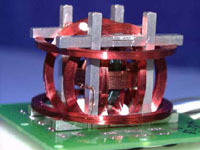 |
| Triaxial fluxgate magnetometer assembly |
The fluxgate sensors each consist of two single ring-core sensors measuring the magnetic field in the X- and Y-directions. The magnetic field in the Z-direction is measured using a coil surrounding both the X- and Y- sensors. The side length of the cuboid sensor triad is approximately 50 mm.
Sensor Electronics
The sensor electronics generates an alternating current with a frequency of ~9.6 kHz which is applied to the excitation coils in the sensors and drives the soft magnetic core material deep into positive and negative saturation. The external magnetic field distorts the symmetry of the magnetic flux and generates even harmonics of the drive frequency in the sense coils with an amplitude proportional to the field strength. The induced voltage in the sense coil is digitised immediately after preamplification at four times the excitation frequency.
A feedback field is used to increase the overall linearity and stability of the magnetometer. It is supplied to all sensor elements by a separate pair of Helmholtz coils per sensor axis. The current in each feedback coil pair is controlled by a 12-bit digital to analogue converter.
Sense and feedback signals are continuously transmitted to the digital processing unit, which calculates the magnetic field values with a resolution of 24 bits by scaling and summing the received data. The appropriate dynamic range is defined by selecting 16 of the calculated 24 bits for transmission.
The measurement range can be modified by telecommand to have a value between ± 32.8 nT and ± 8388.6 nT, with a corresponding digital resolution between 1 pT and 128 pT. The default range will be ± 262.1 nT with a resolution of 8 pT. A magnetic field of ± 10 000 nT can be independently applied to each sensor axis via additional 12-bit digital to analogue converters for compensation of any static stray field.
Data Processing Unit
The Data Processing Unit (DPU) controls the two sensors and the spacecraft interface of the experiment and performs internal data handling, including sampling, pre-processing, compression, and frame generation. The core of the DPU is a radiation-hardened microcontroller, which was specially developed for space systems embedded control. The controlling logic for the DPU, the sensor interfaces, the address decoder, the clock generator, the reset logic and the instrument spacecraft interface (a standard ESA OBDH interface) are implemented in a Field Programmable Gate Array.
Operating Modes
During nominal operations, both MAG sensors are operated simultaneously so that it is possible to separate static and varying spacecraft stray fields from the ambient magnetic field. A magnetic field time series without data gaps is essential to meet the scientific objectives of the experiment. The MAG instrument offers four science and five calibration modes
| MAG Science Modes | |||
| Instrument Mode | Sensors in Operation | Data Rate | |
| Solar Wind One | MAGOS and MAGIS | 1 Hz | |
| Solar Wind Two | MAGOS or MAGIS | 2 Hz | |
| Pericentre One | MAGOS and MAGIS | 4 Hz | |
| Pericentre Two | MAGOS or MAGIS | 64 Hz | |
In calibration mode one, feedback and sense values, which are produced in the sensor electronics and normally summed in the DPU, are transmitted separately. This mode is used for on-ground calibration and is not necessary in nominal flight operations. In calibration modes two to four, the feedback and calibration DACs of the sensor electronics are supplied with pre-programmed values. This is done statically in mode two and dynamically in modes three and four. Operating MAG in one of these calibration modes can perform a complete instrument check. In calibration mode five (Burst Mode), data is transmitted at the instrument's highest internal raw data rate, where both sensors operate at 128 Hz. This mode is used for screening of stray fields varying at rates up to 60 Hz and to study lightning in the atmosphere of Venus.
Flight Operations
The MAG instrument takes measurements over the entire orbit. MAG is operating primarily in an autonomous mode, requiring little or no commanding. Commands are required to initiate in-flight calibration sequences, to optimise variables for in-flight pre-processing (for example, coefficients for digital filtering), to command the number of operating sensors (MAGIS and MAGOS, MAGIS alone or MAGOS alone) and to switch in and out of pericentre mode. Most commands are scheduled, with real time commanding required only in response to unexpected events.
After
The MAG boom was deployed only 9 days after launch on 18 November 2005 to enable evaluation of stray fields in the 'science position' of the outer sensor during the cruise phase.
Science Data Processing
The processing of the raw instrument data includes the following steps:
- Transformation of raw data into field values using pre- and in-flight calibration results
- Subtraction of DC and AC spacecraft fields
- Correction of the transfer function of each sensor
- Production of a standard resolution set of data merged with spacecraft fields, timing corrections, orbit and attitude information
- Creation of a parameter file, containing instrument status (selected range, housekeeping data), offsets, spacecraft fields, timing corrections, and orbit and attitude information for use in reducing high-resolution data
In-Flight Calibration
Statistical methods, using time series of solar wind measurements, are used to determine the offset field at the magnetic field sensors, including instrument inherent offset and spacecraft static field. As a large part of the orbit around Venus is in the solar wind, these data can be used for statistical offset determination. If excessive static offset is detected, supplying suitable values to the 12-bit compensation DACs enables it to be compensated. The maximum possible compensation field is ± 10 000 nT along each of the sensor axes. A front to end health check is possible by generating artificial fields using the 12-bit compensation DACs and Helmholtz coils.
PFS: Planetary Fourier Spectrometer
The Planetary Fourier Spectrometer (PFS) is an infrared spectrometer optimised for atmospheric studies and covering the wavelength range 0.9 to 45 microns in two channels with a boundary at 5 microns. The spectral resolution of the instrument is better than 2 cm-1 . The instrument field of view FOV is about 1.6 degrees FWHM for the Short Wavelength (SW) channel and 2.8 degrees for the Long Wavelength (LW) channel. These fields of view correspond to a spatial resolution of seven kilometres for the SW channel and 13 kilometres for the LW channel when Venus is observed from a height of 250 kilometres (nominal height of the pericentre).
PFS is equipped with a pointing device, which enables it to receive incoming radiation from the surface of Venus or to perform calibration measurements by pointing to a reference black body of known temperature or to deep space.
The incident radiation arrives from the pointing device and is divided into two beams by a dichroic mirror and then filtered before being directed into the two interferometers. The interferometers are of the double pendulum type and are positioned with their planes of operation one above the other so that a single motor can be used to move both pendulums. An optical reference channel controls the pendulum motion by passing light from a laser diode through the same optics as the radiation that is being analysed. The reference channel also generates the sampling signal for the analogue to digital converters that process the detector signals, triggering one sample for each 150 nm of retro-reflector motion. The interferometers are extremely sensitive to optomechanical distortions and the interferometer module must be very rigid and thermally stable to minimise these effects.
| Summary of PFS Characteristics | ||
| Short Wavelength Channel | Long Wavelength Channel | |
| General | ||
| Spectral range (µm) | 0.9 - 5.0 | 5.0 - 45 |
| Spectral range (cm-1) | 2000 - 11 100 | 222 - 2000 |
| Spectral resolution (cm-1) | 1.5 | 1.5 |
| Field of view (rad) | 0.035 | 0.07 |
| Detectors | ||
| Type | Photoconductor | Pyroelectric |
| Material | Lead selenide (PbSe)/ Lead sulphide (PbS) sandwich | Lithium tantalate (LiTaO3) |
| Operating temperature (K) | 200 - 220 | 290 |
| Interferometer | ||
| Type | Double pendulum | |
| Reflecting elements | Cubic corner reflectors | |
| Beam splitter | Calcium Fluoride (CaF2) | Caesium Iodide (CaI) |
| Maximum optical path difference (mm) | 5 | 5 |
| Reference source | Laser diode | |
| Collecting optics | ||
| Type | Parabolic mirror | |
| Diameter (mm) | 49 | 38 |
| Focal length (mm) | 20 | 20 |
| Coating | Gold | |
| Channel separator | Thallium bromide/iodide | |
| Interferogram | ||
| Type | Two sided | |
| Sampling number | 16 384 | 4096 |
| Sampling step (nm) | 608 | 2432 |
| Dynamic range | ± 215 | |
The instrument is able to perform real time Fast Fourier Transform computations in order to select the spectral range of interest for data transmission to Earth.
The PFS instrument design is based on that flown on Mars Express, modified to optimise performance for the Venus Express mission.
SPICAV: Spectroscopy for Investigation of Characteristics of the Atmosphere of Venus
SPICAV (Spectroscopy for Investigation of Characteristics of the Atmosphere of Venus) is an imaging spectrometer for ultraviolet and infrared radiation. SPICAV is derived from the SPICAM instrument flown on Mars Express, which was equipped with two channels, one for ultraviolet wavelengths and one for infrared. SPICAV retains these channels, SPICAV-UV (SUV) for ultraviolet and SPICAV-IR for infrared and adds an additional channel (SOIR, Solar Occultation at Infrared), to observe the Sun through Venus's atmosphere at longer infrared wavelengths (2.3 µm - 4.2 µm).
| SPICAV Channels | |||
| Ultraviolet (SUV) | Infrared (SIR) | SOIR | |
| Spectral range (µm) | 0.11 - 0.31 | 0.7 - 1.7 | 2.3 - 4.2 |
| Spectral resolution | 0.8 nm | 0.5 - 1 nm | 0.2 - 0.5 cm-1 |
| Spectral resolving power (λ/Δλ) | ~300 | ~1300 | ~15 000 |
| Field of View (rad) | 55 × 8.7 | 0.2 / pixel | 0.3 - 3 |
Operational Modes
The operational modes of SPICAV are Test mode (ground use only), Star mode, Sun mode, Limb mode and Nadir mode. The operational modes are derived from the scientific objectives and the related spacecraft attitudes.
| SPICAV Operating Modes | |
| Nadir mode | Used during spacecraft nominal nadir observation mode. SUV and SIR observing. |
| Star mode | Requires dedicated spacecraft attitude. SUV observing. |
| Limb mode | Requires dedicated spacecraft attitude. SUV and SIR observing. |
| Sun mode | Requires dedicated spacecraft attitude. SUV, SIR and SOIR observing. |
In Nadir mode, the instrument points directly at the planet and analyses solar radiation that has travelled through the atmosphere after being reflected from the planet surface. In Star or Sun mode, the instrument points tangentially through the atmosphere towards a star, or the Sun, which is observed through the atmosphere as it rises or sets. The instrument then analyses the light once components of it have been absorbed by the atmosphere. In limb pointing mode, the instrument points across the atmosphere, as during Star mode, but without a target star, and the instrument can analyse the atmospheric glow.
Ultraviolet Channel
The SPICAV ultraviolet channel (SUV) is based around a holographic diffraction grating.
| Ultraviolet Channel Characteristics | |
| Usable dimensions of primary mirror | 40×40 mm |
| Slit width | 0.05 and 0.5 mm |
| Slit length | 6.6 mm |
| Wavelength range | 118-320 nm |
| Spectral dispersion | 0.55 nm/pixel |
| Transmission of optics (mirror + grating) | 30% |
| Pointing accuracy | better than 0.2° |
| Detector | Intensified CCD |
| CCD dimensions | 384×288 pixels |
| CCD pixel size | 23×23 μm |
| Field of view of one pixel | 40"×40" |
The first optical element in the UV channel is an off-axis parabolic mirror, which collects the incident light entering through either the nadir or solar aperture and focuses it.
| Ultraviolet Channel Mirror Characteristics | |
| Off axis portion of parent with origin at centre of parent paraboloid |
x = 30 mm y = 0 mm z = 1.875 mm |
| Focal length | 118.125 mm |
| Dimensions | 44×52 mm |
| Entrance pupil dimensions | 40×40 mm |
| Usable field of view | 1° × 3.16° |
| Material | Aluminium |
| Coating | Magnesium Fluoride, MgF2 |
In the focal plane of the mirror, there is a slit, which can be moved in and out of the field of view by a mechanical actuator, providing two configurations:
- Slit absent, for observation of stellar occultations with a field of view of 1° × 3.16°
- Slit present, for the observation of extended sources
The slit has two parts, with two different widths, to give different flux resolutions.
The focal plane is the entrance of the spectrometer, a holographic concave grating, which collects the incoming light and directs it to the detector block.
| Ultraviolet Channel Grating Characteristics | |
| Type | Holographic |
| Shape | Toroidal |
| Coating | Magnesium Fluoride, MgF2 |
| Dimensions | 50×50 mm |
| Radius of curvature | 148.94 mm |
| Number of grooves per millimetre | 280 |
| Blaze wavelength | 170 nm |
| Incident angle | ~6.5° |
The detection block consists of a CCD detector equipped with an image intensifier tube. The spectrum of a single source point in the focal plane is dispersed along the lines of the CCD. The usable spectral band is 118 to 320 nm, chosen so as to offer good resolution (~1 nm) for stellar observations and to cover the CO2 and O3 bands. The lower wavelength was selected to be just below the Lyman α wavelength and the upper wavelength was chosen to reject visible light. The quantum efficiency of the photocathode is zero beyond 320 nm and the detector is therefore solar blind. The detector has a large dynamic range - by varying the gain of the image intensifier, the spectrometer can perform individual photon counting and deal with very high input intensities.
To observe the Sun, a five millimetre diameter mirror is positioned so as to reflect the light from the Sun via a dedicated entrance aperture onto the parabolic mirror.
Infrared Channel
The SPICAV infrared channel (SIR) is based around a scanning acousto-optical tunable filter (AOTF).
| Infrared Channel Characteristics | |
| Diameter of primary lens | 12 mm |
| Field of view | 2° (6×10⁻⁴ sr) |
| Slit width | 1 mm |
| Wavelength range | 0.25 - 1.7 μm |
| Sampling per pixel | 0.45 nm to 1.12 nm |
| Transmission of optics | 25% |
| Detector | Hybrid Si/InGaAs PIN photodiode (2.4×2.4 mm) |
| Resolution at nadir | 5×5 km |
The entrance optics comprise a lens telescope with a diameter of twelve millimetres and a collimator lens, which collect the incoming radiation and direct it onto the AOTF.
The AOTF consists of a tellurium oxide (TeO2) crystal to which an acoustic wave is applied. The acoustic wave propagating in the crystal causes it to act in a similar way to a diffraction grating. A radio-frequency synthesizer drives a piezo-electric crystal attached to the TeO2 crystal to produce the wave. The frequency of excitation determines the wavelength of the acoustic waves and hence the select wavelength of the AOTF. The frequency range of the synthesizer corresponds to an AOTF passband of 0.25 - 1.7 μm.
The two output beams from the AOTF are collimated by another lens and detected by two hybrid silicon/indium gallium arsenide PIN photodiodes.
When observing the Sun, light entering via the dedicated aperture in the instrument baseplate is directed by an optical fibre and a small mirror into the SIR channel main entrance.
SOIR Channel
The Solar Occultation at Infrared (SOIR) channel is also based around an acousto-optical tunable filter (AOTF).
| SOIR optical components | |
| Entry telescope | Newton type, focal length 180 mm, 35 mm × 50 mm parabolic mirror |
| Field of view diaphragm | 0.5 mm × 4 mm, nickel |
| Folding and polarizing prism | Tellurium oxide, 10 mm × 10 mm |
| Lens | Zinc selenide, focal length 35 mm, diameter 15 mm, R1 = 31.5 mm, R2 = 79.8 mm |
| AOTF | see table below |
| Lens | Zinc selenide , focal length 35 mm, diameter 15 mm, R1 = 79.8 mm, R2 = 31.5 mm |
| Folding and polarizing prism | Tellurium oxide, 10 mm × 10 mm |
| Slit | 0.06 mm × 3 mm, nickel |
| Main mirror | focal length 375 mm, 70 mm × 100 mm, off-axis 8° parabolic |
| Diffraction grating | blaze angle 63.42° |
| Folding mirror | |
| SOIR AOTF Characteristics | |||
| Wavelength (nm) | Excitation frequency (MHz) | Bandwidth (nm) | Angular aperture (°) |
| 2500 | 27.303 | 11.65 | 7 |
| 3172 | 21.971 | 18.87 | 8.2 |
| 4500 | 15.33 | 38.18 | 10.1 |
The SOIR optics pass the filtered and dispersed light to a photo-voltaic mercury cadmium telluride (HgCdTe) detector contained in an Integrated Detector Dewar Cooler Assembly (IDDCA). The detector is arranged as a 320×256 array of 30 μm square pixels. The IDDCA is equipped with a 0.4 Watt Stirling cycle rotary microcooler.
VeRa: Venus Radio Science
The Venus Radio Science experiment (VeRa) performs the following experiments:
- Radio sounding of the neutral Venus atmosphere (occultation experiment) to derive vertical density, pressure and temperature profiles as a function of height, with a height resolution better than 100 metres
- Radio sounding of the ionosphere of Venus (occultation experiment) to derive vertical ionospheric electron density profiles and to derive a description of the global behaviour of the ionosphere through its diurnal and seasonal variations and its dependence on solar wind conditions
- Determination of the dielectric and scattering properties of the surface of Venus in specific target areas using a bistatic radar experiment
- Radio sounding of the solar corona during the inferior and superior conjunctions of Venus
The radio links of the spacecraft communications system are used for these investigations. A simultaneous and coherent dual-frequency downlink at X-band and S-band via the High Gain Antenna (HGA) is required to separate the effects of the classical Doppler shift due to the motion of the spacecraft relative to the Earth and the effects caused by the propagation of the signals through the various dispersive media in the signal path.
The experiment relies on the observation of the phase, amplitude, polarisation and propagation times of radio signals transmitted from the spacecraft and received by ground stations on Earth. The radio signals are affected by the medium through which the signals propagate (atmospheres, ionospheres, interplanetary medium, solar corona), by the gravitational influence of the planet on the spacecraft and finally by the performance of the various systems involved both on the spacecraft and on ground.
Radio sounding of the atmosphere and ionosphere
The sounding of the neutral and ionised atmosphere is performed in the periods just before the spacecraft enters occultation by the planet. The High Gain Antenna is pointed toward the Earth before the approach to occultation. The radio link is a two-way dual-frequency downlink with unmodulated carriers. The radio link passes through a vertical swath of the ionosphere and atmosphere.
Bistatic radar investigation of planetary surface
A bistatic radar configuration is distinguished from a monostatic configuration by the spatial separation of the transmitter (the spacecraft) and the receiver (ground station). The HGA is inertially pointed toward the surface of Venus and an X-band signal without modulation is transmitted. Several passes above specific targets are made. The reflected and/or scattered signal is received by the ground station, for which the preferred choice is the Deep Space Network because of the higher signal to noise ratio that is available.
Solar corona sounding
Solar corona sounding is performed when Venus is within 10° elongation either side of the solar disk. The operational radio link for the sounding of the solar corona is the two-way dual-frequency radio with an S-band uplink. The experiment can be performed whenever the spacecraft is being tracked for data return.
Space segment
The VeRa experiment will make use of the radio transponder and antenna carried by the spacecraft for communication with Earth. Frequency, amplitude and polarisation information can be extracted from the received radio signal by the ground station.
Uplinks are provided either at X-band, for routine operations, or at S-band for coronal sounding. In the coherent two-way mode the received frequency is used to derive the downlink frequencies by using the constant transponder ratios 880/221 and 240/221 for X-band and S-band downlink, respectively.
The spacecraft transmits a dual-frequency downlink at X-band and S-band simultaneously and phase coherently via the HGA. Typically, the X-band and S-band frequencies are related by a factor of 11/3. If an uplink exists, the downlinks are also coherent with the uplink in their respective transponding ratios.
The dual-frequency downlink is used to separate the classical Doppler shift, due to the relative motion of the spacecraft and the ground station, from the dispersive media effects, due to the propagation of the radio waves through the ionospheres and interplanetary medium. Both frequencies are transmitted via the High Gain Antenna to maximise the signal-to-noise ratio.
The two-way dual-frequency radio link is used for coronal investigations. The radio link benefits from the superior frequency stability of the ground station afforded by the use of hydrogen masers as reference sources.
Ground segment
The New Norcia ground station is used to monitor the spacecraft. A tracking pass consists of typically eight to ten hours of visibility. Measurements of the spacecraft range and carrier Doppler shift can be obtained whenever the spacecraft is visible. In the two-way mode the ground station transmits an uplink radio signal at S-band or X-band and receives the dual-frequency simultaneous downlink at X-band and S-band. The information about signal amplitude, received frequency and polarization is extracted and stored together with the time of receipt.
The ground stations employ a hydrogen maser frequency standard to achieve a frequency stability in the order of 10-15 over long integration time (> 100 seconds). This stability is required for precise two-way tracking in order to achieve velocity accuracy better than 0.1 mms-1 at one second integration time.
VIRTIS: Visible and Infrared Thermal Imaging Spectrometer
VIRTIS is an imaging spectrometer that combines three observing channels in one instrument. Two of the channels are devoted to spectral mapping (mapper optical subsystem), while the third channel is devoted to spectroscopy (high resolution optical subsystem).
| Summary of VIRTIS Characteristics | |||
| Mapper subsystem | High resolution subsystem | ||
| Visible channel | Infrared channel | Infrared channel | |
| Spectral range (µm) | 0.25 - 1.0 | 1 - 5 | 2 - 5 |
| Maximum Spectral resolution (nm) | ~2 | ~10 | ~3 |
| Spectral resolving power (λ/Δλ) | 100 - 200 | 100 - 200 | 1000 - 2000 |
| Field of view (mrad) - "pushbroom" mode |
64×0.25 | 64×0.25 | 0.45×2.25 |
| Field of view (mrad) - scan mode |
64×64 | 64×64 | - |
| Spatial resolution (mrad) | 1.0 (default) 0.25 (high) |
1.0 (default) 0.25 (high) |
1.0 |
The optical subsystems are housed inside a common structure - the cold box - cooled to 130K by a radiative surface supported on a truss having low thermal conductivity. On the pallet supporting the truss, two sets of electronics and two cryogenic coolers for the detectors are mounted. The cold box is rigidly mounted on the pallet but thermally isolated from it. The pallet and cold box together form the optics module, which is mounted inside the spacecraft arranged so that the observing axes of the optical subsystems are normal to the nadir pointing wall of the spacecraft. The electronics module, containing the digital electronics and power supply, is mounted separately.
Mapping channel
The mapping channel optical system is a Shafer telescope matched through a slit to an Offner grating spectrometer. The Shafer telescope consists of five aluminium mirrors mounted on an aluminium optical bench. The primary mirror is a scanning mirror driven by a torque motor. The Offner spectrometer consists of a relay mirror and a spherical convex diffraction grating, both made of glass.
The mapping channel utilizes a silicon charge coupled device (CCD) to detect wavelengths from 0.25 micron to 1 micron and a mercury cadmium telluride (HgCdTe) infrared focal plane array (IRFPA) to detect from 0.95 micron to 5 microns. The IRFPA is cooled to 70K by a Stirling cycle cooler. The cold tip of the cooler is connected to the IRFPA by copper thermal straps. The CCD is operated at 155K and is mounted directly on the spectrometer.
High resolution channel
The high resolution channel is an echelle spectrometer. The incident light is collected by an off-axis parabolic mirror and then collimated by another off-axis parabola before entering a cross-dispersion prism. After exiting the prism, the light is diffracted by a flat reflection grating, which disperses the light in a direction perpendicular to the prism dispersion. The low groove density grating is the echelle element of the spectrometer and achieves very high spectral resolution by separating orders seven through sixteen across a two-dimensional detector array.
The high-resolution channel employs a HgCdTe IRFPA to perform detection from 2 to 5 microns. The detector is cooled to 70K by a Stirling cycle cooler.
VMC: Venus Monitoring Camera
The VMC camera consists of one unit that houses the optics, CCD and readout electronics (CRE), digital processing unit (DPU), and power converter (POC). The camera has four separate objective lens systems, each of which images a different, filter selected wavelength range onto a quadrant of a common 1032 × 1024 pixel Charge Coupled Device (CCD) detector. The field of view of the camera is 17.5 degrees (0.3 radians) and the image scale is 0.74 milliradians per pixel.
| VMC filter parameters | ||||
| Filter | Centre wavelength (μm) |
Bandwidth (μm, FWHP) |
Observation goals | |
| Dayside | Nightside | |||
| F3 (UV) | 0.365 | 0.04 | Unknown UV absorber | O2 nightglow at 0.356 & 0.376 μm |
| F4 (VIS) | 0.513 | 0.05 | Visible light imaging | O2 nightglow at 0.376 μm |
| F5 (NIR1) | 0.965 | 0.07 | H2O at ~70 km | H2O below 70 km, clouds |
| F6 (NIR2) | 1.01 | 0.02 | H2O below 70 km | Surface, clouds |
| VMC optical design | ||||
| VMC channel | F4 (VIS) | F5 (NIR1) | F6 (NIR2) | F3 (UV) |
| Focal length | 13 mm | 13 mm | 13 mm | 13 mm |
| F-number | 5 | 5 | 5 | 7 |
| Optics | Three identical Cooke triplets + curved front filter | Separate Cooke triplet + curved front filter | ||