
Hubble instruments
Introduction
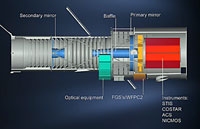 |
|
On board Hubble all the instruments are placed in the so-called radial instrument bay (in red) and axial bay (in yellow). |
Right from the very beginning Hubble has been designed to be a new type of mission - a permanent space-based observatory that could be regularly visited by the Space Shuttle and serviced. At the same time astronauts would be able to replace or upgrade outdated science instruments.
Hubble's complement of science instruments currently includes one camera, three imaging spectrographs, and fine guidance sensors (primarily used for astrometric observations).
Two new instruments are planned to be installed during the Servicing Mission 4: the Cosmic Origins Spectrograph (COS) and the Wide Field camera 3 (WFC3). The latter will replace the WFPC2, and COS will be installed in the instrument bay currently occupied by COSTAR, as this set of corrector mirrors for the first generation instruments is no longer required.
Hubble's position above the Earth's atmosphere means that these science instruments can produce high resolution images of astronomical objects. Ground-based telescopes can seldom provide resolution better than 0.5-1.0 arc-seconds, except for very short times under the very best observing conditions. Hubble's resolution is about 5-10 times better, or 0.05-0.1 arc-seconds.
Present Instruments
| WFC3 | Wide Field Camera 3 (installed during SM4) |
| COS | Cosmic Origins Spectrograph (installed during SM4) |
| ACS | Advanced Camera for Surveys (installed during SM3B) |
| STIS | Space Telescope Imaging Spectrograph (installed during SM2) |
| NICMOS | Near Infrared Camera and Multi-Object Spectrograph (installed during SM2) |
| FGS | Fine Guidance Sensors (astrometry) (part of the original complement; individual units replaced during SM2, SM3A and SM4) |
Former Instruments
| WFPC2 | Wide Field and Planetary Camera 2 (installed during SM1; removed during SM4) |
| COSTAR | Corrective Optics Space Telescope Axial Replacement (installed during SM1; removed during SM3B) |
| FOC | Faint Object Camera (one of the original complement of instruments; replaced by ACS during SM3B) |
| FOS | Faint Object Spectrograph (one of the original complement of instruments; replaced by NICMOS during SM2) |
| GHRS | Goddard High Resolution Spectrograph (one of the original complement of instruments; replaced by STIS during SM2) |
| HSP | High Speed Photometer(one of the original complement of instruments; replaced by COSTAR during SM1) |
| WFPC1 | Wide Field and Planetary Camera 1 (one of the original complement of instruments; replaced by WFPC2 during SM1) |
ACS - Advanced Camera for Surveys
A new digital camera to extend Hubble's vision
 |
|
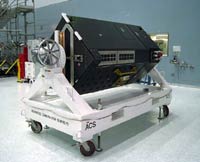
ACS - Hubble's newest scientific instrument on display in a clean-room before launch. |
The Advanced Camera for Surveys (ACS) replaced Hubble's Faint Object Camera during SM3B. Its wavelength range extends from the ultraviolet, through the visible and out to the near-infrared. ACS is a so-called third generation Hubble instrument. Its wide field of view is nearly twice that of Hubble's former workhorse camera, WFPC2, and with its superb image quality and high sensitivity, ACS has increased Hubble's potential for new discoveries by a factor of ten. The name, Advanced Camera for Surveys, comes from its particular ability to map large areas of the sky in great detail. ACS can also perform spectroscopy with a special optical tool called a 'grism'.
Three sub-instruments make up ACS
 |
|
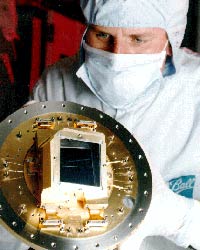
A look into one of ACS's most delicate and crucial parts - the CCD camera. |
Wide Field Camera (WFC)
The Wide Field Camera is a high efficiency, wide field, optical and near-infrared camera. This space eye is optimised to hunt for galaxies and galaxy clusters in the remote and ancient Universe, at a time when our Cosmos was very young. The distribution in space of these distant objects will enable scientists to investigate just how the Universe evolved.
High Resolution Camera (HRC)
Another important sub-instrument is the High Resolution Camera. This camera is designed to take extremely detailed pictures (high resolution) of the light from the centres of galaxies with massive black holes, as well as of ordinary galaxies, star clusters and gaseous nebulae, where extraterrestrial planetary systems may be hidden. The instrument includes a coronograph, capable of improving Hubble's contrast near bright objects by about a factor of 10.
Solar Blind Camera (SBC)
Finally, the Solar Blind Camera blocks visible light to allow faint ultraviolet radiation to be discerned. Among other things, it will be used to study weather patterns on other planets and aurorae on Jupiter.
WFPC2 - Wide Field Planetary Camera 2
The Wide Field and Planetary Camera 2 (WFPC2) was Hubble's workhorse camera for many years. It records images through a selection of 48 colour filters covering a spectral range from far-ultraviolet to visible and near-infrared wavelengths. The 'heart' of WFPC2 consists of an L-shaped trio of wide-field sensors and a smaller, high resolution (Planetary) Camera placed at the square's remaining corner.
 |
 |
|
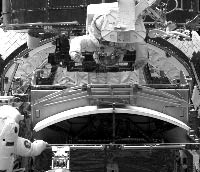
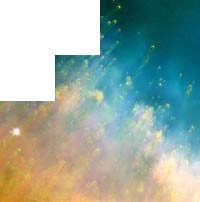
Left: WFPC2 is being readied for insertion into Hubble during the First Servicing Mission. Right: A typical image taken with the WFPC2 camera onboard Hubble. The four CCD chips are so close that the seams between them are difficult to see. They are all 800×800 pixels - also the smaller PC (Planetary Camera) chip in the upper left corner. |
|
WFPC2 has produced most of the stunning images that have been released as public outreach images over the years. Its resolution and excellent quality are some of the reasons that WFPC2 has been the most used instrument in the first 13 years of Hubble's life.
| WFPC2 Facts | |
| Instrument type | Camera |
| Weight | 281 kg |
| Dimensions | 0.8 m × 2.2 m × 2.0 m |
| Field of View | 2.7 arcminutes |
| Wavelength Range | 1200 - 10 000 Ångström |
STIS - Space Telescope Imaging Spectrograph
 |
|
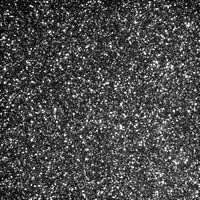
A STIS image of stars in the elliptical galaxy NGC 205 together with stars in the foreground from our own Milky Way. Image: STIS parallel program. Image reduction: Phil Plait. |
The Space Telescope Imaging Spectrograph (STIS) is a versatile "combi-instrument" taking advantage of modern technologies. It combines a camera with a spectrograph, and covers a wide range of wavelengths from the near-infrared region into the ultraviolet. A spectrograph spreads out the light gathered by a telescope so that it can be analyzed to determine such properties of celestial objects as chemical composition and abundances, temperature, radial velocity, rotational velocity, and magnetic fields. Its spectrograph can be switched between two different modes of usage:
- So-called "long slit spectroscopy" where spectra of many different points across an object are obtained simultaneously
- So-called "echelle spectroscopy" where the spectrum of one object is spread over the detector giving better wavelength resolution in a single exposure
STIS also has a so-called coronograph which can block light from bright objects, and in this way enables investigations of nearby fainter objects.
 |
|
|
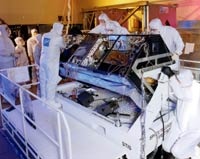
The Space Telescope Imaging Spectrograph (STIS). |
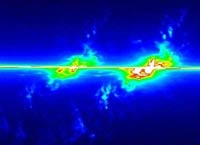
A STIS spectrum of the galaxy NGC 4151 revealing that gas is flowing out of a black hole in its centre. |
| STIS Facts | |||||
| Instrument type | Camera and Spectrograph | ||||
| Weight | 318 kg | ||||
| Dimensions | 2.2 m × 0.9 m × 0.9 m | ||||
| Field of View |
|
||||
| Wavelength Range | 1150 - 10 000 Ångström | ||||
NICMOS - Near Infrared Camera and Multi-Object Spectrograph
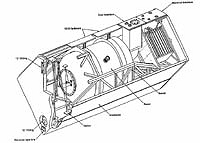
The Near Infrared Camera and Multi-Object Spectrometer (NICMOS) is an instrument providing the capability for infrared imaging and spectroscopic observations of astronomical targets. NICMOS detects light with wavelengths between 8000 to 25 000 Ångström. These wavelengths are infrared and thus invisible to our human eyes.
NICMOS was revived by an electrical cooler installed during Servicing Mission 3B and is now again producing world class science results.
 |
 |
|
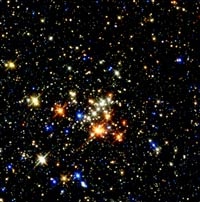
Left: The NICMOS instrument onboard Hubble. Right: Typical image taken with NICMOS. It shows a gigantic star cluster in the center of our milky way. NICMOS is the only Hubble instrument which - due to its infrared capabilities - is able to look through the heavy clouds of dust and gas in these central regions. |
|
| NICMOS Facts | |||||||
| Instrument type | Camera and Spectrograph | ||||||
| Weight | 370 kg | ||||||
| Dimensions | 2.2 m × 0.89 m × 0.89 m | ||||||
| Field of View |
|
||||||
| Wavelength Range | 8000 - 25 000 Ångström | ||||||
COS - Cosmic Origins Spectrograph
 |
|
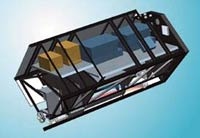
Cosmic Origins Spectrograph (COS). Credit: Ball Aerospace & Technologies |
After its installation during Servicing Mission 4, the Cosmic Origins Spectrograph (COS) has restored spectroscopy to Hubble's scientific arsenal, while providing unique new capabilities that will take the telescope into exciting and uncharted waters. With the installation of COS and the Wide Field Camera 3, Hubble has become a space observatory outfitted with a full suite of ground-breaking scientific instruments for the first time in fifteen years.
Overview
COS studies the large-scale structure of the Universe and the formation and evolution of galaxies, stars and planets. It helps determining the formation of elements considered essential for life, such as carbon and iron. As a spectrograph, COS does not capture the kinds of images that have made Hubble famous. Rather performs spectroscopy, the science of breaking up light into its individual components. Any object that absorbs or emits light can be studied with a spectrograph to determine its temperature, density, chemical composition and velocity.
Technology
COS has two channels, the Far Ultraviolet (FUV) channel covering wavelengths from 115 to 177 nanometres and the Near Ultraviolet (NUV) channel covering wavelengths from 175 to 300 nanometres. The light-sensing detectors of both channels use micro-channel plates to amplify the incoming signal prior to detection. A key feature of COS is it maximised efficiency or throughput. Every bounce of a light beam along its path leads to a loss in signal strength. COS has a single bounce when the beam is fed into the appropriate channel. The table below reveals some of the key parameters for the instrument.
|
COS Facts |
||
| Parameter | FUV Channel | NUV Channel |
| Spectral range (nm) | 115-205 | 170-320 |
| Spectral Resolution | 16000-24000 med. 2000-3000 low |
16000-24000 med. 2000-3000 low |
| Detector Type | X-delay line | NUV MAMA |
| Detector array size (pixels) | 32768 × 1024 | 1024 × 1024 |
| Gratings | 3 | 4 |
| Discovery factor over previous HST instruments | 30× over STIS | 2× over STIS |
Science Goals
The aims of the instrument are organized into three broad categories, united by the theme of cosmic origins:
- Origin of large-scale structure and the Intergalactic Medium (IGM)
- Formation, evolution, and ages of galaxies
- Origins of stellar and planetary systems
Development
COS was built at the Center for Astrophysics and Space Astronomy at the University of Colorado; the team is led by James Green. The prime contractor for the design and manufacture of COS was Ball Aerospace & Technologies Corporation in Boulder, CO. Development of the FUV detector was at the University of California-Berkeley.
Links
- Fact Sheet (PDF file)
WFC3 - Wide Field Camera 3
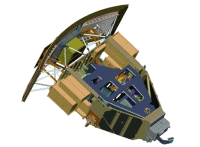 |
| Wide Field Camera 3 (WFC3) Credit: NASA/STScI |
The installation of the new Wide Field Camera 3 (WFC3) during Servicing Mission 4 continued the pioneering tradition of previous Hubble cameras while incorporating critical improvements, clearing the way for a new voyage of discovery. Together with the new Cosmic Origins Spectrograph (COS), WFC3 leads the way to many more exciting scientific discoveries.
Overview
WFC3 is greatly enhancing the observational capabilities of Hubble. Compared to its predecessor, it offers improved resolution over a wider field of view. In terms of overall performance, it offers comparable performance to the ACS instrument, but over a wider range of wavelengths. The combination of these two elements – enhanced field of view and broader waveband – makes for a powerful instrument.
Technology
The instrument has two channels one for ultraviolet and visible light (UVIS) and the other for near infrared (NIR). In both cases, the detectors are the solid-state devices. For the UVIS channel a silicon-based CCD, similar to those found in digital cameras, is used. The similarities end there, however, as the CCD on WFC3 is a 16 megapixel, high sensitivity, low noise array. These high performance chips are made by e2V, a UK based company, who specialise in the fabrication of large, high-performance, detector arrays for use in space. For the NIR channel, a 1 megapixel array made from the exotic material of mercuric cadmium telluride (HgCdTe) is used. The combination of these two technologies gives WFC3 its performance over a broad range of wavelengths. The table below reveals some of the key parameters for the instrument.
|
WFC3 Facts |
||
| Parameter | UVIS Channel | NIR Channel |
| Spectral range (nm) | 200-1000 | 850-1700 |
| Detector type | Si | HgCdTe |
| Detector array size (pixels) | 4096 × 4096 | 1024 × 1024 |
| Field of view (arcseconds) | 160 × 160 | 123 × 137 |
| Pixel size (arcsec) | 0.04 | 0.13 |
| Filter complement | 62 | 15 |
Science Goals
Observations in the ultraviolet and visible range will aim to address:
- Stellar archaeology
- The distribution of galaxies at high redshift
Observations in the infrared range will aim to address:
- The highest redshift galaxies
- Water and ice on Mars and planetary moons
Panchromatic:
- Galactic evolution
- Star birth, death and interstellar medium
Development
The Hubble Program at the Goddard Space Flight Center, the Space Telescope Science Institute in Baltimore and Ball Aerospace & Technologies Corporation in Boulder jointly developed the WFC3. A community-based Science Oversight Committee, led by Prof. Robert O'Connell of the University of Virginia, provided scientific guidance for the development.
Links
- Fact Sheet (PDF file)
FGS - Fine Guidance Sensors
 |
|
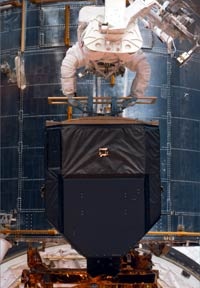
One of the three Fine Guidance Sensors photographed during Second Servicing Mission in 1997. |
Hubble has three Fine Guidance Sensors (FGS'es) onboard. Two are used to point and lock the telescope on the target, and the third can be used for position measurements - also known as astrometry. Because the FGS'es are so accurate, they can be used to measure stellar distances and also to investigate binary star systems. The three FGS'es are located at 90-degree intervals around the circumference of the telescope. Since Hubble needs very high pointing accuracy the FGS'es have been constructed as so-called interferometers that take advantage of the wavelike features of the in-coming starlight. So they can search for a wobble in the motion of nearby stars that could indicate the presence of a planetary companion, determine if certain stars really are double stars, measure the angular diameter of stars, galaxies, etc.
| FGS Facts | |
| Instrument type | Astrometric Interferometers |
| Weight | 220 kg |
| Dimensions | 0.5 m × 1.0 m × 1.6 m |
| Field of View | 69 arcminutes (only 5 × 5 arcseconds at any one time) |
| Wavelength Range | 4670 - 7000 Ångström |
| Resolution | 0.002 arcseconds |
COSTAR - Corrective Optics Space Telescope Axial Replacement
 |
 |
|
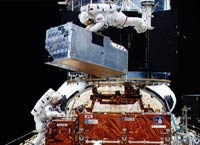
COSTAR being inserted into Hubble during the First Servicing Misson. |
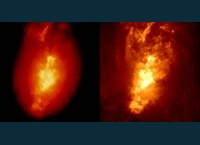
Two images taken of the same region before and after the correction of Hubble's aberration with COSTAR. |
COSTAR is not really a science instrument; it is a corrective optics package that displaced the High Speed Photometer (HSP) during Servicing Mission 1 in December 1993. COSTAR was designed to optically correct the effects of the primary mirror's aberration for three of the first generation of instruments aboard Hubble:
- Faint Object Camera (FOC)
- Faint Object Spectrograph (FOS)
- Goddard High Resolution Spectrograph (GHRS)
All the other instruments, installed since HST's initial deployment, were designed with their own corrective optics. When the FOC was replaced by the Advanced Camera for Surveys (ACS) during Servicing Mission 3B in March 2002, COSTAR had also fulfilled its task and was no longer needed. It will be replaced by the new Cosmic Origins Spectrograph (COS) instrument during the upcoming Servicing Mission 4.
| COSTAR Facts | |
| "Instrument" type | Corrective optics |
FOC - Faint Object Camera
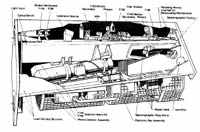
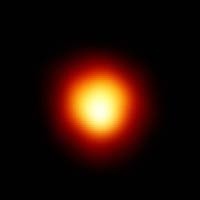
The Faint Object Camera (FOC) was built by the European Space Agency. It is an optical and ultraviolet camera which is able to count the individual rays of light (or light particles / photons) as they arrive. The resolution of FOC is stunning - more than seven times better than Hubble's famous WFPC2 camera.
 |
 |
|
Left: The FOC - Faint Object Camera onboard Hubble. Right: An image taken with FOC. This was, at the time of observation, the first direct image of a star. The star is Betelgeuse or Alpha Orionis. It is a red supergiant star marking the left shoulder of the winter constellation Orion the Hunter. This image was only made possible because of FOC's extremely high resolution. |
|
FOC has two complete detector systems, each producing an image on a phosphor screen that is 100 000 times brighter than the light received. A television camera then scans this phosphor image. This television camera is so sensitive that objects brighter than 21st magnitude must be dimmed by the camera's filter systems to avoid saturating the detectors.
| FOC Facts | |
| Instrument type | Camera |
| Field of View | "Low" resolution (f/48) - 22 arcseconds "Medium" resolution (f/96) - 11 arcseconds "High" resolution (f/288) - 3.6 arcseconds |
| Resolution | "Low" resolution (f/48) - 0.043 arcseconds "Medium" resolution (f/96) - 0.022 arcseconds "High" resolution (f/288) - 0.0072 arcseconds |
| Wavelength Range | 1220 - 5500 Ångström |
WFPC1 - Wide Field Planetary Camera 1
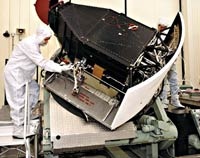
The Wide Field and Planetary Camera 1 (WFPC1) was the original camera installed onboard Hubble during the launch in 1990 and worked flawlessly. Before launch work had begun on the construction of the second generation camera, WFPC2. Due to the improper curvature of the main mirror a modification was built into WFPC2 to compensate for this problem.
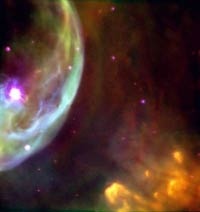
WFPC1 was exchanged with WFPC2 during the First Servicing Mission. WFPC1 made many remarkable results during its three years in space, although these were soon diminished by the stunning results pouring out of WFPC2 with the built-in optical correction.
 |
 |
|
Left: WFPC1 back on the ground again. Right: A typical image taken with WFPC1. Note that the stars seem somewhat more fuzzy than seen in images taken with WFPC2. |
|
| WFPC1 Facts | |||||
| Instrument type | Camera | ||||
| Field of View |
|
||||
| Resolution | 0.043 arcsecond (pixel size Planetary Camera) | ||||
| Wavelength Range | 1150 to 10 000 Ångström | ||||
FOS - Faint Object Spectrograph
 |
|
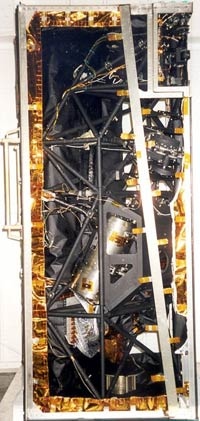
This picture of the Faint Object Spectrograph (FOS) was taken after the instrument was brought back to the Earth again. |
The Faint Object Spectrograph (FOS) was exchanged with STIS during the Second Servicing Mission and brought back to Earth. A spectrograph spreads out the light gathered by a telescope so that it can be analysed to determine such properties of celestial objects as chemical composition and abundances, temperature, radial velocity, rotational velocity, and magnetic fields.
FOS examined fainter objects than the GHRS, and could study these objects across a much wider spectral range. The FOS had two modes of operation - low resolution and high resolution. In low resolution mode it reached 26th magnitude in one hour with a resolving power of 250. At high resolution, the FOS reached only 22nd magnitude in an hour, but the resolving power was increased to 0.9 Ångström at 1200 Ångström.
| FOS Facts | |||||
| Instrument type | Spectrograph | ||||
| Resolution |
|
||||
| Wavelength Range | 1150 to 8500 Ångströms | ||||
GHRS - Goddard High Resolution Spectrograph
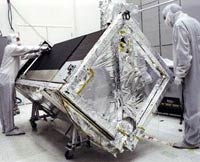
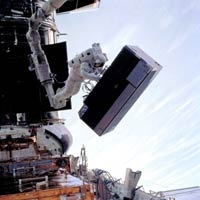
Goddard High Resolution Spectrograph (GHRS) was exchanged with NICMOS during the Second Servicing Mission.
 |
 |
|
GHRS being prepared for launch at Ball Aerospace & Technologies Corp. |
GHRS being removed during Servicing Mission 2. |
GHRS, like FOS and STIS, separated incoming light into its spectral components so that the composition, temperature, motion, and other chemical and physical properties of the objects could be analysed. GHRS contrasts with the FOS in that it concentrated entirely on UV spectroscopy and traded the extremely faint objects for the ability to analyse very fine spectral detail.
| GHRS Facts | |||||||
| Instrument type | Spectrograph | ||||||
| Resolution |
|
||||||
| Wavelength Range | 1050 to 3200 Ångström | ||||||
HSP - High Speed Photometer
 |
|
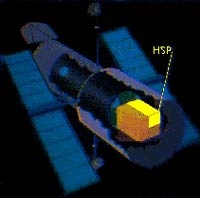
The position of HSP in Hubble's instrument bay. |
The High Speed Photometer (HSP) was one of the four original axial instruments on the Hubble. The HSP, which was removed from Hubble during the First Servicing Mission in December 1993, was used to make very rapid (up to 100 000 measurements per second) light measurements of astronomical objects at a variety of wavelengths from the near ultraviolet to the visible. It had five detectors.
HSP was a special and very simple instrument. The only moving part in the instrument was the filter wheel.
| HSP Facts | |
| Instrument type | Photometer |
| Weight | 300 kg |
| Dimensions | 1 m × 1 m × 2 m |
| Wavelength Range | 1150 to 8700 Ångström |