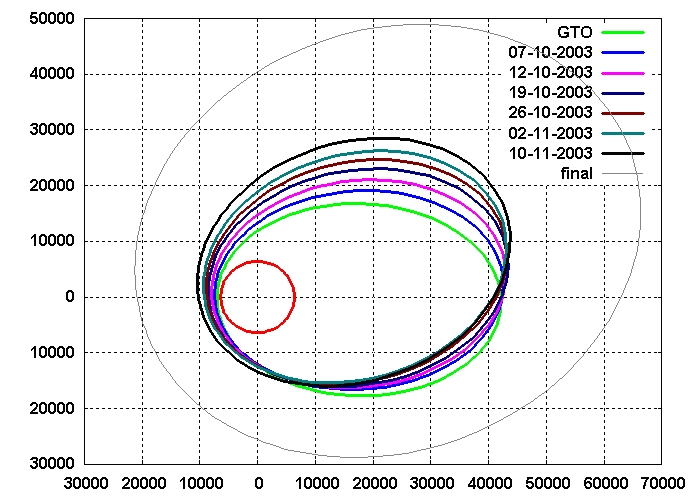
SMART-1 osculating orbit up to 10 November 2003
 Date: 10 November 2003
Satellite: SMART-1
Copyright: ESA
Show in archive: true
In this graphic the GTO, the osculating orbits at launch and at different times are plotted. The large orbit, marked "final", is the one what we expect to achieve at the end of the radiation belt escape in about one month.
From start, the electric propulsion system has managed to increase the semi-major axis of the orbit by 3185 km, increasing the perigee altitude from the original 656 km to 3624 km and the orbital period by more than 2 hours, from the initial 10 hours 41 minutes to the present 12 hours 49 minutes.
Date: 10 November 2003
Satellite: SMART-1
Copyright: ESA
Show in archive: true
In this graphic the GTO, the osculating orbits at launch and at different times are plotted. The large orbit, marked "final", is the one what we expect to achieve at the end of the radiation belt escape in about one month.
From start, the electric propulsion system has managed to increase the semi-major axis of the orbit by 3185 km, increasing the perigee altitude from the original 656 km to 3624 km and the orbital period by more than 2 hours, from the initial 10 hours 41 minutes to the present 12 hours 49 minutes.
Last Update: 1 September 2019