
Uranus
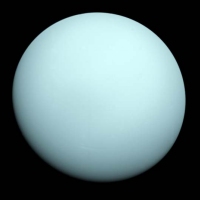 |
Origin of name Uranus is named after the father of Saturn in Roman mythology.
Discovered by
Satellites |
Physical Properties
| Property | Unit | Value | Earth = 1 |
| Equatorial radius, 1 bar level | km | 25 559 | 4.007 |
| Polar radius, 1 bar level | km | 24 973 | 3.929 |
| Flattening | 0.02293 | 6.84 | |
| Mass (x1024) | kg | 86.832 | 14.536 |
| Volume (x1010) | km3 | 6833 | 63.08 |
| Mean density | kgm-3 | 1270 | 0.230 |
| Gravity at equator, 1 bar level | ms-2 | 8.87 | 0.905 |
| Escape velocity | kms-1 | 21.3 | 1.903 |
| Magnetic field at equator (x10-4) | T | 0.23 | 0.75 |
| Magnetic dipole moment (x1017) | Tm3 |
~ 3.9 |
~ 50 |
| Tilt of dipole axis | ° | 58.6 | |
| Dipole field centre offset from planet centre (equatorial radii) | 0.3 | ||
| Number of natural satellites | 27 |
Orbital Parameters
| Property | Unit | Value |
| Perihelion (x106) | km | 2741.30 |
| Aphelion (x106) | km | 3003.62 |
| Mean distance from the Sun (x106) | km | 2869.6 |
| Mean distance from the Sun | AU | 19.182 |
| Eccentricity | 0.0457 | |
| Sidereal orbit period | y | 84.01 |
|
Sidereal rotation period Magnetic coordinates (Voyager 2) |
h | R 17.24 |
| Length of day | h | 17.24 |
| Orbit inclination to Ecliptic | ° | 0.77 |
| Mean orbital velocity | kms-1 | 6.81 |
| Maximum orbital velocity | kms-1 | 7.11 |
| Minimum orbital velocity | kms-1 | 6.49 |
| Axial tilt | ° | 97.77 |
Notes
-
Sidereal orbit period
The time taken by the planet to complete exactly one orbit around the Sun with respect to the celestial sphere. -
Sidereal rotation period
The time in which the planet rotates around its axis exactly 360° with respect to the celestial sphere. -
Length of a day
Defined as the time between two successive sunrises over the meridian. -
Magnetic dipole moment
Calculated as the ratio of the magnetic field strength at the equator divided by the cube of the equatorial radius.
Last Update: 1 September 2019