
Introduction to the Universe
Solar System
The Solar System is a collection of planets, moons, asteroids and comets and other rocky objects orbiting the Sun. The Solar System is believed to extend out to at least 150 000 million km from the Sun, although the planets are all found within about 6000 million km.
Our Solar System is thought to have formed 4.6 x 10⁹ years ago from a vast, rotating cloud of gas and dust known as the solar nebula. As the solar nebula rotated, its gravity began to attract gas and dust towards the centre, eventually forming our Sun.
The Sun
The Sun is the powerhouse of the Solar System. Without it, life on Earth simply would not exist. Despite burning its hydrogen fuel for the best part of 5 billion years, the Sun is still only half way through its life cycle.
The study of the Sun, its environment and how the material it discharges interacts with other worlds in the Solar System is of great interest to us all. ESA has a number of mission that analyse various aspects of this solar emission.
Solar Mission
|
Mission |
Orbit |
Description |
| SOHO | Joint mission with NASA at Lagrange 1 | An observatory viewing and investigating the Sun from its deep core, through its outer atmosphere (the corona) and the powerful solar wind. |
| Ulysses | Highly elliptical Sun centred polar orbit | The main scientific goal of the joint ESA-NASA Ulysses deep-space mission is observing the unexplored region of space above the Sun's poles, a first for solar observatories. |
| Cluster | Four spacecraft flying in formation near the Earth | The Cluster mission is currently investigating the structure (in three dimensions) of the Earth's plasma environment, such as those involved in the interaction between the solar wind and the magnetospheric plasma. |
| Double Star | Joint mission with the Chinese one spacecraft in equatorial and one in polar orbit | Double Star follows in the footsteps of ESA's ground-breaking Cluster mission by studying the effects of the Sun on the Earth's environment. Conducting joint studies with Cluster and Double Star should increase the overall scientific return from both missions. |
Planets and Moons
The formation of the Sun had a dramatic effect on the temperatures across the solar nebula, introducing a temperature range that stretched from about 2000K near the Sun to less than 50K at the outer regions. The heat in the inner Solar System only allowed materials with high condensation temperatures to remain solid. These particles eventually gathered to form the four terrestrial planets: Mercury, Venus, Earth and Mars.
A similar process formed the outer planets of the Solar System: Jupiter, Saturn, Uranus, and Neptune. Yet, they are different because icy materials such as frozen water, carbon dioxide and methane were also available. Consequently, these outer Jovian planets are much larger than the terrestrial planets. In addition these giant planets were able to enhance their atmospheres by capturing gas atoms moving more slowly due to the colder temperatures.
Each planet travels around the Sun in an elliptical orbit that is held in place by the gravitational attraction between the Sun and the planet. Some of the planets, including, of course, Earth, have moons orbiting them. Mars has just two moons in orbit around it, while Jupiter has 63 moons known to be orbiting it. Kepler's three laws of planetary motion define the motion of the planets around the Sun, and the movement of moons around their parent planet.
|
Distance |
Year |
Day |
ESA Mission |
||
|
|
AU |
106 km |
|
|
|
| Mercury |
0.387 |
57.9 |
87.969d |
58.65d |
|
| Venus |
0.723 |
108.2 |
224.701d |
243.01dR |
|
| Earth |
1.000 |
149.6 |
365.365d |
23.934h |
|
| Mars |
1.524 |
227.9 |
686.980d |
24.623h |
|
| Jupiter |
5.203 |
778.3 |
11.862y |
9.842h |
- |
| Saturn |
9.539 |
1427.0 |
29.457y |
10.233h | |
| Uranus |
19.182 |
2869.6 |
84.010y |
17.24hR |
- |
| Neptune |
30.058 |
4496.6 |
164.793y |
18.4 h |
- |
Table 1.1: Distance and Orbital Parameters for the Planets
|
Observational |
Moons |
Physical Data |
|||||
|
Mean Angular Diameter (") |
Mean Visual Magnitude |
Radius | Mass | Density | Gravity | ||
| Mercury |
7.8 |
0.0 |
0 |
0.38 |
0.06 |
0.98 |
0.37 |
| Venus |
25.2 |
-4.4 |
0 |
0.95 |
0.86 |
0.95 |
0.90 |
| Earth |
- |
- |
1 |
1.00 |
1.00 |
1.00 |
1.00 |
| Mars |
17.9 |
-2.0 |
2 |
0.53 |
0.15 |
0.71 |
0.38 |
| Jupiter |
46.8 |
-2.7 |
63 |
11.19 |
1323 |
0.24 |
2.69 |
| Saturn |
19.4 |
0.7 |
47 |
9.41 |
752 |
0.13 |
1.19 |
| Uranus |
3.9 |
5.5 |
27 |
3.98 |
64 |
0.24 |
0.93 |
| Neptune |
2.3 |
7.8 |
13 |
3.81 |
54 |
0.32 |
1.22 |
Table 1.2: Observational Characteristics of the Planets
Asteroids and Comets
There was some material left over from the solar nebula once the Sun and the planets had formed. Some of this debris remains in our Solar System in the form of asteroids and comets.
Asteroids
Asteroids, which are sometimes called minor planets, are rocky bodies mostly found in the planetary region between Mars and Jupiter. This region is known as the asteroid belt, and it stretches from about 250 million km to about 600 million km from the Sun. The largest known asteroid is Ceres with a diameter of roughly 1000 km. Only around a dozen are more than 250 km across. Over 100 000 asteroids larger than one kilometre in diameter are known to exist, with more being discovered all the time.
We often hear of asteroids on the news, when near-Earth asteroids pass close enough to our planet to cause concern of a potential impact either now, or in the future. These near-Earth objects have highly elliptical orbits, which bring them into the inner Solar System, crossing the orbit of Mars and occasionally coming close to Earth.
Comets
Comets are often referred to as 'dirty snowballs', as they are made up of ice and dust. The ones we can see travel around the Sun in highly elliptical orbits taking from a few years to thousands of years to return to the inner Solar System. Typically comets are just a few kilometres across, which makes them very difficult to spot for most of their orbit. As they approach the Sun, however, solar radiation vaporizes the gases in the comet and the characteristic comet 'tail' is formed. The tail of a comet consists of two parts: a whiter part made of dust, which always points away from the Sun, and a blue part consisting of ionised gas. Comets are mainly found in two regions of the Solar System: the Kuiper belt, a region that extends from around the orbit of Pluto to about 500 AU from the Sun, and the Oort Cloud (from the Kuiper Belt to about 50 000 AU from the Sun).
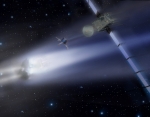 |
The Rosetta mission will track the comet 67 P/Churyumov-Gerasimenko and deploy a lander onto its surface. On its 10-year journey to rendezvous with the comet, the spacecraft will hopefully pass by at least one asteroid. |
Meteors
Occasionally small rocks or dust particles enter the Earth's atmosphere. The dust particles and small rocks burn up in the atmosphere leaving behind brief trails in the sky witnessed as meteors. It is estimated that more than 200 million kg of meteoritic material is swept up by the Earth each year, with around 10% reaching the ground.
Much of this material orbits the Sun in distinct streams, usually as debris from different comets. At various times throughout the year the Earth crosses these streams and for a few nights an observers can witness a meteor shower.
|
Shower |
Activity Dates |
Max |
Rate |
Parent Object |
| Quadrantids | 1-6 Jan | 3 Jan |
60 |
2003 EH1A |
| Lyrids | 16-25 April | 22 Apr |
15 |
C/1861 GI Thatcher C |
| η Aquarids | 19 April–28 May | 5 May |
35 |
1P/Halley C |
| δ Aquarids | 12 July–19 Aug | 29 Jul |
20 |
pos. 96P/Macholz C |
| Perseids | 17 July–24 Aug | 12 Aug |
75 |
109P/Swift-Tuttle C |
| Orionids | 16-27 Oct | 21 Oct |
25 |
1P/Halley C |
| Taurids | 20 Oct–30 Nov | 5 Nov |
10 |
2P/Encke C |
| Leonids | 14-21 Nov | 17 Nov |
15 |
55P/Tempel-Tuttle C |
| Geminids | 7-17 Dec | 14 Dec |
75 |
3200 - Pantheon A |
|
Parent Object: A – Asteroid, C – Comet Rate – typical number per hour at maximum |
||||
Table 1.3: Dates of Primary Meteor Showers
Sometimes larger fragments survive their passage through the atmosphere and impact the surface, where they become known as meteorites. Most impacting fragments are tiny and cause little or no damage. Historically, however, there have been several major impacts, which may be responsible for changes in climate and the mass extinction of species.
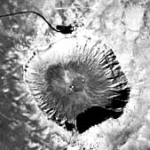 |
The image alongside shows the Barringer Meteor Crater in the United States. It was created around 50 000 years ago when a 50 m wide rock hit the ground at an estimated speed of 65 000 kilometres per hour. The resulting crater is 175 m deep, 1500 m wide and scattered debris in a 15 km radius. |
Figure 1.1: Barringer Meteor Crater (credit: NASA)
Bodies of the Universe
It is hard to comprehend the enormity of our Universe. Our Sun is only one of billions of stars in our galaxy, known as the Milky Way. But beyond the Milky Way, there are billions of other galaxies, too. Collectively, all these galaxies, along with the vast amount of space found in between them, are called the Universe.
Solar System
| The Sun
The star at the center of our solar system. It has a diameter of 1.39 million kilometres and the temperature of the visible surface is 5780 K. |
|
Planets 9 planets orbit the Sun: Mercury, Venus, Earth, Mars, Jupiter, Saturn, Uranus, Neptune, Pluto |
|
Moons There are now over 100 known moons in the orbit around the planets of the Solar System. Some, like Earth and Pluto, have just one companion while Jupiter has over 60. |
| Comets
Rocky-icy bodies in elliptical orbits travel through the Solar System developing a large tail of gas and dust in their orbit as they draw closer to the Sun. There are at least 150 periodic comets. |
|
Asteroids Thousands of rocky bodies, the largest being around 1000 km across, orbit the Sun. The majority are found between the orbits of Mars and Jupiter in a region known as the asteroid belt. In recent years observations have begun to probe the extent of another source of asteroid type objects (transneptunian objects) in the Kuiper Belt stretching 30 to maybe 100 AU. |
Our Galaxy
|
Stars
|
Star Clusters
|
|
Nebulae
|
Extragalactic
Galaxies
|
|
|
Cluster and Supercluster of Galaxies |
|
Quasars |
| Active Galactic Nuclei |
|
Gamma-Ray Burst |
Other Components
|
Dark Matter |
Dark Energy
Stellar Clusters & Constellations
We are familiar with the constellations that we see regularly in the night sky - a distinctive pattern of stars. However, although these stars may form shapes that are recognisable to us here on Earth, they do not usually have any real link to each other, as they are often at different distances from the Earth, and are in fact very far away from each other.
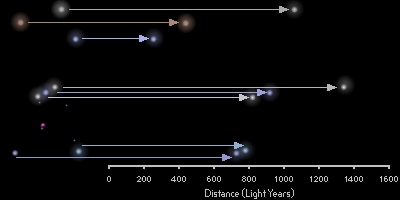 |
Figure 1.2: View of Orion and Actual Distance to Stars
Stellar clusters, on the other hand, are systems of stars that are held together by the gravity of their members. Eventually these clusters slowly evaporate. After a few billion years, the relatively loose collections of stars known as open clusters will no longer be held together by gravity and the cluster will stop existing. More highly compacted stellar clusters, known as globular clusters, which are typically about 15 billion years old, have not yet evaporated. Due to their relatively well-known distances, and the similarities that tend to exist among their stars, stellar clusters play an important role in astrophysics. Some of the nearest stellar clusters are visible with the naked eye. The most visible open clusters are the Pleiades and Hyades, both to be found in the constellation of Taurus.
|
Name |
Type |
RA |
DEC |
North/South |
| Pleiades | Open | 03h47 | +24°07 | North |
| Hyades | Open | 04h29 | +16°30 | North |
| Beehive | Open | 08h40 | +20°00 | North |
| M35 | Open | 06h09 | +24°20 | North |
| M47 | Open | 07h37 | -14°30 | South |
| NGC4755 | Open | 12h54 | -60°20 | South |
| M13 | Globular | 16h42 | +36°28 | North |
| M4 | Globular | 16h24 | -26°32 | South |
| ω Centauri | Globular | 13h27 | -47°29 | South |
| 47 Tucanae | Globular | 00h24 | -72°05 | South |
Table 1.4: List of the brightest Open and Globular Clusters
Relative Distances To Objects
A light year is the distance light travels through empty space in the course of one year.
1 light year = 9.461 x 10 12 km = 5.878 x 10 12 miles
In order to comprehend the enormity of space, astronomers use a variety of methods to measure the distances between stars and between galaxies.
Our own galaxy, the Milky Way, is around 120 000 light years across and the Sun occupies a position roughly 28 000 light years from the centre. Within the Milky Way, the nearest star to the Sun is Proxima Centauri, which is about 4.4 light years away. But most of our nearest stars are between 100 and 1000 light years away from Earth.
From any given location on Earth it is possible to view around 7000 stars with the naked eye and countless more with a telescope. In all, our galaxy contains over 1 billion stars.
The distance to stars in our galaxy is obtained using a technique called parallax. By identifying certain stellar properties it is then possible to calibrate a distance scale out to our galactic neighbours.
The nearest galactic objects are the Magellanic Clouds. The Large Magellanic Cloud is 170 000 light years away, while the Small Magellanic Cloud is at a distance of 210 000 light years. The next nearest galaxy is Andromeda (M31 in the Messier catalogue), at a distance of 2.3 million light years.
Galaxies are usually part of a larger group of galaxies. The group of galaxies that includes the Milky Way and Andromeda, plus several other smaller companion galaxies, is known as the Local Group. The other galaxies in the Local Group are between 80 000 to three million light years away from the Milky Way.
The next nearest rich cluster of galaxies, the Virgo cluster, is around 60 million light years away. It is believed that the Milky Way-Andromeda cluster is part of an even bigger supercluster along with Virgo-Coma cluster.
Stellar Motions
Diurnal Effects
During the course of one night, the constellations appear to move across the sky. Stars rise above the eastern horizon and set below the western horizon. The stars appear to rotate around one point in the sky. This optical effect occurs because the Earth itself is rotating about axis.
View the sky changing over 24 hours
Annual Effects
If you observe the night sky regularly over the course of one year, you will notice that the constellations appear to change their position slightly from one night to the next at any given time, only returning to their original positions once a year. This is due to the difference between a calendar day (24 hours) and a sidereal day (23 hours 56 minutes), or the time the Earth actually takes to spin once on its axis.
View the sky changing over 1 year
Annual Parallax
Annual Parallax is the difference between the position of a star observed from the Earth and by a hypothetical observer at the Sun. The effect is a tiny shift in the positions of relatively close stars against the background of distant stars. If the position of a nearby star is plotted during the course of a year it sweeps out an ellipse, called the parallactic ellipse, across the sky. This change in position is very small and requires high precision instruments to make the observation.
Precession
This effect, which can be observed for example with a spinning top, is caused by the gravitational pull from the Sun and Moon on the Earth's equatorial bulge. (Note - if the Earth were a perfect sphere precession would not occur.)
Precession causes the Earth's rotation axis to sweep out a circle on the sky with an angular radius of 23° 27' (this value corresponds to the axial tilt of the Earth). The circle is traced out at the rate of 1° every 71.6 years, taking 25 800 years to complete a full circle.
This means that the celestial pole, which currently points at the star Polaris, changes with time. Careful examination of the 'View of the sky changing over 24 hours' animation (above) shows the Pole Star also leaving a star trail since it is ¾ of a degree away from the celestial pole.