• → European Space Agency

    • About Science & Technology

    • For Public

    • For Educators

    • ESA

    • Science & Technology

    • Ulysses

    • Missions
    • Show All Missions
    • Mission Home
    • Summary
    • Fact Sheet
    • Objectives
    • Mission Team
    • Orbit View
    • Science Overview
    • Discoveries
    • Solar Cycle
    • Jupiter
    • 1st Solar Orbit
    • 2nd Solar Orbit
    • Beyond the Heliosphere
    • Spacecraft
    • 3D Model
    • Instruments
    • Engineering
    • Mission Operations
    • Launch
    • Orbit/Navigation
    • Mission Timeline
    • Status Reports
    • Science Operations
    • Ulysses SOC
    • Data Archive
    • Resources
    • News Archive
    • Multimedia Gallery
    • Publications Archive
    • Calendar of Events
    • Services
    • Contact Us
    • Subscribe
    • Terms and Conditions
    • Bookmark and Share

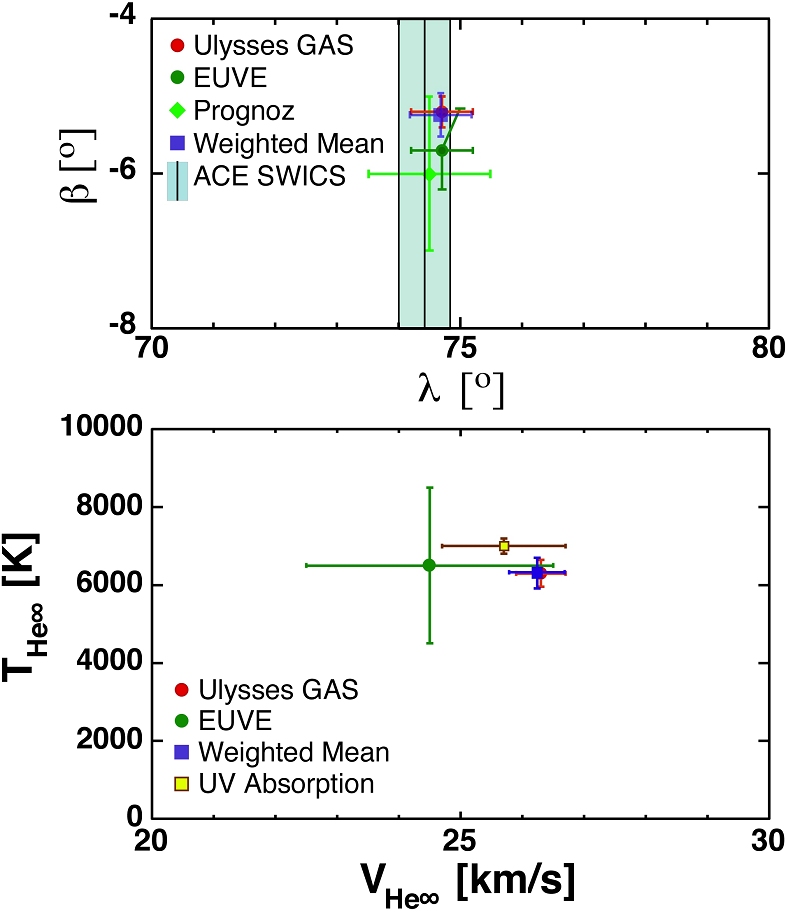
    Interstellar Helium Flow in the Solar System

    Date: 22 Sep 2004
    Satellite: Ulysses, ACE, EUVE
    Depicts: Data from multiple satellites on Helium flow
    Copyright: ESA

    Data from several satellites on the flow of interstellar helium in the solar system is presented here. The figure shows a compilation of the observations along with weighted mean values from all available observations.

    Upper panel: direction of the helium flow in ecliptic coordinates.

    Lower panel: flow speed and temperature. 

    It is evident that the direct observation of the neutral atoms by the GAS instrument provides the flow characteristics with the least uncertainty. 


    Last Update: 22 Sep 2004

    • Shortcut URL
    • http://sci.esa.int/jump.cfm?oid=35876
    • Latest selection
    • Solar Wind Speeds
    • The Heliosphere
    • The Heliosphere
    • Image Hi-Res Versions
    • Hi-Res [jpg]
      145.97 kb.
    • See also
    • The Flow of Interstellar Helium in the Solar System

    Connect with us

    • RSS
    • Youtube
    • Twitter
    • Flickr
    • Google Buzz
    • Livestream
    • Subscribe
    • App Store
    • ESA Science Twitter

    Follow ESA science

    • Copyright 2000 - 2013 © European Space Agency. All rights reserved.

    • Terms and Conditions