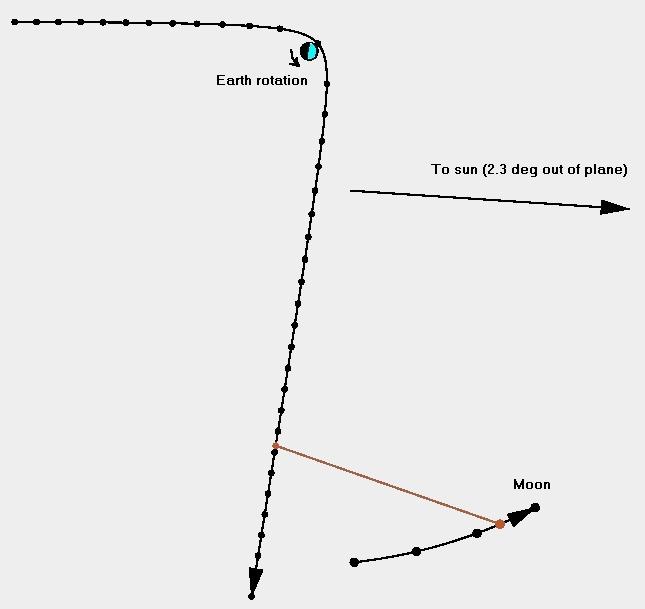
Rosetta Earth Swing-by on 04.03.05
 Date: 03 March 2005
Satellite: Rosetta
Depicts: Plot of Rosetta's trajectory during first Earth swing-by
Copyright: ESA
Show in archive: true
Rosetta will approach from the direction away from the Sun and have its closest approach on the illuminated side of the Earth. This plot shows the swing-by in the ecliptic plane, as seen when looking from the top (north ecliptic pole) onto the plane of the Earth's orbit. As the spacecraft approaches, it will seem to fly to the west and will disappear on the dayside of the Earth.
Date: 03 March 2005
Satellite: Rosetta
Depicts: Plot of Rosetta's trajectory during first Earth swing-by
Copyright: ESA
Show in archive: true
Rosetta will approach from the direction away from the Sun and have its closest approach on the illuminated side of the Earth. This plot shows the swing-by in the ecliptic plane, as seen when looking from the top (north ecliptic pole) onto the plane of the Earth's orbit. As the spacecraft approaches, it will seem to fly to the west and will disappear on the dayside of the Earth.
Last Update: 1 September 2019