
Galaxies and the Expanding Universe
Structure of Milky Way
The Milky Way Galaxy, the home of our Solar System and approximately 400 billion other stars and their planets, has a spiral structure. With a diameter of around 120 000 light years, the Milky Way's mass could amount to one trillion solar masses. Everything in the Milky Way galaxy orbits around a centre of mass called the Galactic Centre. At the distance of the Sun a full orbit takes 225 million years - even though the Solar System is travelling at 250 km per second.
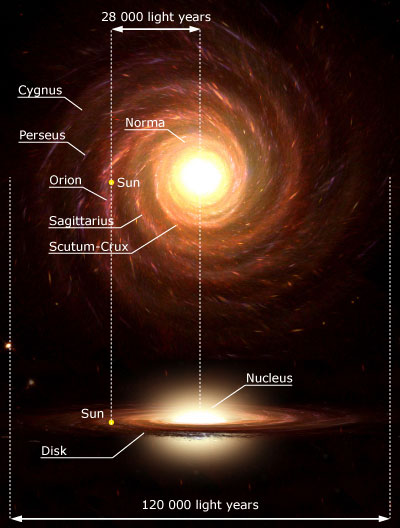 |
Figure 6.1: Structure of Milky Way
The Milky Way has a distinct shape, formed by the three major components that make up the galaxy:
- A thin disc made up of spiral arms. Within these arms are plentiful quantities of the gas and dust out of which stars are produced, and these are constantly being formed.
- A central bulge made up of older stars.
- A more mysterious element - a dark halo of unknown composition. There are no luminous stars in this halo, but we know it is there because it exerts a gravitational pull on visible matter.
The Sun is located around 28 000 light-years from the Milky Way’s centre, equivalent to roughly two-thirds of the way from the centre, a distance confirmed by data acquired by ESA’s astrometric satellite Hipparcos. The Solar System is found in a smaller spiral arm called the Local or Orion Arm. This arm connects two much bigger arms, the Sagittarius Arm and the Perseus Arm.
Types of Galaxy
Astronomers classify galaxies in three main groups: elliptical, spiral and barred spiral.
Eliptical
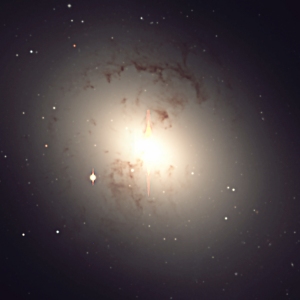 |
Image Credit: European Southern Observatory
These galaxies range in shape from almost spherical (often referred to as lenticular galaxies), to a flattened lens shape. This group encompasses both the biggest and the smallest of the known galaxies in the Universe. The image is a colour composite photo of the central area of NGC 1316, a giant elliptical galaxy in the Fornax cluster of galaxies. Many dark dust clouds and lanes are visible. Some of the star-like objects in the field are globular clusters of stars that belong to the galaxy.
Spiral
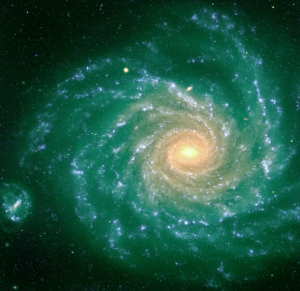 |
Image Credit: European Southern Observatory
The distinguishing feature of spiral galaxies is the set of arms winding out from a central bulge. Most frequently, there are two arms, but sometimes there are more. This spectacular image of a large spiral galaxy is based on three exposures in ultra-violet, blue and red light, respectively. The colours of the different regions are clearly visible: the central areas contain older stars of reddish colour, while the spiral arms are populated by young, blue stars and many star-forming regions.
Barred Spiral
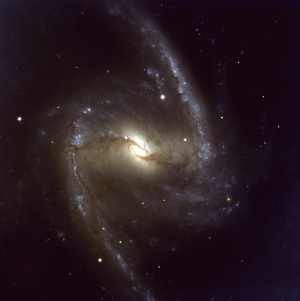 |
Image Credit: European Southern Observatory
NGC 1365 is one of the most prominent barred galaxies in the sky. It is a supergiant galaxy with a diameter of about 200 000 light years.
A massive straight bar runs through this galaxy and contains the nucleus at the centre. It consists mostly of older stars that give a reddish colour to the bar.
The gravitational perturbation from the bar causes interstellar gas and dust clouds to form a pair of spiral arms that extend from the ends of the bar. Young luminous hot stars, born out of the interstellar clouds, give these arms a prominent appearance and a blue colour.
The bar and spiral pattern rotates clockwise, as seen from Earth. One full turn takes about 350 million years.
Irregular
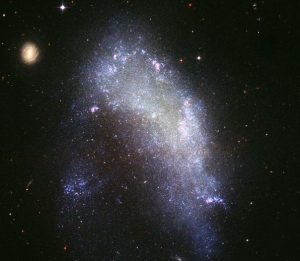 |
Image Credit: NASA, ESA, and The Hubble Heritage Team (STScI/AURA)
Under the gravitational grasp of a large gang of galaxies, called the Fornax cluster, the small bluish galaxy is plunging headlong into the group at 600 kilometres per second. NGC 1427A will not survive long as an identifiable galaxy passing through the cluster. Within the next billion years, it will be completely disintergrated, spilling its stars and remaining gas into intergalactic space within the Fornax cluster.
Interacting
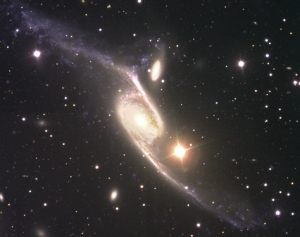 |
Image Credit: European Southern Observatory
The spectacular barred spiral galaxy NGC 6872 that is shaped like an "integral sign". It is of type SBb and is accompanied by a smaller, interacting galaxy, IC 4970 of type S0 (just above the centre). The bright object to the lower right of the galaxies is a star in the Milky Way.
The upper left spiral arm of NGC 6872 is significantly disturbed and is populated by a plethora of bluish objects, many of which are star-forming regions. This may have been be caused by a recent passage of IC 4970 through it.
Local Group
Gravity draws galaxies together into groups known as galactic clusters, which orbit around a common centre. As well as the stars, gas and dust that make up the galaxies, the galactic cluster is embedded in vast clouds of extremely hot gas, filling the space between the galaxies. Scientists, however, have calculated that the galaxies and the gas on their own do not have sufficient mass to allow the cluster to hold together. They deduce, therefore, that dark matter must be present in order to provide sufficient mass to produce the gravitational pull required.
| Galaxy |
R.A. |
Dec |
Distance | |
|
1 |
Milky Way | 17h45m | -28°56m |
7.7 |
|
2 |
Sagittarius Dwarf | 18h55m | -30°29m |
22.9 |
|
3 |
LMC | 05h23m | -69°45m |
48.3 |
|
4 |
SMC | 00h52m | -72°49m |
60.3 |
|
5 |
Ursa Minor Dwarf | 15h09m | +67°12m |
66.1 |
|
6 |
Sculptor Dwarf Spheroidal | 01h00m | -33°42m |
84.3 |
|
7 |
Sextans Dwarf Spheroidal | 10h13m | -01°36m |
85.9 |
|
8 |
Draco Dwarf | 17h20m | +57°54m |
85.9 |
|
9 |
Carina Dwarf | 06h41m | -50°57m |
97.7 |
|
10 |
Fornax Dwarf Spheroidal | 02h39m | -34°26m |
134.9 |
Table 6.1: Local Group of Galaxies
The Milky Way is part of a galactic cluster known as the Local Group. The Milky Way and the Andromeda Nebula are the only two bright members of the Local Group. Other members include the Milky Way’s two small companion galaxies, the Large and Small Magellanic Clouds. Most galaxies are members of clusters containing up to thousands of galaxies.
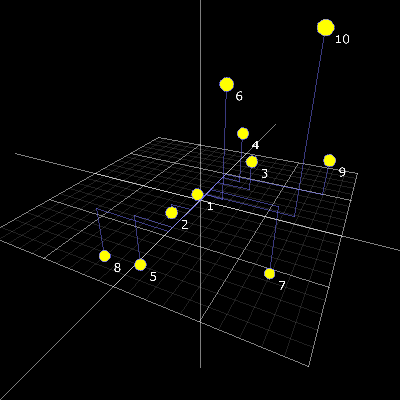 |
Figure 6.2: Relative Position of Local Group Galaxies.
The 10 nearest members of the Local Group. Click to load an interactive java applet containing the positions of all the galaxies in the local group. Use your mouse to rotate the applet and the up and down arrow keys to zoom in and out.
Distant Galactic Clusters
Beyond our local group of galaxies further clusters and superclusters of galaxies are known to exist.
The nearest galactic cluster is the Virgo Cluster containing around 2000 objects at a distance of around 50 million years ± 10%. Virgo’s gravity is so strong, thanks to its enormous mass, that our Local Group of galaxies is affected by its pull. Called the Virgo-Centric flow, this immense force will eventually pull nearby galaxies close enough to join the Virgo cluster.
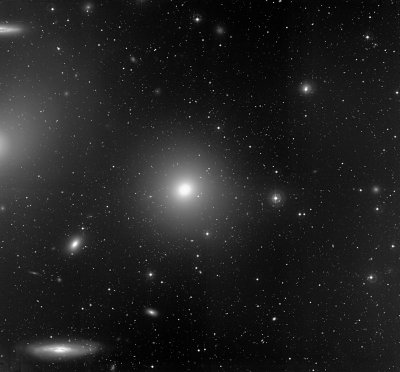 |
Figure 6.3: Virgo Cluster - NOAO/AURA/NSF
The Coma Cluster is more than 350 million light years away from Earth in the constellation of Coma Berenices. The Coma cluster, thought to contain over 1000 galaxies, is nearly spherical in shape. Its galaxies, estimated at around 15 billion years old, are mainly elliptical.
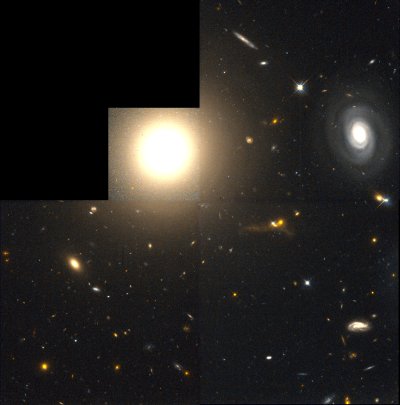 |
Figure 6.4: Coma Cluster - Hubble Space Telescope WFPC Team, NASA, STScI
A galactic supercluster is formed when lots of clusters are drawn together by gravity. They are the largest structures in the Universe, and can contain tens of thousands of galaxies that span hundreds of millions of light years.
A Redshifted Universe
The observed wavelength of light increases if the source of the light is moving away from the observer. This effect is observed in dark absorption lines or bright emission lines in the spectrum of a galaxy. If a galaxy is moving away from us, the wavelengths of all the lines in its spectrum are moved to longer wavelengths, and the lines appear shifted towards the red end of the spectrum. This effect is known as redshift (z).
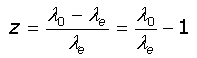 |
Where λ0 is the observed wavelength and λe is the emitted wavelength.
Astronomers analyse the spectra from distant galaxies and look for key lines such as the K and H lines of ionized calcium and the H-alpha line of hydrogen. The position of these lines can be found by laboratory experiment and compared to the observed position in the galactic spectrum.
For velocities <0.1c (where c is the speed of light) the redshift equation can be rewritten as:
 |
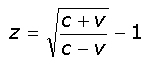
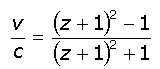
At relativistic velocities the equation needs to be modified and becomes:
 |
or
 |
Redshift is an important tool for cosmology, because it indicates that the Universe is expanding. Astronomer Edwin Hubble using the 100-inch Hooker reflector at the Mount Wilson Observatory, was the first to discover that virtually all galaxies show redshifts in their spectra. Initially the cause of the redshifts in the spectra of galaxies was misinterpreted and consequently it is often known as a Doppler shift due its similarities with the Doppler effect for sound waves.
Astronomers assumed, at first, that the galaxies were travelling through space at enormous velocities due to a great explosion. Later it was realised that the Universe appears to expand not because the galaxies are moving, but because the space between the galaxies expanded.
Hubble's Law
In 1929 US astronomer Edwin Hubble first noticed that distant galaxies were moving away from us. He also realized that the further away they were, the faster they were moving and that this relationship was constant.
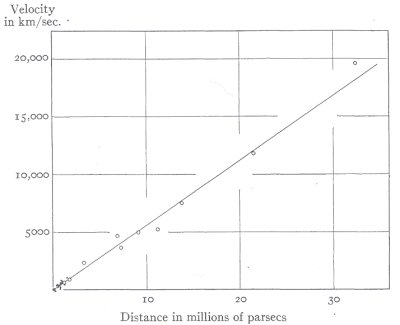 |
Figure 6.5: Recreation of Hubble's Original Data
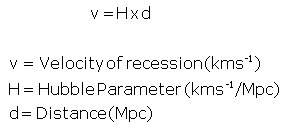
The gradient of this plot is known as the Hubble Parameter, or Hubble Constant is defined in the following equation
 |
Limitations of Hubble’s Law
By using Hubble's equation, it is possible to determine a galaxy's distance from us, once we have measured its velocity of recession. This is calculated by determining by how much the observed light has been shifted into the red part of the spectrum. There are, however, several factors that make this measurement problematic:
- Galaxies often have intrinsic motions which influence the observed velocity.
- Gravitational movements caused by two galaxies orbiting each other, or by galaxies orbiting within a cluster of galaxies.
Deriving Hubble Constant
By combining the two previous elements we can attempt to calculate the value of the Hubble constant. Hubble's Law can be rewritten as:
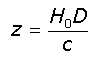 |
If we can measure the redshift of a galaxy and find its distance by another method the value of H0 can, therefore, be calculated.
Standard Candles
Asronomers use a series of standard candles to measure the distance to galaxies. By having an overlap between the different methods used it is possible to validate each step in the process.
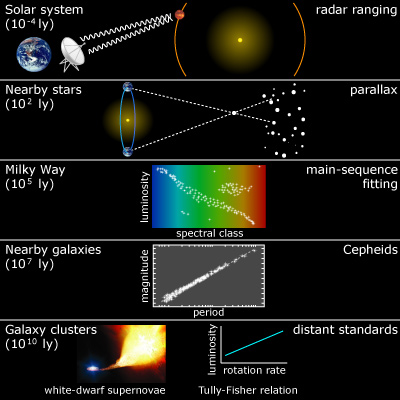 |
Figure 6.6: Different Methods for Calculating Distance
Age of Universe
The Hubble Parameter has the effective unit of 1/Time, which means that determining the value of the Hubble Parameter will give the age of the Universe. The current value is:
|
|

Big Bang
The moment that our Universe came into being, commonly referred to as the Big Bang, occurred around ten billion years ago. In a fraction of a second, our Universe expanded from the size of a grapefruit to a size equivalent to the current Earth.
At the time of the Big Bang, it is widely believed that matter and antimatter were created in almost equal numbers. Antimatter consists of antiparticles: identical partners of elementary particles with opposing charges. Since they are opposites, when matter and antimatter meet, they destroy each other. Since we see plenty of matter around us everyday, scientists have concluded that at the moment of the Big Bang, there was an excess of matter over antimatter. Particle physicists conduct experiments in order to find out whether antiparticles are indeed the exact opposite of particles, recreating the environment of the beginnings of the Universe in laboratories called ‘particle accelerators’.
We can still detect the existence of antimatter today in the form of positrons, the antiparticle of an electron.
As the Universe expanded, it cooled sufficiently to allow electrons and protons to combine into hydrogen atoms. As the temperature fell further, nucleosynthesis of the light elements occurred: into deuterium (D), helium-3, and helium-4. Around a quarter of the Universe is thought to be made up of helium-4.
The Big Bang model also gives us an explanation of how stars and galaxies came to be formed. After about 10 000 years, the temperature of matter had cooled down so much that the energy density of the Universe began to be concentrated in massive particles. Inevitably, gravitational forces between these massive particles came into play, forcing them together into million solar mass stars. Scientists estimate that these enormous structures eventually exploded to form the myriad of stars we have today. They in turn are continually subjected to the forces of gravity in order to form galaxies and galactic clusters.
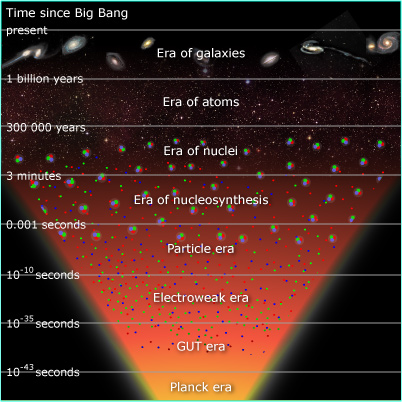 |
Figure 6.7: Different Epochs in Universe
ESA's Planck mission, launched in 2009, will address many of our questions about the beginnings of Universe. Planck will be studying the most ancient radiation in the Universe, known as the 'Cosmic Microwave Background'. These observations will allow scientists to look back at the dawn of time, in order to find out more about how individual galaxies and galactic clusters formed.