
Stellar Processes and Evolution
Stellar Fusion
Stars form out of nebulae – giant clouds of gas often found in the spiral arms of galaxies. The gas (predominantly hydrogen) can exist in a cloud for many millions of years, but if it is somehow disturbed (by the blast from a nearby supernova, or through intercloud collision for example) the cloud may collapse in on itself.
As the density of the core region increases the collapse accelerates due to the ever-increasing gravitational attraction. The central region will start to collapse faster than the outer regions and so a cloud of gas shrouds the core. If the cloud is particularly large it may produce multiple stars. This process of cloud collapse signifies the start of star formation.
Under continuing collapse, the gas in the cloud begins to warm up and gradually brightens. Eventually the core region reaches a critical temperature such that nuclear reactions can begin and the body evolves from a protostar into a true star.
The remaining gas and dust from the original interstellar cloud starts to condense and planets can form. A strong stellar wind, however, drives away some of the matter. Such stars are called T Tauri stars (from the first star of this type to be observed).
Nucleosynthesis
Nuclear fusion, where nuclei combine to make a nucleus with a larger number of protons and neutrons, occurs in main sequence stars once they reach a critical temperature. As the core temperature rises, due to ongoing core contractions and resulting increase in pressure, the atomic nuclei move faster thereby increasing the probability of two nuclei colliding with each other and fusing into heavier elements.
Proton-Proton Chain
The simplest reaction that occurs in stars is the conversion of hydrogen into helium - a process known as the proton-proton chain and requires a core temperature of at least 10 million K. In this process six hydrogen atoms are needed to create one helium nucleus of two protons and two neutrons.
|
Process |
Result |
Extras | |
| 1 | proton + proton | deuterium | positron, neutrino |
| 2 | proton + deuterium | helium-3 | gamma-ray |
| 3 | helium-3 + helium-3 | helium-4 | 2 protons |
Table 5.1: Proton-Proton Chain Reactions
In Step 1 two protons come together to form deuterium (a nucleus of one proton and one neutron). This interaction also involves the liberation of a positron (a positively charged electron) and a neutrino. This process occurs 1038 times per second in the Sun.
In Step 2 the resulting deuterium nucleus combines with a proton to make the rare isotope helium-3 consisiting of one neutron and two protons. This reaction also produces a gamma-ray.
In Step 3 the helium-3 nucleus becomes a helium-4 nucleus by the addition of a neutron. This step can occur in several ways, but the combination of two helium-3 nuclei is the most common way.
Steps 1 and 2 must occur twice before step 3 can occur. Six protons go into the cycle, but two come back out. The overall process results in 4 protons (hydrogen nuclei) becoming a helium-4 nucleus, two positrons, two neutrinos and two gamma-rays.
|
|
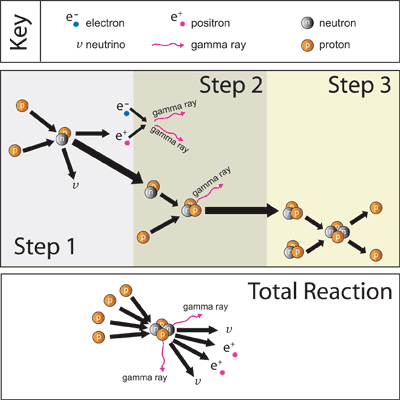
Figure 5.1: Proton-Proton Chain
Each helium-4 nucleus has a mass that is about 99.3% of the mass of four protons. In the Sun, for example, 600 million tons of hydrogen are converted into 596 million tons of helium every second. The missing 4 million tons of matter is released as energy in accordance with Einstein's equation E=mc2.
CNO Cycle
In more massive stars (at least 4 solar masses) the Carbon-Nitrogen-Oxygen cycle dominates as the main process for proton burning proton. The heavier elements are already present in the star, therefore largely restriciting this process to younger Population I stars.
The CNO cycle occurs only in more massive stars due to the necessity of a convective core with a temperature of at least 20 million K. In the process a 12C nucleus and four protons combine in various stages ultimately resulting in the creation of another 12C nucleus, a helium nucleus and the liberation of a significant amount of energy. The carbon is acting as a catalyst in the process of converting hydrogen into helium. There is no net creation of the heavier elements through this process.
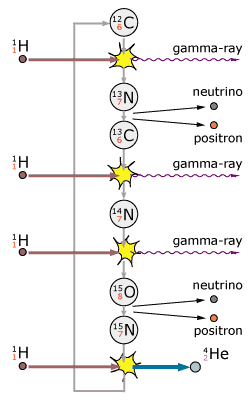 |
Figure 5.2: CNO Cycle
|
Process |
Result |
Extras | |
| 1 | carbon-12 + proton | nitrogen-13 | gamma-ray |
| 2 | nitrogen-13 decay | carbon-13 | neutrino, positron |
| 3 | carbon-13 + proton | nitrogen-14 | gamma-ray |
| 4 | nitrogen-14 + proton | oxygen-15 | gamma-ray |
| 5 | oxygen-15 decay | nitrogen-15 | neutrino, positron |
| 6 | nitrogen-15 + proton | carbon-12 | helium nucleus |
Table 5.2: CNO Cycle Reactions
The Future?
Once the stellar core has used up the majority of its hydrogen source the core region is dominated by helium. The future evolution of the star now depends very firmly on its mass and whether there is sufficient gravitational pressure to induce helium burning and the burning of successively heavier elements.
Evolution
All stars, irrespective of their initial mass, spend the majority of their life consuming hydrogen. This period, which can last tens of billions of years, is the most stable time in the stellar lifecycle.
The lifetime of a star depends largely on its mass. Somewhat counter intuitively, the more massive a star is the shorter its lifetime! Although massive stars contain a larger reservoir of fuel, the increased gravitational pressure in the core means an accelerated consumption rate.
|
Star Type |
Temp (K) |
Mass |
Age |
|
O5 |
40 000 |
40 |
1 My |
|
B0 |
28 000 |
18 |
11 My |
|
A0 |
9 900 |
3.5 |
440 My |
|
F0 |
7 400 |
1.7 |
3 Gy |
|
G0 |
6 600 |
1.1 |
8 Gy |
|
K0 |
4 900 |
0.8 |
17 Gy |
|
M0 |
3 500 |
0.5 |
56 Gy |
Table 5.3: Stellar Properties and Lifetime
As hydrogen converts into helium, so the composition of the stellar core changes. The initial ball of hydrogen becomes a ball of helium surrounded by a shell of hydrogen.
Paths on HR Diagram
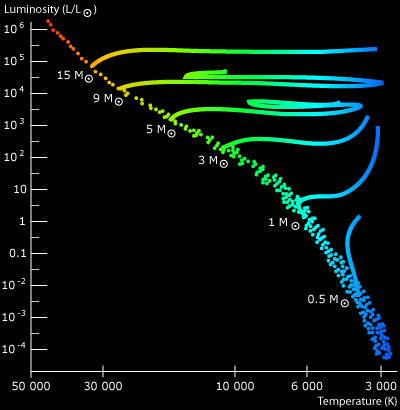 |
Figure 5.3: HR Diagram showing paths of different mass stars
The HR diagram can be used to plot the changes in a stars brightness and temperature over time. All stars, irrespective of their mass spend most of their lifetime on the Main Sequence - the diagonal band spanning from top left to lower right.
Stars of differing mass exist at different points along the main sequence. The more massive a star the further up and left it appears. As all stars enter a giant phase their brightness remains constant, but the effective surface temperature cools. This reflects a change in the process at work in the star. The outer layers have expanded and are no longer places of nuclear burning. As these layers cool, the star drifts towards the right side of the HR diagram.
The subsequent evolution depends on the mass of the star. Low mass stars undergo an increase in luminosity, while more massive stars retain the same luminosity but have an oscillating surface temperature.
Solar Mass Stars
A star with a mass comparable to the Sun, with a core of pure helium and surrounded by a hydrogen shell, will continue to evolve through helium burning.
Since helium has two protons in its nucleus, compared to the one in hydrogen, a higher core temperature is necessary to overcome the electrostatic potential. As hydrogen burning comes to an end the core temperature is not sufficient for helium burning to occur.
With no source of energy production in the core there is no longer any outward radiative pressure to resist gravitational collapse. As the outer regions start to collapse the temperature increases. This heat raises the temperature in hydrogen shell such that hydrogen fusion can occur.
The core continues to collapse and the temperature in the hydrogen shell keeps on increasing and so the luminosity also increases. The core collapse is now fuelled by two sources – gravity extends radiation pressure and the hydrogen burning shell also exerts a pressure.
The burning shell also provides pressure on the outer layers of the star and causes them to expand. As the layers expand they cool and the star appears to become redder. After just a few million years the hydrogen shell will run out of fuel.
Once again the star will contract under its own weight. The compact core may flash into life for a short period and helium be fused into carbon. As the energy released in the helium flash reaches the outer layers the star becomes a red giant again and up to half its mass is thrown out into space and seen as a planetary nebula leaving a core behind.
The core is a curious object. It has around half the mass the star had during its lifetime yet it is smaller in size than Uranus or Neptune. The core is also very hot, hotter again than when on the main sequence, yet produces no energy and will eventually cool down.
The surface gravity can be in excess of 100 000 times gravity on Earth. The average density is over 1000 kg per cubic centimetre causing the atoms to be packed so closely making the star electron degenerate. This star is known as a white dwarf.
Electron-degeneracy theory predicts that the uppermost mass a white dwarf can attain is about 1.44 times the mass of the Sun, called the Chandrasekhar Limit. Any heavier, and the tremendous pressure on the innermost atoms would squeeze their electrons into the nuclei they orbit, turning all the protons and electrons in the star into neutrons. The low surface area and high specific heat means that such an object would take longer than the currently estimated age of the Universe to cool.
Medium Mass Stars
Stars with a mass of between 8 and 20 solar masses have a more complex evolution. Initially, they evolve in the same way as low mass stars, turning into red giants and undergoing a core helium burning phase.
In medium mass stars, however, the burning of helium into carbon is no longer the end phase of stellar evolution. When the core helium supply is exhausted, the additional mass allows stellar collapse to take place and the outer layers to reignite. A cross section through the star at this point would show an outer shell of hydrogen burning, an inner shell of helium burning and the core, where there is now sufficient energy for the carbon to fuse with helium into oxygen.
Once the carbon supply is exhausted so oxygen fuses into neon, the helium shell becomes a carbon burning shell, the hydrogen shell a helium shell and a new outer layer of hydrogen burning forms. Neon can then fuse into magnesium, into silicon, and so on to chromium into iron. Each of these stages produces less energy than the previous stage and lasts for less time. During these final stages the star expands to thousands of times the diameter of the Sun, becoming a red supergiant like Betelgeuse.
The star finally hits a problem. To fuse iron into heavier elements requires an input of energy. Separating into the lighter elements again requires an input of energy. So as iron burning stars the core cools down – it draws in heat from its surroundings to power the fusion. Suddenly the outward radiative pressure, which has supported the star for many millions of years, ceases and the star undergoes a free fall gravitational collapse.
The core, which represents a large percentage of the stellar mass, now exceeds the 1.44 Chandrasekhar mass limit for a white dwarf. The protons and electrons in the core are compressed into a ball of neutrons, the size of a large city and the density of an atomic nucleus, held up by neutron degeneracy pressure. Such an object is a neutron star.
As a result of the core collapse a shock wave forms and blasts out through the star releasing an enormous amount of energy in a few seconds. All the outer layers of the star become superheated plasmas, with temperatures high enough to fuse iron and heavier elements, like gold and uranium. These outer layers brighten rapidly and are ejected into the interstellar medium at speeds approaching the speed of light. Such events are witnessed as Type II Supernovae.
Pulsars
A pulsar is a neutron star that produces pulsed emissions across the entire electromagnetic spectrum. Neutron stars spin rapidly and have large magnetic fields. Radiation channelled down the field lines is beamed out across the Universe like the light from a lighthouse. If the Earth happens to be in the line of sight then the emission is seen. Many pulsars spin rapidly with pulse durations of the order of fractions of a second.
High Mass Stars
Stars with over 20 solar masses have an even more catastrophic end. They evolve in the same way as their slightly less massive companions dying in a supernova explosion, but the core evolves in a very different way.
A neutron star can have up to around three solar masses. After this point neutron degeneracy pressure is no longer sufficient to prevent core collapse. With nothing left to resist collapse the core condenses into an infinitely small, infinitely dense point called a singularity.
Nothing can escape from the singularity. Nothing that comes within three kilometres times the mass of the singularity in solar mass (the Schwarzchild Radius) can escape. The whole stellar core swallows itself, leaving behind a gravitational potential well. It is known as a black hole.