
SMART-1 Search for Lunar Peaks of Eternal Light
14 April 2005
SMART-1 has started to monitor the illumination of the lunar poles since the beginning of 2005, even before arriving at its final science orbit in March. The Moon's rotational axis is only 1.5° inclined to the ecliptic plane. This orientation allows for areas to exist at the bottom of near-polar craters that do not see direct sunlight and where ice might potentially be trapped. On the other hand, at higher elevations on the rim of polar craters, there are areas that see the Sun for more than half of the time. The popular astronomer and writer Camille Flammarion proposed in 1879 that there might be peaks of eternal light at the poles - "pics de lumiere eternelle".Although for most of the Moon's surface there are no perceptible seasonal variations in the length of the day, there can be large variations of illumination over the poles during the course of the year. The northern winter solstice is around 24 January providing the less favourable illumination conditions. In collaboration with astronomers from the University of Arizona, the SMART-1 team has analysed AMIE images to look for potential sites at the lunar north pole that are favourable for placing future telescopes on the Moon.
 |
 |
|
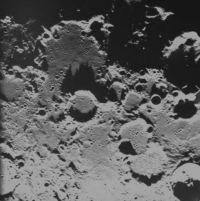
This image was taken by the AMIE camera on board SMART-1 on 29 December 2004 from a distance of 5500 km. It shows an area, 275 km across, of heavily cratered highland terrain close to the lunar north pole (upper left corner). |
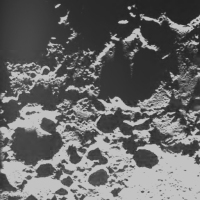
This image was taken by the AMIE camera on board SMART-1 on 19 January 2005 (close to the northern winter solstice) from a distance of 5000 km. The image shows an area 250 km wide near the lunar north pole. |
SMART-1 took these views of the north-polar region from a distance of 5000 km during a pause in the spiralling descent to the science orbit. "This shows the ability of SMART-1 and its camera to image even with low light levels at the poles and to prospect for sites for future exploration", says AMIE camera PI Jean-Luc Josset, (Space-X, CH). One can see highland terrains, very highly cratered due to their old age. The rims of the large craters project very long shadows; even on surrounding features.
"SMART-1 will monitor the polar shadows cast during the Moon's rotation, and their seasonal variations, to look for places with long-lasting illumination" says Bernard Foing, SMART-1 Project scientist. "If we can confirm peaks of eternal light, or pairs of sites exposed to sunlight at any moment, this could be an advantageous location to install a solar power infrastructure to feed future robotic/human outposts and colonies".
Contacts
ESA Communications Department
ESA/HQ Paris
Tel: +33 15369 7155
Fax: +33 15369 7690
Bernard H. Foing
Chief scientist, ESA/SCI-S
ESA SMART-1 Project scientist
Tel: +31 71 5655647
