
Leonids 1999 Observing Campaigns
Radio observation campaign
On 17 November 1999 a team of ESA scientists were to listen to the sound of Leonid meteors as they silently sweep across the night sky.
Instead of using cameras or simply observing with the naked eye, their aim was to try an experiment using new digital signal processing to make audible the impact of the myriads of shooting stars as they hit the Earth's upper atmosphere.
During the nights of 16 - 18 November, as the annual Leonid meteor shower reached its peak, the group from ESA's Solar System Division at ESTEC, was to be glued to a radio receiver and their computer screens.
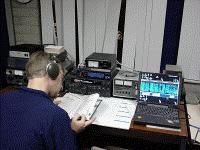 |
|
Figure 1. Radio experiment at ESTEC |
Listening to these radio signatures of the meteors was one of the popular ways of observing them. All over the world amateurs were to be using radio techniques to observe the Leonids during the forthcoming encounter.
"But we will be trying something different", said fellow team member Trevor Sanderson. "We will detect the minute changes in the signal frequency caused by the motion of the meteor trail in the upper atmosphere, using advanced signal processing techniques," explained Sanderson. "We will also try to turn these small changes into an audible signal so that we can hear a "ping" or some such sound every time a meteor hits the atmosphere."
"The technique employed relies on measuring the frequency of the signal after it has been reflected by the trail of ionisation left by the meteor. The motion of the meteor trail due to the upper atmosphere winds changes the frequency of the reflected signal due to the Doppler effect. The change is so small that we have to use advanced signal processing techniques to detect it."
|
Figure 2. Spectrogram received in Portugal on 14 November, courtesy of Bev Ewan-Smith, COAA, Portugal |
"We will analyse the signals in real time, and also record them on digital audio tape so that we can analyse them later," said Lebreton. "We're also hoping to put the recording on the Web so that everyone can hear the sound of shooting stars!"
"I got interested in the Leonids after I saw last year's fireballs which came the night before the predicted peak. I was fortunate enough not to trust the predictions and was up early on the morning of 17 November to observe the fireball display in the Dutch sky!" explained Jean-Pierre Lebreton.
"We were inspired by a new method developed by a UK communications expert Peter Martinez. We will be using his software, as well as software developed by the Centro de Observação Astronómica no Algarve in Portugal", said Sanderson.
So why were they going through all this trouble?
"We're hoping to complement the optical observations that are planned by some of our colleagues," said Lebreton. "And we wanted to do something that would be of interest to the public". One of the advantages of radio observing is that meteors can be detected when skies are cloudy or during daylight. Radio observing has some advantages at night, too. The human eye can only see shooting stars brighter than 6th magnitude, but radio methods can detect meteors that are at least 5 times dimmer.
The experiment
The Doppler method can be tried by anyone with a good shortwave receiver and a PC. Suitable software and a description of the method can be downloaded from the related link to "instructions for Doppler experiment", which includes a description of the method.
This software uses the sound card of the PC to analyse the signal. All that is needed is a connection from the headphone output of the receiver to the PC's sound card input. Download the software, install, read the help file and you are ready to go. Tune to a station around 500 km or so away. Switch to SSB mode, and start the software. All you need now are the Meteors!
A simpler experiment
For this you use your FM receiver with an external aerial. Try to find a station a long way away (that's the difficult bit, as usually a nearby station gets in the way). Under normal circumstances the transmission should be difficult or impossible to detect, but when a meteor intervenes the signal jumps over the horizon and a brief fragment of the transmission can be heard. Depending on the type of transmission, it might sound like a tone, a fragment of music or voice, or simply noise. Contact lasts for as long as the meteor train persists, usually from 100 milliseconds to a few seconds.
Useful links
For further information visit the "Radio Observations of Meteors" section at the International Meteor Organisation (IMO).
What's so special about this new radio experiment?
To try to illustrate the difference between the two main methods for meteor radio detection - between a simple echo monitoring experiment and one which performs a frequency analysis of the echo - Jean-Pierre Lebreton performed the following simple experiment:
"I recorded on a simple tape recorder the sound of a scooter (motor + horn) approaching and passing by me. I made two similar recordings. The two consecutive recordings have been transformed in a single audio *.wav file."
| Recording of passing scooter | 1.8 Mb | WAV |
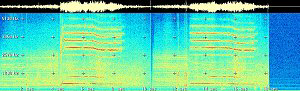
"I then analysed the wav file with an audio analysis programme and the result of the analysis is shown in the image below. The used software is available on-line and can be accessed through the related link 'Spectrogram Software'.
 |
|
Figure 3. Audio analysis of scooter.wav |
"The top plot shows the simple time sequence of the recorded sound. The bottom plot shows the spectral analysis of the signal. The motor sounds for the first 4 seconds; then the horn sounds between 4.5 and 8.5 seconds. The scooter passed in front of me at 7 seconds."
"The horn spectrum is rich in harmonics. Note the change in tone (frequency) at about 7 seconds Before then the scooter was approaching me; after that the scooter was going away from me.
"The experiment is repeated in the second part of the Figure.
"You can clearly note that the frequency increases when the source is approaching the listener (me) and the frequency decreases when the source moves away from the listener. Note the big frequency change around the time of the velocity direction change with respect to the listener.
"Measuring the relative change in frequency before and after passing by me, you can deduce the speed of the scooter (try it and you should get about 9 ms-1, assuming a sound speed of 330 ms-1)."
See also 'A novel experiment to demonstrate doppler shifting'.
Radio observation report
Using a new Radio-Doppler technique to analyse the reflection of broadcast radio stations from meteors, scientists in ESA's Space Science Dept, in Noordwijk, the Netherlands and in the Centro de Observação Astronómica no Algarve (COAA) in Portugal were able to listen to the sound of the reflections from the recent Leonids meteor shower. The technique, developed by UK Radio Amateur Peter Martinez, uses DSP software to measure the minute changes in frequency of the carrier of a short wave broadcast station due to Doppler shift caused by the the motion of the meteor trail in the upper atmosphere. The method of course works both by night and day, and under cloudy skies, and was recently used with dramatic effect during the Leonids.
|
Figure 4. Spectrogram of a fireball exploding |
The top spectrogram, taken in Portugal by COAA, shows a fireball exploding. Time is plotted along the x-axis, and frequency along the y axis. The straight line shows the signal from the carrier, which in this case was a shortwave station in the 15 MHz broadcast band. Each time a meteor impacts the atmosphere it leaves behind it a trail of ionisation which may last for a second or two. This trail reflects a part of the radio signal. The frequency of the reflected signal is Doppler shifted by a few Hz due to the changes due to motion of the trail caused by the upper atmosphere winds, or in this case by the expansion of the cloud. The very small vertical trace is a meteor. The slightly ragged shape of the trace is due to the different layers of the upper atmosphere moving in different directions. Also seen in the top left is the signature of an aeroplane as it slowly crosses the sky.
|
Figure 5. Spectrogram showing signatures of two fireballs |
The second plot, taken in the Algarve by COAA on the morning of November 17, shows the signature of two fireballs disintegrating over the sky in Portugal. When the first fireball exploded, a cloud of ionisation was released, which drifted off in several directions. The three yellow patches are probably due to patches of ionisation in different layers of the atmosphere which drift in different directions, and therefore impart three different Doppler shifts to the reflected signal. The second fireball signature is much more complicated, and shows evidence of some stratified motion prior to the final disintegration. As well as displaying being able to display this data in a spectrogram, it is possible to listen to the signal reflected by the meteor. If the received signal is fed to a loudspeaker, a more or less constant tone, dominated by the carrier, is heard. By removing the tone of the carrier using a notch filter, only the sound of the reflection of the meteor is left. The next spectrogram is of a short 1.25 minute period of data taken around the time of maximum of the Leonid shower on the morning of November 18. The signal has been notched out, and all that is left is the sound of the Leonid. This sound is available as a .wav file. This is the sound of a small fireball exploding.
| Radio Recording of Fireball | 1.8 Mb | WAV |
Spain campaign
Introduction
Organized by the Space Science Department (SSD) of ESA, a team of six observers will observe the Leonids from two locations in Southern Spain. Another observer will participate in the American Leonid Multi-aircraft Campaign (Leonid MAC) to observe the Leonids from an altitude of 10 km above Spain and Israel.
The following report is a diary from the ground-based group:
- Joe Zender (ESA/SSD), Mark Neijts and Joost Hartman (both from Werkgroep Meteoren), who will go to the Calar Alto Observatory (CAHA), and
- Detlef Koschny, Rita Schulz, and Luisa Maria Lara (all ESA/SSD) and Andre Knöfel (International Meteor Organisation) will go to the Observatory Sierra Nevada (OSN) of the Instituto Astrofisica de Andalucia (IAA).
OSN - 10 November 1999
We are packing! Joe Zender, Detlef Koschny, and Andre Knöfel will take a van and drive from Holland to Spain with all our equipment. In total, we take 11 intensified video cameras, with VCRs, power supplies, tripods, several computers, a radio receiver station to detect reflections of the meteors, warm clothes, and much more...
|
The van, before |
The van, after |
All cameras were tested, one does not work properly yet but we decided to fix that on the mountain. We leave Noordwijk around 16:00 on the 10 November, heading south. To get to Grenada on time, we decided to drive through the first night. One person drives, one person keeps the driver awake, the last one sleeps. After a few short stops for refueling and grabbing some food, we arrive at a small hotel close to the highway, about one hour north of Grenada, on the evening of 11 November.
OSN - 11 November 1999
Unfortunately we have clouds, so we could not check whether the 'Linearids' were visible. This was the newly predicted meteor shower from the comet Linear, which might have been visible in the evening of 11 November. Hopefully, other groups had better weather.
In the morning, just as we get ready to go, a police car stops next to our car. "Who are you? What's in all those boxes?" they said - of course in Spanish. We didn't understand them, and they didn't understand English. Fortunately, mentioning the name of our contact person here at IAA, Jose Juan Lopez-Moreno, prompted one of them to say something like "professor of astronomy in Grenada", so obviously he knew him. He convinced his colleague to let us go...
 |
|
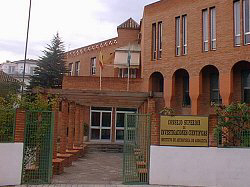
Institute for Astrophysics, Grenada |
We arrived at the Institute for Astrophysics in Grenada around noon time. The first message by Jose Juan (called Pepe) is: It snowed last night, and there is no way to go up to OSN! We called Calar Alto Observatory (CAHA), and the news there is: it is snowing right now, and there is no way to get up. Of course we are a little bit disappointed right now and considering what we can do. TV producers Isabelle Leonard and David Whitbourn,(commissioned by ESA Science) just joined us, so they are setting up to do some interviews for ESA TV. In a few hours, Joe will go to the airport and pick up our two colleagues from the Werkgroup Meteoren. And then, we'll probably stay in Grenada and wait...
CAHA - 12 November 1999
|
28 km to Calar Alto |
We finally decided to go all together up to Calar Alto. The situation at the observatory of the Sierra Nevada (OSN) still looks bad and we do not expect that we can get up there before Monday morning because of all the snow.
|
Andre Knöfel (IMO) and Detlef Koschny (ESA/SSD) |
|
Hotel Los Abades |
It's late and we prepare for the coming nights by catching some sleep NOW...
CAHA - 13 November 1999
The night from 12 to 13 November was cloudy and the CAHA night assistant proposed that we wait until daylight to set up. So we get up around 9 o'clock to beautiful blue skies and sunshine. But our out that our van doesn't work anymore! Maybe the Diesel doesn't like the -5°C? Anyway, we get an offer of help the observatory staff. We unload our van into "No. 7", a small Renault from CAHA. The last 100 metres we have to carry our boxes to the wooden hut which will be our observing site for the next few days.
|
Joe Zender (ESA/SSD) in the zero degree 'computer room'! |
The "computer room", unfortunately, has no heater, so the inside temperatures are the same as outside! But at least we are sheltered from the wind. And we are promised heaters for tomorrow. The mess slowly mutates to chaos. The chaos is interrupted by lunch break. After that, Marc and Mr Schulz from CAHA put the van in a large garage. There it is warm and they are also able to charge the battery.
The rest of the afternoon we are busy setting up our equipment:
- The "public relations" camera, (which will be used to send pictures back to the ESA Science web team) - an intensified video camera set up on a guiding mount, together with a Photometrics CCD camera which we want to use to detect the "radiant glow".
- Another intensified video camera, which will observe in parallel with two cameras on OSN.
- A fish-eye camera from Joost, which records the complete sky on photographic film with exposure times of about one hour.
- Marc sets up his two photo cameras with longer focal lengths, one equipped with an objective grating.
- Marc and Joost also set up a radio receiver which will allow us to listen to the meteors (and to Spanish radio stations)!
- Another video camera, set up outside the building, to be pointed to any persistent trails which will show up.
While we set up, David and Isabel (the TV team) join us with their TV camera and film our activities and the nice view around us - snow-covered trees, telescope domes, and beautiful blue sky.
In the meantime, the chaos is no more. Several tables are covered with equipment, and most of it is working. As night falls, we see the first stars through our camera systems, orient them in the right direction and focus them. Unfortunately, the sky is not so nice anymore, and we do not start yet with systematic observations.
CAHA - 14 November 1999
Report from Calar Alto meteor team Jo Zender of ESA/SSD, Andre Knöfel, Joost Hartman and Marc Neijts. "Werkgroep Meteoren", a part of the Dutch NVWS (Nederlandse Vereniging voor Weer en Sterrenkunde).
Andre and Detlef went to bed quite early, because they left for Granada early in the morning. We had a wonderful, clear night and saw quite a number of meteors. The Leonids seem not to be active yet, and most of the meteors we saw were sporadics or Taurids.
We operated one camera during the second half (clear sky) of the night and did some flatfielding and testing of the CCD (2kx2k) photometrics camera. Unfortunately, we experienced a lot of problems with the power supplies. Computers rebooted several times during the night and observations had to be restarted. There seems to be a problem with the Earth leakage circuit breaker and no obvious solution to it was found. We disconnected the fuse and will see tonight what will happen. Marc is setting up his radio experiment and spends quite some time of the time with searching for the right radio frequencies.
Communication is difficult up here. There are only two places up here at the mountain, where the GSM phones work - if we stand in exactly the right spot! Nevertheless we try to stay in contact with the Detlef and Rainer at OSN, and Erica and Cees, the Science web team at ESTEC and the ESOC people in Darmstadt.
 |
|
Winter landscape at Calar Alto |
Clear Skies!
Joost, Marc and Joe
Joost Hartman and Marc Neijts of Werkgroep Meteoren/NVWS and
Jo Zender of ESA/SSD
CAHA - 18 November 1999
First impression from Calar Alto 03:45 UT
We had a fine display! We estimated between 600 and 1000 meteors an hour, not storm level but very impressive. At this moment the rate is still 3-5 per minute. It was a cold -6°C, clear night with a moderate wind, which keeps your feet cold enough.
Greetings from 2200 metres! The team from Calar Alto, Spain:
- Marc Neijts and Joost Hartman (IMO and Werkgroep Meteoren)
- Jo Zender, ESA/SSD
OSN - 18 November 1999
Report from Sierra Nevada - We saw it!
The predictions were right! Between 02:03 and 02:04 (local time) Andre saw 110 meteors, and I saw 40. Corrected for our different eyesights, this corresponds to a Zenithal Hourly Rate (zhr) of over 10 000! In total, each of us saw more than 1 000 meteors in about 3 hours of observing time.
We did not see any fireballs, i.e. no meteors brighter than the stars. A preliminary check of our video tapes showed that the highest meteor activity took place in the brightness range of the naked eye.
While the sky was clear, the wind was horrible - we had wind speeds between 40 and 70 km/h, storm gusts! The snow was blown in our face and made standing outside a challenge. With chill factor, we had temperatures of -28°C. Special thanks to Udo Telljohann, who loaned me some of his low-temperature clothing intended for a trip to Kiruna - I did not notice the temperature at all!
No long-lasting persistent trails were visible, so even though we were prepared to point our 1.5-m-telescope to do spectroscopy, we did not get the chance to do it. However, the other video cameras operated well. Only our high-resolution imaging system was blown away by the wind 15 minutes before the peak...
As a first estimate, we have about 20 hours observing time in parallel with our Calar Alto station, so we will be able to determine many orbits and magnitude profile. We will also be able to determine flux rates from all wide-angle camera systems.
Rita Schulz and Luisa Lara (ESA/SSD) went down the mountain today with a motor sled. We will record the sky for another night and pack tomorrow morning.
Detlef and Andre
Detlef Koschny (European Space Agency)
Andre Knöfel (International Meteor Organisation)
OSN - 19 November 1999
 |
|
The Ratrac |
We prepared our visual observing reports which were immediately published by the International Meteor Organisation in their Leonid press release. Instead of sleeping, we packed in the morning.
 |
|
40 kg of Spanish "Jamon" |
Down where our van was waiting we unloaded from the Ratrac into our car and went to Grenada, picking up some souvenirs like 40 kg of the excellent Spanish "Jamon" and 50 litres of olive oil.
Andre and myself then drove to CAHA, where we would pack up Joe's equipment and spend the night.
CAHA - 22 November 1999
After a verrrrry long trip through Spain and France, we finally made it back... Here is our adventure story.
I was woken on Saturday morning at CAHA by André (Knöfel) with the words "Detlef - we have a problem". When I opened my eyes and looked outside, there was about 20 cm of snow. We got up anyway and had breakfast. The observatory (SNO) staff said that at some point a snowplough would clear the route down the mountain, so we should have no problem leaving the observatory. However, when we went to start the van, it refused! It seems our van does not like CAHA. We pushed the van out of the parking lot, almost freezing our hands off. We wanted to roll it down the hill, hoping to start it that way.
 |
|
Saved by the snowplough! |
At the bottom of the mountain it was raining and raining. We decided to take the route back at the coast, since going via Madrid through central Spain would have got us into snow again. Arriving in France, close to Montpellier, around 22:00 in the evening, we were told at the gas station that the road between Nimes and Orange was totally blocked due to snow. So we made a detour, first in the direction of Marseilles and then north towards Orange. It soon started snowing heavily. And in Orange - the road further north was blocked! So it wasn't the road between Nimes and Orange, that was blocked after all, but after Orange! We had a long discussion what to do and after driving around in Orange for a while (passing the famous arena!) we decided to go back to Montpellier and head north from there. We drove through heavy snowfall in darkness for hours (and had some discussions about the similarity of snowfall as seen from a moving car and meteor stream radiants). At 5:00 in the morning we were back in Montpellier...
The road north was sometimes normal road and sometimes motorway. Going through the Massive Central we got some beautiful vistas of snow-capped mountains, seen from a snow-covered street... But at least there were no trucks on this route and it was not blocked.
The rest of the trip was quiet - we passed Paris on Sunday afternoon and reached Den Haag around 19:00. Oh no - the road was blocked again! Apparently, on the motorway between Den Haag and Leiden there had been a heavy traffic accident, so we spent about half an hour waiting until the police let us pass. But then we luckily arrived around 20:00 in the evening.
André spent the night at my place and went back to Germany early Monday morning. Joe and myself unloaded the van in the morning and brought it back to the rental agency. Now we are checking our data.
So what did we get out of all this? Well, a lot of adventure and a few very exhausted people. But also about 240 hours of video recordings of the night sky, some of that with stereo observations. So we will be able to do what we were planning to do - to determine number fluxes of the meteors with video systems, to determine orbits of Leonids and other meteors, and to look at the dependency of the observed meteor numbers to the radiant elevation (by comparing it to data from other groups with whom we collaborate).
Unfortunately, we did not have a long-lasting persistent meteor trail in the maximum night, so we did not get a spectrum of it. Also, the automatic communication to ESOC in Darmstadt failed and we had to give reports via email and telephone. These minor issues aside, the campaign was a very great success and a very interesting personal experience. And the next few months we will be busy looking at the data...
Leonid-MAC campaign
Michael Schmidhuber is a man with a mission. Flying high above the clouds, his task is to capture video images of thousands, possibly tens of thousands, of shooting stars.
Michael has been enlisted by the ESA Space Science Department in ESTEC (Netherlands) to participate in an international project to study the famous Leonid meteor shower. If all goes well, he should be able to witness one of the most majestic sights in nature - a meteor storm to rival the most glorious of man-made firework displays.
Over a period of four nights around the predicted peak of meteor activity, he will climb aboard a specially equipped NASA Boeing 707 with scientists from the United States and Europe for the photo opportunity of a lifetime.
Unfortunately, Michael has been given a full research programme, so he won't have much time to admire the view.
"There are windows in the ceiling of the aeroplane through which we can point our cameras," said Michael. "The cameras will be fixed to a kind of rail so that they can stand alone to take video images of the shower."
In order to avoid getting a stiff neck, Michael will be given a useful little gadget to wear on his head.
"The view of the night sky seen in my camera will be fed to a Video Head Display so that I can see everything in the camera's field of view," he explained. "We say what we see, then someone notes it down, and every 15 minutes or so the meteor count is forwarded to a NASA ground station."
Counting meteors is an important job. Although most meteors are no larger than a grain of sand, the Leonids travel so fast (40 times faster than a rifle bullet) that if they plough into a satellite they can cause serious damage. The results from Michael's vigil will be fed to satellite operators around the world so that they can take measures to protect their satellites if they see a storm building.
After a rehearsal on 15-16 November, the work will start in earnest the following night. However, the most exciting time of all will come on 17-18 November, when the number of meteors is expected to reach its peak.
"Our observations will last much longer on this night," said Michael. "The plane will fly against the Earth's rotation so that we stay in darkness for the longest time possible."
So how does he feel about his mission to catch a shower of falling stars?
"Although I'm a keen amateur astronomer, I've never done anything like this before," he admitted. "However, I'm used to counting meteors and know what to look for."
"Curiously, I've never actually seen the Leonids," he added. "I looked last year, but the cloud cover was too bad."
If you want to read about Michael's adventures, extracts from his diary will be published on this Web site during each day of the Leonid meteor campaign.
Presentation at conference
Why is it that meteors - popularly known as shooting stars - are seen in greater numbers from an aircraft than from the ground? It's an absorbing tale, according to ESA's Detlef Koschny, one of the speakers at the International Leonid Multi-Instrument Aircraft Campaign (Leonid-MAC) Workshop, which is currently being held in Tel Aviv, Israel.
For the past two years, the Leonid meteor shower has attracted considerable attention from both the scientific community and the general public. Last November's apparition was blessed with favourable viewing conditions over much of Europe, and scientists from the European Space Technology and Research Centre (ESTEC) in The Netherlands were on hand to witness the event.
Simultaneous ground-based observations were made from two observing sites located on mountain tops in southern Spain. Meanwhile, ESA scientist Michael Schmidhuber, armed with a meteor camera, was cruising above the Mediterranean on board a specially modified U.S. Air Force Boeing 707.
After months of analysing the data from these experiments, preliminary results from the ESTEC team have established that the meteor count was 5 - 10 times higher from the aircraft than from the ground locations.
227 meteors were seen over a period of 10 hours 6 minutes from Calar Alto Observatory, while 138 were recorded over 9 hours 13 minutes from the Sierra Nevada site. In contrast, 136 meteors were observed from the aircraft over a mere five minutes near the peak of the meteor storm (1.47 - 1.52 GMT on 18 November 1999). Why was this?
ESTEC scientist Detlef Koschny today told the Leonid-MAC meeting that he believes it is the result of improved viewing conditions at high altitude.
According to Dr. Koschny, it doesn't really matter whether you look towards the horizon or towards the zenith from ground-based observatories. The number of meteors you see will be more or less the same.
At first glance, this seems rather surprising. Since meteors burn up at 80-120 km above the Earth, more meteors should, in theory, be visible over the same area of sky if the observer looks towards the horizon. This is because the observer is looking through a larger volume of atmosphere than if he or she looks well above the horizon.
Unfortunately, the greater thickness of atmosphere also results in increased scattering and absorption of light. This is the reason why we see red sunrises and sunsets. So the two effects more or less cancel each other out, and the number of observed meteors varies very little with viewing angle.
Suppose, however, that the observer is lucky enough to be inside an aeroplane which is cruising at an altitude of 10 km, where the air is thin. This time, there is considerably less air along the line of sight when he or she looks towards the horizon, and so the atmosphere 'swallows' less light. There is also the added bonus that the atmosphere is slightly darker from high altitude. As a result, more meteors are recorded.
Dr. Koschny concluded, "It was worth placing a camera on an aircraft because the transparency of the atmosphere is so much better at high altitude. This meant we were able to see much fainter meteors in large numbers."
Although predictions are not promising for the November 2000 shower, Detlef Koschny is hoping to repeat his experiment in the Far East in 2001.
"It will not be dark in Europe at the predicted time of the storm," he explained.
The Leonid-MAC Workshop is sponsored by NASA, the U.S. Air Force, and the Israel Space Agency. Scientists from all over the world will be discussing the recent Leonid observing campaigns and other Leonid storm studies. Apart from reports of observations from the November 1998 and 1999 campaigns, astronomers are putting forward their plans for the future years.
The 1999 Leonid Multi-Instrument Aircraft Campaign (Leonid-MAC) was the first of its kind, and involved two research aircraft provided by the U.S. Air Force. Eight observing windows, four on either side, were available in the EC-18 (a modified Boeing 707) aircraft. This was the home of ESTEC scientist Michael Schmidhuber for several days during November 1999. On the NKC-135 aircraft, 20 upward-looking ports oriented at different angles for maximum coverage of the sky were available for other observers.