
Solar Total Eclipse 1999
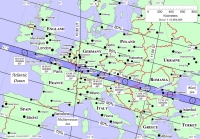
Path of totality
 |
|
Path of totality across Europe |
A total solar eclipse will cross the European continent around noon on 11 August 1999. This will be the last total solar eclipse of the millennium. Most of Europe will see a partial solar eclipse, a rare and spectacular event in itself. More than 350 million people will be able to observe it, from all the capital cities of the European Union.
A strip some 110 km wide, from Cornwall, Le Havre, Rouen, Reims, Virton, Luxembourg, Saarbrucken, Strasbourg, Stuttgart, Munich, Salzburg, Graz, Szombathely, Lake Balaton, Timisoara, Bucharest, will get the full impact of a total eclipse. In this narrow band, for around two minutes, noon will turn to night.
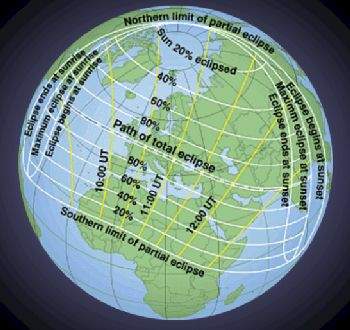
The totality zone will extend further, across the Black sea, Turkey, Syria, Iraq, Iran, Pakistan and India, with decreasing eclipse duration. For most of those who witness it, this will be a unique experience, as for any given place on Earth, a total eclipse occurs less than once every few hundred years.
 |
|
Full path of the total solar eclipse |
Practical Guide
Where to observe in Europe
Given here are the times of Totality, and levels of Eclipse partiality over European sites.
| Place | Time of totality (Universal Time) |
| Cornwall | 10:12 |
| Noyon | 10:24 |
| Strasbourg | 10:33 |
| Munich | 10:38 |
| Graz/Szombathely | 10:45/10:47 |
| Bucharest | 11:07 |
| Karachi | 12:27 |
|
Table 1. Totality on Wednesday 11 August 1999 | |
Eclipse partiality: (330 million people will see a partial eclipse)
| United Kingdom |
London (96.8%), Birmingham (94.3%), Belfast (89.1%) |
| Ireland | Dublin (92.5%) |
| France | Paris (99.2%), Marseilles (84.1%), Toulouse (83.6%) |
| Belgium | Brussels (97.5%) |
| Netherlands | ESTEC (93.8%) |
| Germany | Berlin (89.3%), ESOC/Darmstadt (98.5%), Essen (91.1) |
| Austria | Vienna (99.0%) |
| Switzerland | Bern (95.6%), Geneva (92.9%), Zurich (97.3%) |
| Spain | Madrid (72.8%), Barcelona (77.2%), Canary Islands (35%) |
| Italy | Rome/Esrin (83.8%), Milan (92.2%), Naples (82%) |
| Scandinavia | Copenhagen (81.5), Oslo (71.8%), Stockholm (70.3%), Helsinki (65.2%) |
See eclipse calculation for your own site:
How to take pictures
Warning: never observe without protection filter (density 5) during partial eclipse
| Focal | Field | Size of Sun | Example of image |
| 24 mm | 56×83 | 0.2 mm | Landscape Parinacota |
| 100 mm | 13×19 | 0.9 mm | |
| 200 mm | 7×10 | 1.8 mm | |
| 500 mm | 2.6×3.8 | 4.58 mm | Tamron Chile 94 |
|
Table 2. Examples of possible focal lengths | |||
During the partial eclipse, looking through the filter, you can use indications given by the exposure meter. During the totality, remove the filter and use several exposure times.
After the totality, remember to protect your eyes again, and also your equipment
A feast for amateur observers and eclipse chasers
 |
|
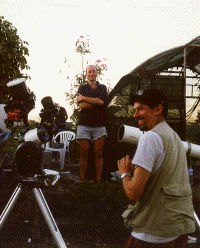
Figure 1. Eclipse chasers |
Eclipses attract crowds of enthusiastic amateurs, who travel long distances, sometimes to exotic countries. They first discover and then rekindle for professional observers the wonder of the moments of eclipse totality. They come with their friends, equipment and obtain beautiful images useful for scientists, and inspire enthusiasm in those around them. They recall their previous eclipse expeditions with much emotion. The eclipse chasers plan their expeditions long in advance. Some of them can predict their future 10 years in advance: they already know they will be along the path of totality for many of the next eclipses! The enthusiasm of these amateurs generates in those around them a true sense of excitement and adventure of science and space.
But don't forget...
...even if you are doing experiments, to watch the eclipse! It is a wonderful scene and a unique experience, that even the best pictures cannot reproduce.
ESA activities
International Science Committee
To coordinate the ESA Eclipse '99 activities, an international Committee has been set up:
ESA ECLIPSE99 International Science Committee
R.M. Bonnet (chairman), ESA Director of Science Programme
B.H. Foing (co-chairman), ESA ECLIPSE99 coordinator
A. Acker, ULP Strasbourg, Presidente Association des Planetariums
E. Antonucci, Professor, Turin observatory
J. Audouze, Director, Palais de la Découverte, Paris
F. Clette, chairman JOSO eclipse working group
R. Ferlet, President Societe Astronomique de France
B. Fleck, ESA, SOHO Project Scientist
M. Huber, Head ESA Space Science Dept.
K. Phillips, Rutherford Appleton Lab., Chair UK eclipse coordination
B. Schmieder, Obs. Meudon, President JOSO
M. Stavinschi, Director Bucharest Observatory
S. Vauclair, Toulouse, President Soc. Francaise Specialistes en Astronomie
O. von der Luhe, Freiburg, Director, Kiepenheuer Institute
J.C. Vial, Orsay, Director MEDOC centre
R. West, ESO, Public Outreach and Education
J. P. Zahn, President, European Astronomical Society
Multi-site Local Organising Committee
We have also set up a Local Organising Committee to support the science experiments and communication activities before and during the eclipse.
We indicate the sites where the members will be present on the day of the eclipse, with their tasks, and possible languages for interview. Staff have been trained for media and about eclipse information.
| Tasks | Sites | Languages (incl. English) |
| B. Foing | Coordinator Overall | F, E, ES |
| B. Battrick | ESA Publication ESTEC | E |
| T. Beaufort | Eclipse Exp. ESTEC | F |
| C. Bingham | SSD support ESTEC | E |
| P. Brekke | SOHO support | F N |
| J. Cami | Youth Camp Szombathely (HU) | NL, F |
| J. Clavel | Vilspa coord. Vilspa | E F, E, S |
| F. Drigani | SCI Communic ESTEC | I |
| B. Fleck | SOHO support Munchen/Stuttgart | D |
| M. Fridlund | SSD Noyen | S, E |
| H. Graf | ESTEC PR ESTEC NL | D |
| C. Habfast | ESA P.R. Paris | D, F |
| S. Ihaddadene | SSD support ESTEC & F | F, Arabic |
| C. Nilsson | SSD support ESTEC | N, SE, F |
| S. Orlando | Science coord. Szombathely (HU) | I |
| H. Olthof | ESA Prodex Bucarest | NL |
| D. Koschny | Experiment Munchen | D |
| H. Maree | PR Paris | NL F |
| R. Marsden | Science/PR ESTEC/Belgium | E, NL |
| D. Nelson | Graphics/media ESTEC | E |
| E. Page | Science/PR UK Cornwall | E |
| E. Rolfe | Science web ESTEC | E |
| L. Sanchez | SOHO Data Coord.SOHO Goddard | ES, E |
| P. Sonnentrucker | Science Strasbourg | F |
| M. Talevi | SCI Communic. ESTEC | I |
| B. Vandenbussche | Youth camp Szombathely (HU) | NL |
| S. Volonte | Science/PR Belgium | F, I |
| K.P. Wenzel | SSD support ESTEC/Germany | D |
| J. Zarnecki | Science/PR Romania | E |
| J. Zender | Data links Munchen | D |
| B. Zufferey | ESA Prodex Bucarest | F |
|
Table 1. ESA Local Organising Committee | ||
Multi-site SSD campaign coordinated with SOHO
A multi-site eclipse campaign will provide a longer sequence of coronal observations. Some of the eclipse images will be transmitted for live internet distribution. The core SSD science experiments will build on previous eclipse campaigns to study temperature and density structure and dynamics in the corona, and to search for cool material in the very hot corona. These eclipse results will be analysed with SOHO data.
See also the links to "Latest SOHO images" and "SOHO and the August 1999 eclipse".
These pages will be updated during the experiments' preparation.
| Site | Planned measurements |
| SOHO | SOHO instruments, MEDOC images online |
| UK- Cornwall | |
| UK- Elderney | |
| F- Noyon | High definition video |
| B- Vitton | Photography |
| F- Strasbourg | High definition video |
| NL- ESTEC | Data collection and internet distribution |
| D- Munich | High definition video, real-time video transmission |
| H- Szombathely | Core SSD eclipse experiements, high definition video, real-time image transmission |
| RO- Vilnica-Rimnicu | High definition video |
| RO- Bucharest | High definition CCD, real-time internet |
|
Table 2. Multi-site eclipse campaign | |
Joint science communication activities at partner sites
| SOHO activities | SOHO live images |
| Eclipse from Space | Meteo and eclipse images |
| UK- Cornwall | Support exhibition and media |
| UK- Alderney | Science Comm. with Royal Astronomical Society |
| F- Palais Decouverte | Exhibition (July-August) |
| F- Museum Hist. Nat. Media resource center | Eclipse info (week before eclipse) |
| F- Moselle | Nuit des Etoiles, TV magazine (10 August) |
| F- Noyon | Societe Astronomique de France |
| B- Vitton | Belgian Astronomy Society |
| F- Strasbourg | European Science, education, cultural activities |
| D- Stuttgart | Stuttgart municipality, Freiburg Obs., ESOC |
| D- Munich | Bayern Astronomy Society, ESO |
| AU- Salzburg/Graz | ASA, space agencies, Alpbach school participants |
| H- Szombathely | Youth astronomy camp |
| RO- Vilnica-Rimnicu | Eclipse maximum |
| RO- Bucharest | Bucharest observatory, EAS, ESA Prodex |
| ESA SSD Astronomische Vereinigung West-München (AVWM) | |
|
Table 3. Joint science communication activities at partner sites | |
Observation Reports
The 11 August total solar eclipse was a unique opportunity to communicate and share our interest for space with the public. Scientists and engineers from ESA's Space Science Department had prepared a range of activities culminating with dedicated eclipse events in Europe. "The experience, the emotions and the memories have been overwhelming, both for those that had clear and those that had cloudy skies. More than 300 million Europeans became eclipse viewers or chasers, and turned into amateur scientists".
From the Atlantic, the UK, Paris, Noyon, Thionville, Strasbourg, Stuttgart, Munich, Hungary and Bucarest, several ESA staff have filmed animated events or captured images to be shared with the European public. Here we give some highlights from these Eclipse99 events in Europe.
The Atlantic
The jetplane expedition by the Irish ESA astronomer Leo Metcalfe and his crew to the eclipse shadow from Ireland was successful and very exciting. See also the 12 August story "Eclipse Riders in The Sky".
Noyon, France
A large event took place with some 8000 amateur astronomers and general public in the official eclipse viewing site with participation of 380 staff from ESA ESTEC and Paris, and 40 000 people in the city of Noyon. Images and results of SOHO were shown and commented for the public and radio by B.H. Foing and M. Laurent, vice-president of Societe Astronomique de France. Live interviews were given in particular to national radios (such as France-Inter, France Info and even the Washington radio). This was a large PR and communication event for ESA and SOHO. More than 30 interviews were given by ESA multinational staff. However the clouds thickened before the eclipse totality.
Thionville, France
A small eclipse imaging team found good weather conditions and took eclipse pictures which were put on the BBC site online.
Chateau de Malbrouk near Metz, France
R.M. Bonnet ESA, Director of Science appeared on French TV on 10/8 and 11/8, twice on France 2 and once on France 3, with large personal success. The sky, however, was cloudy at totality.
Strasbourg, France
The whole week of 4-11 August (16h00-18h00) a daily press conference took place at the France 3 TV auditorium, where SOHO videos, CD-ROM, latest images were presented by the Eclipse99 coordinator B.H. Foing and the SOHO Deputy Project Scientist P. Brekke. On the eclipse day, P. Brekke with F. Perino (conseil general), A. Lancon (Obs de Strasbourg), M. Wirth (vice-president of conseil general) and B.H. Foing (duplex from Noyon), animated a radiophonic event for more than 5000 people in the Strasbourg Petite France area, as well as giving a multimedia show including SOHO images, and eclipse broadcast on a giant projection screen provided by the Conseil General of Bas-Rhin. A successful event organsied by the planetarium also took place on Place Kleber in Strasbourg.
"The eclipse day started with morning rain, then clouds. Just before eclipse totality, the sky just opened up", P. Brekke says. "It was blue and it was dark and people were just stunned". A beautiful eclipse video sequence was obtained.
Stuttgart, Germany
This was a large PR event for the Sun and SOHO, with participation by the SOHO Project Scientist B. Fleck, and scientists from the Max Planck Institute für Aeronomie (Lindau) and the Kiepenheuer Institute (Freiburg). The Science Fair of Stuttgart attracted some 500 000 participants. It was, however, raining on the day of eclipse.
Munich, Germany
In the morning of 11 August, people gathered on the airfield of the "Aeroclub Dachau" close to Munich. Together with the "Astronomische Vereinigung West-München", they organised a small internal gathering to view the eclipse. Detlef Koschny and Joe Zender, scientists of the Space Science Department of ESA, joined them with a setup to send images of the Sun via telephone line to ESA/ESTEC.There was a clear sky at totality and great eclipse video images were obtained.
Burgenland, Austria
A team from the Space Generation Forum that met previously for the UNISPACE III conference in Vienna, organised an eclipse viewing trip led by the ESTEC Young Graduate Trainees N.Frischauf and G. Weinwurm to the central totality line near Oberwart, where they could watch the eclipse shadow approaching from the west and experienced the longest totality over ESA member states (2mn21.5 s).
Szombathely, Hungary
At the International Youth Astronomy Camp in Vep, near Szombathely (Hungary near the Austrian border), more than 150 students had assembled since the beginning of August for lectures and experimental activities. They also prepared educational experiments for the eclipse. S. Orlando and his local collaborators also installed the SSD eclipse science experiments which were previously used in total eclipses in Chile in 94 and Guadeloupe in 98. There was rain and clouds on the morning until first contact, but clear sky at totality. Great eclipse video images were obtained by S. Orlando on a soundtrack which shows the local excitement, and were sent to BBC for their web broadcast.
Bucarest, Romania
There was a fantastic clear and blue sky, which allowed B. Zufferey (ESA Prodex) to obtain video eclipse images.
Ouside the path of totality
Other media activities featuring the Sun, SOHO and space took place all over European sites undergoing only partial eclipse.
Paris, France
A press conference took place daily at the Museum of Natural History from 6 to12 August, with participation from ESA by R.M. Bonnet, B.H. Foing and P. Brekke as well as of scientists from the SOHO MEDOC center. Some of the ESA Eclipse99 European results have been presented at the press conference in Paris on 12 August, and broadcast on French TV TF1 and M6.
Turin, Italy
Eclipse99 committee member Ester Antonucci reports an event in Turin, with TV coverage on the 3rd national channel. The initiative was an overwhelming success: 6000 people turned up at the Turin event and the TV live broadcasting on the eclipse got 41% of the national share, with a peak audience of 6 million people.
Noordwijk, The Netherlands
At ESTEC a public event was organised at Noordwijk Space Expo for more than 1600 people, ESA staff and general public. SSD solar scientist W. Chaplin and eclipse veteran T. Beaufort gave presentations about the Sun, SOHO and eclipses. Also from ESTEC, F. Moser and T. Beaufort coordinated the installation of the cameras and data acquisition and transmission system from ESTEC in the six different sites, simultaneously. The images captured from the different sites were transmitted to BBC and were shown live on the BBC web.