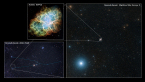
Most detailed image of the Crab Nebula [heic0515]
5 December 2005
A new Hubble image - among the largest ever produced with the Earth-orbiting observatory - gives the most detailed view so far of the entire Crab Nebula. The Crab is arguably the single most interesting object, as well as one of the most studied, in all of astronomy. The image is the largest ever taken with Hubble's WFPC2 workhorse camera.
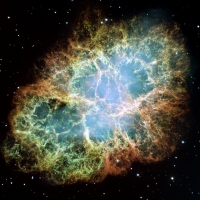 |
| Messier 1: the Crab Nebula |
The Crab Nebula is one of the most intricately structured and highly dynamical objects ever observed. The new Hubble image of the Crab was assembled from 24 individual exposures taken with the NASA/ESA Hubble Space Telescope's Wide Field and Planetary Camera 2 (WPFC2) and is the highest resolution image of the entire Crab Nebula ever made.
The Crab Nebula is a six-light-year-wide expanding remnant of a star's supernova explosion. Japanese and Chinese astronomers witnessed this violent event nearly 1000 years ago in 1054.
The filaments are the tattered remains of the star and consist mostly of hydrogen. The rapidly spinning neutron star embedded in the centre of the nebula, only barely visible in this Hubble image, is the dynamo powering the nebula's eerie interior bluish glow. The blue light comes from electrons whirling at nearly the speed of light around magnetic field lines from the neutron star. The neutron star, like a lighthouse, ejects twin beams of radiation that appear to pulse 30 times a second due to the neutron star's rotation. A neutron star is the crushed ultra-dense core of the exploded star.
The Crab Nebula derived its name from its appearance in a drawing made by Irish astronomer Lord Rosse in 1844, using a 36-inch telescope. When viewed by Hubble, as well as large ground-based telescopes such as ESO's Very Large Telescope, the Crab Nebula takes on a more detailed appearance that yields clues into the spectacular demise of a star, 6500 light-years away.
The newly composed image was assembled from individual Wide Field and Planetary Camera 2 exposures taken in October 1999, January 2000, and December 2000. The colours in the image indicate the different elements that were expelled during the explosion. Blue indicates neutral oxygen, green singly ionized ionised sulphur and red doubly-ionized ionised oxygen. The Hubble data have been superimposed onto images taken with the European Southern Observatory's Very Large Telescope at Paranal Observatory, Chile.
# # #
Notes for editors
The Hubble Space Telescope is a project of international cooperation between ESA and NASA.
Image credit: NASA, ESA and Jeff Hester (Arizona State University)
Acknowledgement: Davide De Martin (www.skyfactory.org)
Contacts
Jesper Sollerman
Dark Cosmology Centre, Copenhagen, Denmark
Tel: +46 8 5537 8554
E-mail: jesper astro.ku.dk
Allison Loll
Arizona State University, Tempe, USA
Tel: +1-480-965-0741
E-mail: allison.lollasu.edu
Jeff Hester
Arizona State University, Tempe, USA
Tel: +1-480-965-0741
E-mail: jhesterasu.edu
Lars Lindberg Christensen
Hubble/ESA, Garching, Germany
Tel: +49-(0)89-3200-6306
Cellular: +49-(0)173-3872-621
E-mail: larseso.org
Ray Villard
Space Telescope Science Institute, Baltimore, USA
Tel: +1-410-338-4514
villardstsci.edu