
Lunar Eclipse Overview
Introduction
A lunar eclipse occurs when the Earth comes between the Sun and the Moon and the Earth's shadow passes over the Moon. This phenomenon can be seen by any observer on Earth for whom the Moon is above the horizon. Lunar eclipses occur at the time of a Full Moon, but not every Full Moon, because the Moon has to be near one of the nodes of intersection between its orbit and the ecliptic plane.
 |
|
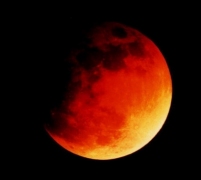
Total Lunar Eclipse |
In practice, the lunar eclipse conditions are modified due to the refraction of the Sun's rays by the Earth's atmosphere. This refraction (of 35 minutes of arc) allows some light to penetrate the cone of the geometric umbra. So even during total lunar eclipse, the lunar disk is not completely dark. This grazing light is more absorbed by the Earth's atmosphere in the blue and yellow portions of the spectrum, giving a particular reddish light during total lunar eclipse.
Science of Eclipses
The study of the Earth's shadow projected on the Moon allows us to deduce that the Earth is spherical. The Ancient Greeks worked this out. Using lunar eclipse timing, as far back as 3rd century BC Aristarchus from Samos estimated the lunar diameter. Using Eratosthene's previous measurement of the Earth's diameter, he deduced the Earth-Moon distance. Hipparcos (150 BC) and Ptolemeus (2nd century AD) improved with impressive precision the measurements of the lunar diameter and Earth-Moon distance.
In the 17th century, in order to improve longitude determination, absolute cartography made use of lunar eclipse phenomena, which were observable simultaneously from different points.
Today, during lunar eclipses, laser ranging measurements can be made with great accuracy using reflectors placed on the Moon during the Apollo and Lunakhod missions. This has allowed more precise measurement of lunar acceleration and the slow down in the Earth's rotation.
Analysis of the refracted light of the Earth's atmosphere during lunar eclipses has also made it possible to show that atmospheric ozone is confined to a layer between 50 and 80 km above the Earth's surface.
Eclipse Conditions
Solar and lunar eclipses are not independent. For both kinds of eclipse the Sun, Earth and Moon have to be aligned. If the lunar orbit plane did coincide with the ecliptic plane, there would be a lunar eclipse at each Full Moon and a solar eclipse at each New Moon. However, due to the inclination (5° 8' 43") of the Moon's orbit compared to that of the Earth, for an eclipse to occur the Moon has to pass through the plane of the Earth's orbit close to Full Moon, or close to New Moon. This happens about twice per year. Due to perturbations in the Moon's orbit the eclipse cycle is not exactly six months.
When these conditions are met, there can be a lunar eclipse and a solar eclipse within 15 days of each other. For example, before the solar eclipse of 11 August 1999, there was a lunar eclipse of 28 July 1999.
A periodicity in the cycle of eclipses was noticed by ancient Greek astronomers. Its duration is 6585.32 days (or 18 years and 10.3 days), after which time the position of the Sun and the Moon, as viewed from the Earth, recur. This is known as the 'Saros cycle'. Within a given Saros cycle the eclipses succeed each other in almost identical manner, except that the observation position on Earth shifts by 120 degrees (0.32 days) from one eclipse to the next.
On average there are 42 solar eclipses (14 partial solar eclipses, 28 central solar eclipses) and 42 lunar eclipses (including 14 total lunar eclipses) per Saros cycle.