
No. 51 - Second Push-Broom Operations Phase
This especially affects the solar arrays at perilune when SMART-1 passes the subsolar point with the Sun on one side and the illumination by light reflected of the full Moon on the other, causing temperatures to rise above 105 °C. This would be close to the qualification limit of the solar arrays of 110 °C.
After several considerations including the trend analysis of the real time telemetry, it was decided not to take any risk and implement a 35° offset in the solar array orientation, enough to keep it within a reasonable range of temperatures. This was implemented on 9 May 2006 and proved to be successful, lowering the maximum reached temperature to around 85 °C instead of the 96 °C prior to the implementation of the offset.
Other SMART-1 operations have been nominal during this period which saw the start of the second push-broom observations phase.
Moon impact preparation:
- Flight Dynamics strategy is completed
- The Swedish Space Corporation Analysis is completed
- The Thermal analysis and simulations are completed
- The new procedures development, testing and validation are completed
- The SMART-1 Principal Investigator, Bernard Foing is finalizing the coordination of the SMART-1 Moon impact and observation campaign
The SMART-1 Ground Operations Automation System (GOAS) will be used operationally in the second half of May, which is a first for an ESA mission.
Future Activities
The future activities are focused on the following:
- Procedures development to raise the orbit by 90 km using the attitude thrusters in June/July
- Finalise documentation and release of the end of mission and Moon impact analysis
- Tone ranging test on SMART-1 with Chinese CLTC Kashi station and with ISRO
- Start using the SMART-1 Ground Operations Automation System (S1 GOAS)
- Preparation of papers for Spaceops and IAA in Valencia
Note: The second ranging test with the Chinese station Kashi is now confirmed for week 22.
Spacecraft Status
AOCS
The AOC subsystem has done well in the reporting period. The solar array off-pointing and the push-broom activities did not affect the overall performance of the AOCS.
Electric Propulsion, Power and Thermal
Electric Propulsion
The Electric Propulsion has been off during the reporting period.
Power
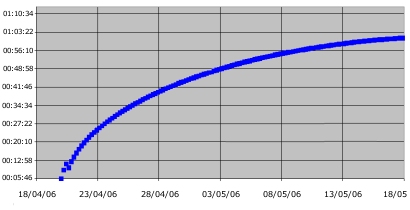
The reporting period saw the start of an eclipse season. The evolution of the eclipse duration can be seen in the plot.
 |
|
Eclipse duration in hh:mm:ss (total for Umbra and Penumbra) |
During the reporting period the maximum eclipse occurred on 14 May and lasted just over one hour:
| Time (UT) | Event |
| 22:02:53 | SMART-1 enters Moon Penumbra |
| 22:03:23 | SMART-1 enters Moon Umbra |
| 23:02:45 | SMART-1 leaves Moon Umbra |
| 23:03:26 | SMART-1 leaves Moon Penumbra |
The performance of the Power Subsystem was very good. As part of the routine analysis during the eclipse, a check of the battery cell capacity was done, showing that there is no degradation of the cells and that the performance is as expected, when compared with previous eclipses.
Thermal
The Thermal Subsystem has performed very well during the reporting period.
Orbital Information
|
SMART-1 OD432 Close to Apolune 2363 Elements WRT Moon and its equator of date | |
| Pericentre Distance (km) | 2133.593201 |
| Apocentre Distance (km) | 4703.495591 |
| Semi Major Axis (km) | 3418.544396 |
| Eccentricity | 0.375877 |
| Inclination (°) | 90.852895 |
| Ascending Node (°) | 239.345651 |
| Argument of Pericentre (°) | 232.698778 |
| True Anomaly (°) | 180.000000 |
| Osculating Orbital Period (h) | 4.982153 |
The changes in four parameters since apolune 2329 are:
- semi-major axis -0.3 km
- perilune height -36.3 km
- apolune height +35.7 km
- orbital period -0.0 min