• → European Space Agency

    • About Science & Technology

    • For Public

    • For Educators

    • ESA

    • Science & Technology

    • Venus Express

    • Missions
    • Show All Missions
    • Mission Home
    • Summary
    • Fact Sheet
    • Objectives
    • Mission Team
    • Orbit View
    • Background Science
    • Venus vs Earth
    • Venus Transits
    • Spacecraft
    • 3D Model
    • Instruments
    • Engineering
    • Mission Operations…

      • Launch Vehicle
      • Launch Campaign
      • Launch Phase
      • Cruise Phase
      • Orbit Insertion
      • Operational Orbit
      • ESOC info
      • Status Reports
    • Science Operations
    • Venus Express Science Operations
    • Data Archive
    • Resources
    • News Archive
    • Multimedia Gallery
    • Publication Archive
    • Status Report Archive
    • Calendar of Events
    • Services
    • Contact Us
    • Subscribe
    • Terms and Conditions
    • Bookmark and Share

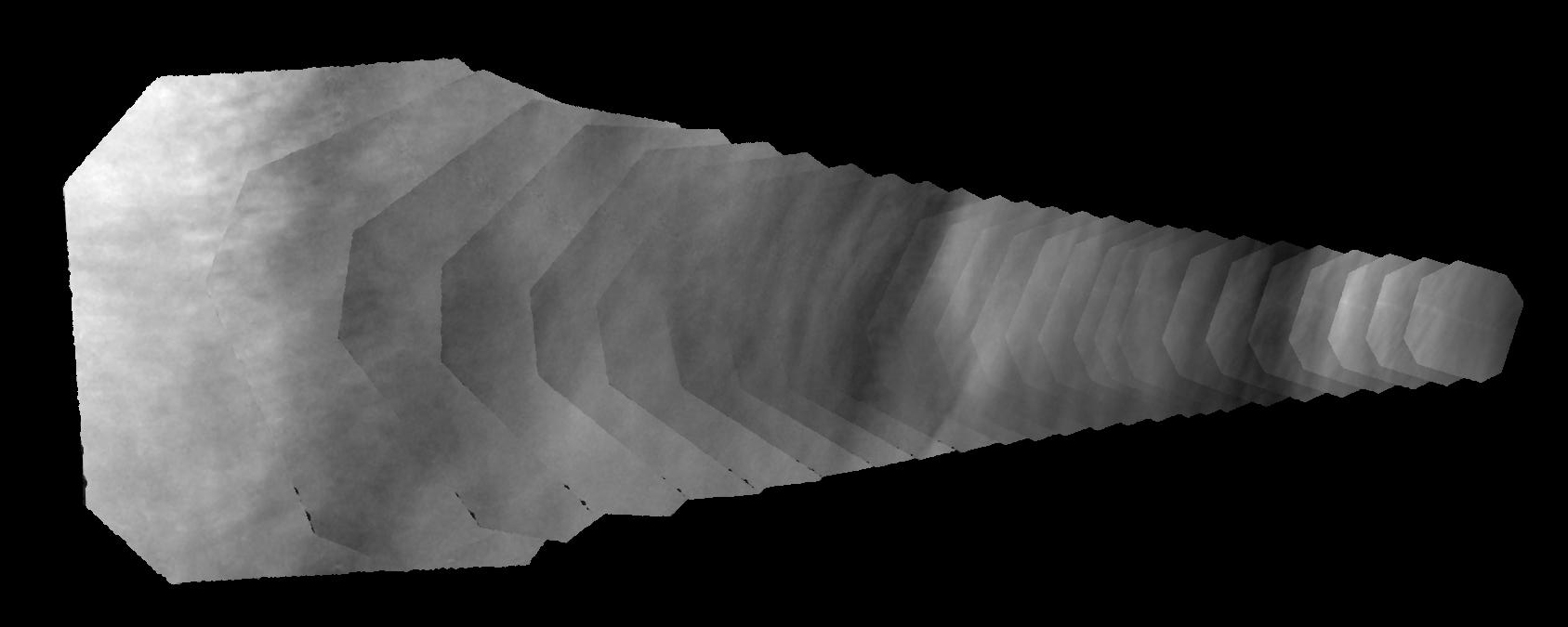
    Ultraviolet Mosaic of Venus's Cloud Structures

    Date: 12 Jul 2006
    Satellite: Venus Express
    Depicts: Ultraviolet images mosaic of Venusian cloud cover
    Copyright: ESA/MPS, Katlenburg-Lindau, Germany

    This mosaic is composed of ultraviolet images taken by the Venus Monitoring Camera (VMC) on 24 April 2006, when the Venus Express spacecraft was flying over the northern hemisphere, at distances ranging between 7505 and 1570 kilometres from the surface.

    The original images (taken at a wavelength of 365 nanometres) were projected on geographical coordinates. While flying over the cloud deck at high speed (from left to right), Venus Express got closer to the deck itself and obtained ever more detailed images.

    The sequence allows a first qualitative analysis of the cloud structures. Low-contrast stripe-features are visible, possibly due to the presence of strong winds that produce elongated structures. A set of periodic wave patterns in the clouds, possibly due to the local variation of temperature and pressure, or to a kind of tidal forces in action at Venus, can also be seen.

    Ultraviolet markings on the cloud top, caused by as yet unidentified UV absorbers, are visible as darker features in this movie. The substance that causes this absorption still represents a true puzzle for the scientists. It absorbs almost half of the solar energy received by the planet, hence the name.

    Differently from Earth and other planets, Venus absorbs only the ultraviolet radiation coming from the Sun, while it scatters most of the rest of the solar radiation, giving rise to a high albedo. This is the reason why Venus appears so bright in the sky.

    Last Update: 12 Jul 2006

    • Shortcut URL
    • http://sci.esa.int/jump.cfm?oid=39679
    • Latest selection
    • Venus Express coverage of Venus (06 January 2013 until 02 February 2013)
    • Venus Express coverage of Venus
    • Change in Venus Express's local time at ascending node
    • Image Hi-Res Versions
    • Hi-Res [tif]
      818.43 kb.
    • Hi-Res [jpg]
      218.84 kb.
    • Related Images
    • Flying over the Venusian Cloud Deck

    Connect with us

    • RSS
    • Youtube
    • Twitter
    • Flickr
    • Google Buzz
    • Livestream
    • Subscribe
    • App Store
    • ESA Science Twitter

    Follow ESA science

    • Copyright 2000 - 2013 © European Space Agency. All rights reserved.

    • Terms and Conditions