
Results from Observations
Overview
The SMART-1 Lunar Impact is being observed across the electromagnetic spectrum with input expected from radio, infrared and optical observatories from around the globe.
3 September - 14:06 UT
- Radio - summary of actvities has been added
- Optical - AMIE images from 2 September
3 September - 08:06 UT
An Infrared image around the moment of impact has been captured by the CFHT team.
3 September - 05:13 UT
The following details have been uploaded:
- Optical - Mosaic of AMIE images of the impact region
3 September - 02:39 UT
The following details have been uploaded:
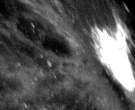
- Optical - SMART-1 star tracker video of lunar surface
- Infrared - CFHT images of lunar surface from 2 September
Radio
SMART-1 was also observed by a network of five cooperating radio telescopes over several months leading up to Moon impact. The observatories' activities are coordinated by the Joint Institute for Very Long Baseline Interferometry (JIVE), hosted by ASTRON (the Netherlands Foundation for Research in Astronomy), Dwingeloo, The Netherlands.
The participating observatories are capable of making highly sensitive observations, characterized by very accurate timing and the ability to detect very weak radio signals.
Starting in the spring of 2006, the cooperating telescopes observed radio signals emitted by SMART-1 and reflected from the Moon as part of a programme to test and validate the very long baseline interferometry (VLBI) technique. VLBI allows ground-based telescopes to track spacecraft with very high accuracy, and furthermore has applications in radio astronomy, including the testing of radio wave propagation in the vicinity of massive bodies like the Moon and the study of the Moon's surface physical properties.
In working with SMART-1, the radio telescopes applied the same techniques used by ground telescopes to track the descent of ESA's Huygens probe to the surface of Saturn's moon Titan in January 2005. This technique is also expected to be used in tracking China's Chang'e-series of Moon missions, to be launched starting in 2007.
Infrared
Click on the tumbnail to view the full image and caption.
3 September 2006
| A contour map of the flash, so bright that it is saturated, shows that the North (top) and South (bottom) of the flash are not identical. There is a clear elongation on the South side in the direction of the motion. | 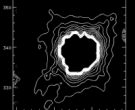 |
| An infrared image from the 3.6m CFHT showing the lunar surface around the time of impact. | 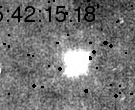 |
2 September 2006
| An image from the CFHT showing the projected impact site for SMART-1 24 hours before impact. The image was acquired with the 3.6 m telescope using an H2 filter with a central wavelength of 2122nm and a bandwidth of 32nm. | 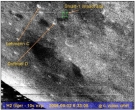 |
Optical
Click on the tumbnail to view the full image and caption.
3 September 2006
|
View: Oblique |
 |
| View: Overhead Description: Rim and ejecta of an unidentified crater |
 |
| View: Overhead Description: Relative smooth region of the lunar surface with two small impact craters. |
 |
| View: Overhead Description: Surface Craters |
 |
| View: Overhead Description: Surface in Detail |
 |
|
View: Overhead |
 |
|
View: Oblique |
 |
| Mosaic of images across the Lunar surface spaning around 1800 km and including the impact site. | 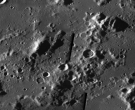 |
| Annotated mosaic of images across the Lunar surface spaning 1800 km and including the impact site | 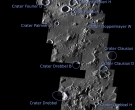 |
2 September 2006
| View: Rotating Oblique Description: An amazing sequence of Moon images in earthshine was taken by one of the SMART-1 star trackers, or attitude cameras, on 1 September 2006. The images are presented as they were acquired, without additional processing. |
 |