• → European Space Agency

    • About Science & Technology

    • For Public

    • For Educators

    • ESA

    • Science & Technology

    • Venus Express

    • Missions
    • Show All Missions
    • Mission Home
    • Summary
    • Fact Sheet
    • Objectives
    • Mission Team
    • Orbit View
    • Background Science
    • Venus vs Earth
    • Venus Transits
    • Spacecraft
    • 3D Model
    • Instruments
    • Engineering
    • Mission Operations…

      • Launch Vehicle
      • Launch Campaign
      • Launch Phase
      • Cruise Phase
      • Orbit Insertion
      • Operational Orbit
      • ESOC info
      • Status Reports
    • Science Operations
    • Venus Express Science Operations
    • Data Archive
    • Resources
    • News Archive
    • Multimedia Gallery
    • Publication Archive
    • Status Report Archive
    • Calendar of Events
    • Services
    • Contact Us
    • Subscribe
    • Terms and Conditions
    • Bookmark and Share

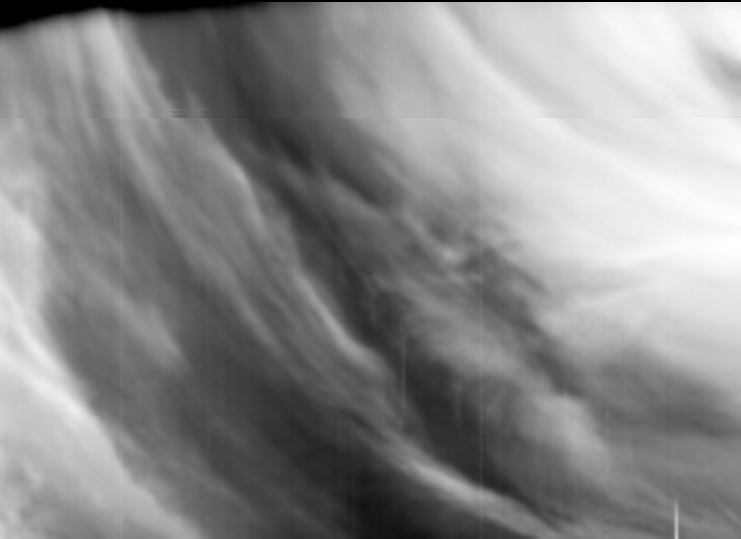
    Venus at 2.3 micron

    Date: 20 Oct 2006
    Satellite: Venus Express
    Depicts: Negative of VIRTIS image of Venus at 2.3 micron
    Copyright: ESA/VIRTIS/INAF-IASF/Obs. de Paris-LESIA

    This picture of the Venusian atmosphere is the negative of a night-side infrared image acquired by the VIRTIS instrument on board Venus Express on 29 July 2006, at a distance of about 65 000 kilometres from the surface.

    The image shows the observed radiation at 2.3 μm, but in negative: bright regions correspond to regions with less infrared radiation coming from the surface due to intervening cloud cover which absorbs it. Therefore the bright regions in this image follow the cloud structure. 

    At the centre of the image is a large cloud extending toward the bottom-right part of the view. The cloud is about 2000 kilometres long and 500 kilometres wide. It presents the peculiar elongated shape of clouds at Venus, which is due to the planet's high-speed winds. 

    The cloudy (bright) region visible at the top-right of the image is situated below 60° south latitude, and represents the transition to the region where the atmosphere is dominated by the effects of the powerful double-eyed south polar vortex.

    Last Update: 20 Oct 2006

    • Shortcut URL
    • http://sci.esa.int/jump.cfm?oid=40163
    • Latest selection
    • Tracking clouds on Venus
    • Increasing wind speeds on Venus
    • Venus cloud tops
    • Image Hi-Res Versions
    • Hi-Res [jpg]
      95.99 kb.
    • Hi-Res [tif]
      188.90 kb.

    Connect with us

    • RSS
    • Youtube
    • Twitter
    • Flickr
    • Google Buzz
    • Livestream
    • Subscribe
    • App Store
    • ESA Science Twitter

    Follow ESA science

    • Copyright 2000 - 2013 © European Space Agency. All rights reserved.

    • Terms and Conditions