
A three-dimensional view of variable winds in the cloud layers on Venus
18 September 2008
A detailed, three-dimensional view of the wind speeds and directions in the cloud layers of Venus has been obtained with the VIRTIS instrument on Venus Express. This study, which benefited from an extensive and homogeneous data set, contributes to a better understanding of the temporal and spatial behaviour of the winds on Venus.
 |
|
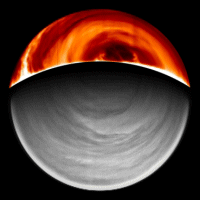
Figure 1. Composite VIRTIS view of Venus's day side (grey) and night side (red). Credit: ESA/VIRTIS/INAF-IASF/Obs. de Paris-LESIA/ Universidad del País Vasco (R. Hueso) |
The study was performed by examining cloud features in pairs of images taken between 20 and 74 minutes apart. The evolution of the cloud features between each image provided a measure of their location as a function of time. From this the zonal and meridional wind speeds were derived.
Multi-wavelength spectral images from VIRTIS can be used to probe different altitudes in the thick cloud layers of Venus. In their study, Sánchez-Lavega and colleagues probed three different altitude ranges using the three wavelengths: 0.38 µm, 0.98 µm and 1.74 µm (see Table 1).
| Lambda (μm) |
Altitudes (km) |
Atmospheric Region | No. of clouds Tracked |
| 0.38 | 62-70 |
Top of upper cloud layer |
625 |
| 0.98 | 58-64 |
Base of upper cloud layer |
662 |
| 1.74 | 44-48 |
Lower cloud layer |
932 |
|
Table 1. Characteristics of the data used in this study | |||
Observed wind speeds
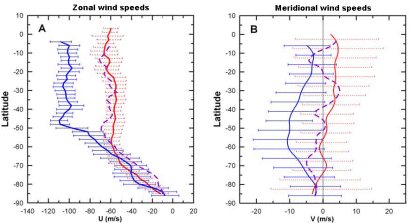
Figure 2 shows the mean wind speed as a function of latitude for both the zonal wind and meridional wind as derived from the observed cloud features. The values are temporally and spatially averaged over narrow latitude bins. Each plot shows the wind speed variation at the three different altitude ranges: 62-70 km (blue), 58-64 km (purple) and 44-48 km (red).
 |
|
Figure 2. Spatially and temporally averaged wind speeds as a function of latitude for the zonal winds, U (A, left) and meridional winds, V (B, right) in the southern hemisphere of Venus. Altitude colour code: blue=62-70 km, purple=58-64 km, red=44-48 km. |
Spatial variations
| Altitudes (km) |
Mean Zonal wind speed (m/s) |
| 62-70 | -102 ± 10 |
| 58-64 | - 62 ± 10 |
| 44-48 | - 60 ± 10 |
|
Table 2. Mean zonal wind speed, temporally and spatially averaged between 0° - 55°S latitude. | |
Clearly visible is the fast westward zonal rotation (known as super-rotation) of the upper cloud deck with an average speed of 102 ms-1 between 0° and ~55° southern latitude. In the other two altitude ranges the same westward wind is present, but with a substantially lower wind speed (table 2). This implies there is a large shear between adjacent altitude layers mainly in the upper cloud deck and from the equator down to ~55°S.
At higher southern latitudes the zonal wind speeds drop linearly and steadily toward the pole for all three altitudes. In addition, at these latitudes the difference between the wind speeds in the three altitude ranges diminishes as all layers start to co-rotate coherently with the large polar vortex.
The meridional wind speed was found to vary little with latitude. Taking account of the measurement uncertainties it is only at the top of the upper cloud deck that a trend is observed with an increase from ~0 to ~10 ms-1, peaking at the latitude 55°S (Figure 2B, blue curve).
Temporal variations
The long time span covered by the observations allowed the team to investigate the temporal variation of the measured wind speed. There was some indication of variation in the speed of the zonal wind as a function of latitude and in the 58-64 km altitude range. It was ~13 ms-1 faster at the start of observations (in April 2006) compared to the average over the entire observation period. This variation, however, needs to be confirmed with further measurements.
A more pronounced effect found in the course of the study by Sánchez-Lavega and colleagues was a strong dependency on wind speeds with local solar time. Between the morning and mid-afternoon the zonal wind speed increased by about 10 ms-1. This effect only occurred in the top cloud layers and only at the higher latitudes (above 50°S).
Overall, the results reported in Sánchez-Lavega et al, when combined with measurements of the Venusian wind speeds obtained with other spacecraft, confirm a sharp change in the zonal circulation at ~55 degrees latitude.
Ongoing observations with Venus Express will help to determine if the observed mean wind speeds are stable and typical for Venus, and will further characterise the nature and variations of the mean zonal winds in the cloud layers.
Related publication
Sánchez-Lavega, A., et al. (2008), Variable winds on Venus mapped in three dimensions, Geophys. Res. Lett., 35, L13204, doi:10.1029/2008GL033817
