• → European Space Agency

    • About Science & Technology

    • For Public

    • For Educators

    • ESA

    • Science & Technology

    • Hubble

    • Missions
    • Show All Missions
    • Mission Home
    • Summary
    • Fact Sheet
    • About Hubble
    • Orbit View
    • Spacecraft
    • Spacecraft
    • 3D Model
    • Hubble instruments
    • Engineering
    • Mission Operations
    • Operating Hubble
    • Launch
    • SM 1
    • SM 2
    • SM 3A
    • SM 3B
    • SM 4
    • Timeline
    • Science Operations
    • Science Archive
    • Resources
    • News Archive
    • Multimedia Gallery
    • Publication Archive
    • Calendar of Events
    • Services
    • Contact Us
    • Subscribe
    • Terms and Conditions
    • Bookmark and Share

    Stars forced to relocate near the Southern Fish [heic0902]

    03 Mar 2009

    A new Hubble image shows three galaxies locked in a gravitational tug-of-war that may result in the eventual demise of one of them.
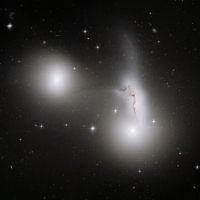
    ACS image of the group of three galaxies NGC 7173, NGC 7174 and NGC7176

    About 100 million light-years away, in the constellation of Piscis Austrinus (the Southern Fish), three galaxies are playing a game of gravitational give-and-take that might ultimately lead to their merger into one enormous entity. A new image from the Advanced Camera for Surveys on the NASA/ESA Hubble Space Telescope allows astronomers to view the movement of gases from galaxy to galaxy, revealing the intricate interplay among them.

    The three pictured galaxies - NGC 7173 (middle left), NCG 7174 (middle right) and NGC 7176 (lower right) - are part of the Hickson Compact Group 90, named after astronomer Paul Hickson, who first catalogued these small clusters of galaxies in the 1980s. NGC 7173 and NGC 7176 appear to be smooth, normal elliptical galaxies without much gas and dust. In stark contrast, NGC 7174 is a mangled spiral galaxy, barely clinging to independent existence as it is ripped apart by its close neighbours. The strong tidal interaction surging through the galaxies has dragged a significant number of stars away from their home galaxies. These stars are now spread out, forming a tenuous luminous component in the galaxy group.

    Ultimately, astronomers believe that the stars in NGC 7174 will be redistributed into a giant 'island universe', tens to hundreds of times as massive as our own Milky Way.

    Notes for editors
    The Hubble Space Telescope is a project of international cooperation between ESA and NASA.
    Image credit: NASA, ESA and R. Sharples (University of Durham, U.K.)

    Contact

    Colleen Sharkey
    Hubble/ESA, Garching, Germany
    Tel: +49-89-3200-6306
    Cell: +49-151-153-73591
    E-mail: csharkeyeso.org


    Last Update: 17 Mar 2009

    • Shortcut URL
    • http://sci.esa.int/jump.cfm?oid=44338
    • Images and Videos
    • Three interacting galaxies
    • Wide-field view of the Hickson Compact Group 90
    • A wide-field view of Piscis Austrinus, Aquarius and Capricornus
    • Related Links
    • Related videos [heic0902]

    Connect with us

    • RSS
    • Youtube
    • Twitter
    • Flickr
    • Google Buzz
    • Livestream
    • Subscribe
    • App Store
    • ESA Science Twitter

    Follow ESA science

    • Copyright 2000 - 2013 © European Space Agency. All rights reserved.

    • Terms and Conditions