
ESA support team in action for HST servicing mission
13 May 2009
The fifth and final servicing mission to the Hubble Space Telescope (HST) is now underway. Although most eyes will be on the astronauts as they carry out the instrument replacement activities a lot of behind-the-scenes work will be going on in support of these activities. This includes the work of a dedicated ESA engineering support team monitoring the ESA hardware on the HST.ESA's contribution to HST
 |
|
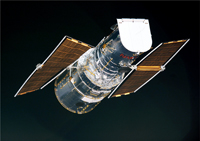
The Hubble Space Telescope with the two ESA solar arrays before they were replaced. Credit: NASA/ESA |
The Hubble Space Telescope (HST) is a joint ESA/NASA project with ESA having a nominal 15% stake in the mission. ESA provided one of the original imaging instruments - the Faint Object Camera (FOC) - and the first two solar array wings (and auxiliary mechanisms) that power the telescope. Although the original ESA solar array wings have been replaced the auxiliary mechanisms remain. These comprise the two Solar Array Drive Mechanisms (SADM), the Solar Array Drive Electronics (SADE), and the Drive Control Electronics (DCE). The SADMs, located on each of Hubble's two solar array wings, are used to maintain the solar pointing aspect of the arrays. In addition they also play a key role in ensuring the pointing accuracy required for scientific operations.
During normal operations of the HST in-orbit, the ESA engineering support concentrates on the performance trend assessment of the SADMs, which show excellent performance over the mission. In addition, support has been provided for the preparation of the required documentation for the past and present servicing missions. These documents govern all Flight/EVA operations (Flight Rules, Command Plan, Contingency Operation Procedures, etc.).
As well as the hardware contributions ESA also supports a team of scientists and computer staff working at the Space Telescope Science Institute in Baltimore (Maryland). In Europe the astronomical community receives observational assistance from the Space Telescope European Coordinating Facility (ST-ECF) located in Garching, Munich.
Special solar array configurations for EVAs
The ESa hardware will be closely monitored during servicing mission 4. From the capture of the HST by the Remote Manipulator System of the Shuttle until final release of the telescope after completion of the servicing mission, the SADMs have to rotate the solar arrays into specific configurations suitable for EVA access to the various worksites and compliant with the design constraints of the hardware performance limitations.
A dedicated ESA team at GSFC for SM4
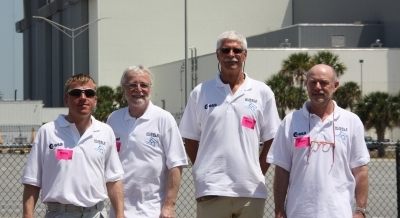
A dedicated engineering support team led by Michael Eiden, ESA HST Project Manager, and including Lothar Gerlach from the technical directorate at ESA, and Udo Rapp and Manfred Schmid from EADS Astrium will be on duty during SM4 to monitor the ESA hardware. In case of any anomalies, the quick reaction of the team in resolving problems will be essential for the overall success of the servicing mission.
 |
|
ESA HST team members (from left): Udo Rapp, Lothar Gerlach, Manfred Schmid and Michael Eiden. Credit: ESA |
The team brings a wealth of experience to this servicing mission with both Michael and Lothar having participated in two previous servicing missions and all four team members having many years of experience with the HST.
During SM4 the team will be based at the Space Telescope Operations Control Center (STOCC) at NASA’s Goddard Space Flight Center. Working in pairs covering 12 hour shifts for the duration of the 11 day mission they will closely monitor the behaviour of the ESA hardware on the HST via consoles at the STOCC. These allow them to follow live transmissions of the ground to in-orbit to ground communications (via mission control in Houston) and the telemetry status. With this data the team can check that the tasks are executed according to the pre-planned and pre-programmed servicing mission integrated timeline (SMIT) and verify that the hardware performances remain within acceptable design ranges and capabilities.
Status reports
For the duration of the servicing mission the team will provide regular updates on their activities in the form of status reports. These reports can be accessed from the right-hand menu.
