
Planck cooling system
Summary
To achieve its scientific objective of measuring the cosmological parameters, the Planck mission must make measurements of the temperature variation in the Cosmic Microwave Background with an unprecedented sensitivity down to ΔT/T ~ 2×10⁻⁶ and an angular resolution of 5 arcminutes.
In order to reach these sensitivity levels, the detectors of Plancks two instruments (the low frequency instrument (LFI), and the high frequency instrument (HFI)) need to be cooled to cryogenic temperatures. The LFI detectors require an operational temperature of 20 K while the HFI detectors need to be cooled down to a mere 0.1 K.
These operational temperatures are achieved with a cooling chain using several temperature steps, through a combination of passive cooling and a sophisticated active cooling system, which are detailed in the two related articles in the right-hand menu.
Passive cooling
The key elements of the Planck spacecraft's passive cooling system are the three V-groove thermal shields and the telescope baffle.
V-grooves
 |
|
The Planck spacecraft with its characteristic V-grooves and telescope baffle (26 Feb 2009) |
The V-grooves are a set of three specular, conical thermal shields with an opening angle of 5° between adjacent shields. They are located between the service module, which operates at ambient temperatures and houses all spacecraft's warm elements, and the telescope that is at about 50 K or -220 °C.
Each V-groove is composed of six 60° sections. The layout of the V-grooves with their reflective surfaces and the opening angle make them efficient insulators (any radiated heat is reflected out into space). The V-grooves are at progressively colder temperatures, dropping in three steps from the 300 K of the service module to about 45 K at the topmost V-groove, closest to the payload.
Baffle
The telescope baffle surrounds the telescope and the focal plane. It is a high-efficiency radiator made of aluminium honeycomb and painted black on the outside. The baffle is fully reflective inside and also acts as a straylight shield, preventing unwanted radiation from entering the telescope and the instrument detectors located in the focal plane underneath the telescope's primary mirror.
Together, the baffle and V-grooves provide a thermal environment at about 45 K for the telescope and the focal plane units (FPU) of the LFI and HFI instruments. This passive cooling is an important pre-cooling stage for the active cooling system.
An important factor for the effectiveness of the spacecraft's passive cooling is that Planck is operated at the second Lagrange point L2 of the Sun-Earth system, where the lower side of the spacecraft is continuously oriented towards the Sun, keeping the V-grooves and the telescope always in the shadow with direct view to cold space.
Active cooling system
The Planck spacecraft's active cooling system builds on the thermal environment provided by the passive cooling system. It comprises three different coolers and ultimately reaches a temperature close to absolute zero to bring the instrument detectors to their final sensitivities:
- a hydrogen sorption cooler that cools the LFI FPU to 20 K and pre-cools the HFI FPU to 18 K
- a Joule-Thomson cooler that cools the HFI FPU to 4 K
- a 3He/4He dilution cooler that cools the bolometers of the HFI FPU to 0.1 K
20 K cooler
 |
|
Planck cooling system with the |
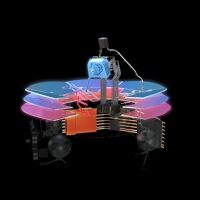
The first cooler in the active cryogenic cooling chain is a closed-cycle sorption cooler, with hydrogen as the working medium. It cools the LFI FPU to 20 K and pre-cools the HFI FPU to 18 K. The cooler consists of a sorption compressor unit, piping, and a cold end. Inside the sorption compressor unit six identical compressor elements use a unique metal hydride material to absorb hydrogen gas at low pressure and temperature and to release it again at high pressure when they are heated.
The hydrogen leaves the heated compressor element and flows through piping to the cold end, located inside the focal plane. The piping runs past the three V-grooves that efficiently pre-cool the gas through heat exchange down to about 45 K. At the cold end the gas undergoes a Joule-Thomson expansion, producing liquid droplets whose evaporation provide the cooling power. After cooling the FPU the hydrogen is guided back to the compressors to be re-absorbed. Cycling through the six compressor elements (switching from one compressor to the next when it has released its hydrogen) achieves a constant massflow and cooling power.
To provide full redundancy to the mission, two identical 20K coolers are installed on the Planck spacecraft. The 20K coolers were built by the Jet Propulsion Laboratory (Pasadena, California, US), a member of the LFI and HFI Consortia.
4 K cooler
 |
|
Planck cooling system with the |
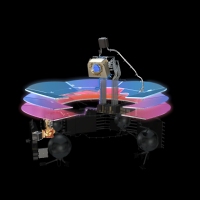
The second cooler in the active cryogenic cooling chain is a Joule-Thomson cooler that cools the HFI FPU down to 4 K. It is a closed-cycle system with 4He as the working medium. Two frictionless mechanical compressors situated in the service module pump 4He gas into the cooler pipework. The pressurised gas flows through the piping towards the cold end located in the HFI FPU. On its way there the gas is pre-cooled through a heat exchanger on the spacecraft's coldest V-groove and one on the 18 K stage of the 20 K cooler.
At the cold end the 4He gas undergoes a Joule-Thomson expansion leading to small amounts of liquid helium that provides the cooling power and cools the HFI FPU to about 4 K. The 4K cooler was built by the Rutherford Appleton Laboratory (Didcot, UK), a member of the HFI Consortium.
0.1 K cooler
 |
|
Planck cooling system with the |
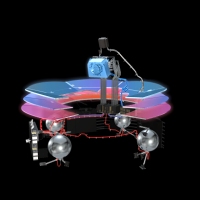
The final, and coldest, stage of the active cryogenic cooling chain is the dilution cooler that cools the HFI detectors to 0.1 K. It also keeps an enclosure that surrounds the detectors within the HFI FPU at an intermediate temperature of 1.6 K, acting as a buffer towards the FPU's warmer 4 K outer enclosure.
The working principle of the 0.1 cooler is based on the thermo-dynamical properties of 3He/4He mixtures at a temperature below ~1K. A phase transition induced by over-saturating the mixture of these two helium isotopes with 3He causes the mixture to cool, drawing heat from its surroundings.
Three high pressure tanks filled with 4He and one high pressure tank filled with 3He are housed in the service module. From each tank a pipe runs to the flow regulation control unit. From here the helium isotope gases flow separately towards the HFI FPU. Along the way the gases progressively cool down through heat exchangers with the spacecraft's three V-grooves and with the 18K and 4K stages of the active cooling system. Within the HFI FPU the 3He and 4He are mixed, after which the mixture cools and the detectors reach 0.1 K.
The 0.1 K cooler is an open system: at the end of the cooling process in the FPU the gas mixture is guided out through piping and vented into space. Over the course of the mission the helium from the four tanks will slowly be depleted. The required gas flow rates, however, are very low and the amount of 3He and 4He that Planck carries on-board is enough for about 3 years of operations.
The 0.1K cooler was built in collaboration by the Institut Néel (Grenoble), the Institut d'Astrophysique Spatiale (Orsay, FR), both members of the HFI Consortium, and DTA Air Liquide (Grenoble).

