
No. 215 - Mission Operations Update
| Bad weather at the site of the Cebreros ground station in Avila, Spain, impeded any contact with the spacecraft on 21 December (DOY 355). The 35-metre antenna that is used for the daily communication passes with Venus Express was covered in snow and ice. The image on the right was taken by the Cebreros webcam. | 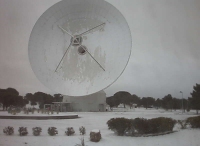 |
| MET (Day) |
Date | DOY | Main Activity |
| 1503 | 20/12/09 | 354 |
Communications pass over Cebreros |
| 1504 | 21/12/09 | 355 |
Communications pass over Cebreros. |
| 1505 | 22/12/09 | 356 |
Communications pass over Cebreros |
| 1506 | 23/12/09 | 357 |
Communications pass over Cebreros |
| 1507 | 24/12/09 | 358 |
Communications pass over Cebreros |
| 1508 | 25/12/09 | 359 |
Communications pass over Cebreros. |
| 1509 | 26/12/09 | 360 |
Communications pass over Cebreros |
At the end of the last Cebreros pass in the reporting period (DOY 360) Venus Express was orbiting Venus at 255 million km from the Earth. The one-way signal travel time was 850 seconds.
Spacecraft
Attitude and Orbit Control System (AOCS)
The AOCS is in its nominal configuration and performing nominally. Operations continue with all four reaction wheels.
The slight increase in the friction level on reaction wheel 1 (RW1) that started earlier on DOY 352 lasted up to DOY 357. The bearing temperature of RW1 has followed the same pattern, showing an increased temperature between DOY 352 and DOY 357, dropping again afterwards.
The behaviour of RW2 remains the same as during the previous reporting periods (see status report no. 212).
Payload Activities
ASPERA
The instrument was regularly operated as part of the routine plan.
MAG
The instrument was regularly operated as part of the routine plan.
PFS
The instrument was not operated during the reporting period.
SPICAV
The instrument was regularly operated as part of the routine plan.
VeRA
No radio science observations were made during the reporting period.
VIRTIS
VIRTIS-M was operated in the visual channels only.
VMC
The instrument was regularly operated as part of the routine plan.
Future Milestones
- Venus at superior conjunction on 11 January 2010. Venus Express superior conjunction operations: 29 December 2009 to 22 January 2010
---
Legal disclaimer
This report is based on the ESOC mission operations report, MOR #215. Please see the copyright section of the legal disclaimer (bottom of this page) for terms of use.
