
AKARI produces two new infrared all-sky catalogues
31 March 2010
Two new infrared catalogues, containing more than 1.3 million celestial sources, are made public today. The AKARI All-Sky Catalogues, based on the first all-sky infrared survey in more than a quarter of a century, will provide important new data for a wide range of studies that cover topics ranging from the properties of nearby stars, to the formation of planetary systems, and the star formation history of the distant Universe.All-sky surveys are an essential tool for astronomers. The large numbers of objects that are detected in these surveys lend themselves to classification and statistical analyses of celestial bodies. The astronomical census that results from a multi-wavelength, all-sky survey provides a firm framework on which to build a deeper understanding of the formation and evolution of galaxies, stars and planetary systems. For more than 25 years astronomers have relied on the IRAS all-sky atlas, based on observations made in 1983 with the InfraRed Astronomical Satellite, to provide this type of information at infrared wavelengths. Today, the scientific community has an important new tool for this work: the AKARI all-sky catalogues.
 |
|
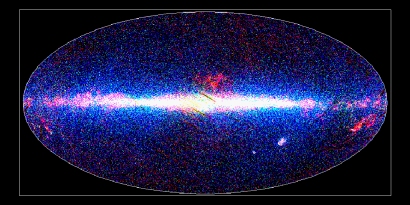
AKARI's view of the infrared sky: sources found at 9 micrometres are represented in blue, at 18 micrometres in green, and at 90 micrometres in red. Credit: JAXA |
These new catalogues, the AKARI-IRC Point Source Catalogue and the AKARI-FIS Bright Source Catalogue, are a significant improvement upon the previous all-sky infrared survey that was produced with IRAS. AKARI can pinpoint the location of a star to an accuracy of arcseconds (compared to arcminutes with IRAS), and it is about 10 times more sensitive (at 18 micrometres) than IRAS. These improvements will have a significant impact on the science that can be performed with these all-sky surveys.
"The release of the catalogues is very timely", notes Alberto Salama, Project Scientist for AKARI at ESA. "Many of the objects detected by AKARI and contained in these catalogues will be prime candidates for future investigation at far-infrared and submillimetre wavelengths with Herschel. These catalogues will be very useful for astronomers preparing for the next opportunity, in May, to propose observations with Herschel."
Some preliminary scientific studies using these new AKARI catalogues have been carried out by AKARI team members. These touch on: studies of the star formation history in the Universe, properties of star-forming galaxies, and searches for evidence of dust associated with planet formation in the debris disks around stars other than the Sun. These early studies, described in the accompanying article "Selected highlights from early studies with the AKARI all-sky catalogues" (see link in right-hand menu)demonstrate the role and importance of infrared observations in exploring a wide variety of astronomical topics.
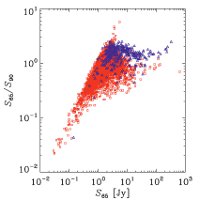
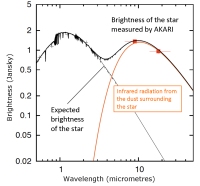
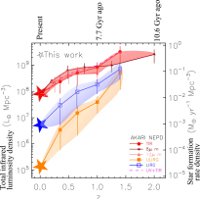
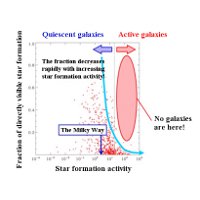
Highlights from some of the preliminary studies performed with the new AKARI all-sky catalogues include: (top left) the development of a new classification scheme for distinguishing stars from galaxies in large data sets, (top right) investigation into the frequency of the planet formation process, (lower left) determination of the local star formation density – an important contribution to determining the cosmic star formation history - and (lower right) new measurements of the amount of dust that is obscuring local galaxies.
Editors notes:
AKARI, the first Japanese infrared astronomical satellite, was launched in February 2006, surveying the entire sky during its 16 month cryogenic mission lifetime between May 2006 and August 2007. The 68.5 cm diameter telescope was specially designed for infrared observations with its two instruments: the Infrared Camera (IRC), and the Far-Infrared Surveyor (FIS) instrument. In addition to the all-sky survey, AKARI performed more than 5000 pointed observations over the wavelength range 2-180 micrometres in 13 bands, providing comprehensive multi-wavelength photometric and spectroscopic coverage of a wide variety of astronomical sources: nearby solar system objects, zodiacal light, brown dwarfs, young stars, debris disks and evolved stars in our Galaxy and in other galaxies of the Local Group.
AKARI achieved its planned 'cold' lifetime of 550 days, during which it conducted the all-sky survey. AKARI also carried out more than five thousand individual pointed observations in this phase.
Its on-board supply of liquid helium ran out on 26 August 2007, and the spacecraft entered a new mission phase. The liquid helium was required to keep AKARI cold enough to observe in the far-infrared. The warm phase now uses the surviving instrument, the near-infrared mode of the infrared camera, which can operate under the warmer conditions provided by the on-board mechanical cooler, for near-infrared observations.
AKARI is a JAXA project with the participation of ESA. Development of the satellite and instruments, operation, and data reduction have been carried out in collaboration with the following institutes; Nagoya University, The University of Tokyo, National Astronomical Observatory Japan, Imperial College London, University of Sussex, The Open University (UK), University of Groningen / SRON (The Netherlands), and Seoul National University (Korea). The far-infrared detectors were developed under collaboration with The National Institute of Information and Communications Technology.
ESA's European Space Operations Centre (ESOC) in Darmstadt, Germany, provided the mission with ground support through its ground station in Kiruna, Sweden, for several passes per day in the cold phase of the mission.
ESA's European Space Astronomy Centre (ESAC) near Madrid, Spain, provided support for the sky-survey data processing through the pointing reconstruction - this allows the determination of accurate astronomical positions for each of the sources detected. ESAC also contributed to the issue of the AKARI-IRC Point Source catalogue. The AKARI survey catalogues are an important legacy for Herschel and Planck.
ESAC also provides user support for European astronomers who have been granted observing opportunities. The 10% of observing time obtained from this collaboration resulted in 400 observations in the cold phase and 844 in the warm phase, covering various fields of astronomy, from comets to cosmology.
The two catalogues that are publicly released are the AKARI-FIS Bright Source Catalogue Version 1 containing far-infrared (65, 90, 140, 160 micrometres) fluxes of 427,071 sources, and the AKARI-IRC Point Source Catalogue Version 1 containing mid-infrared (9 and 18 micrometres) fluxes of 870,973 sources. The data are provided as files (FITS/Text) as well as via the AKARI Catalogue Archive Server (AKARI-CAS) web search interface from the following websites: http://www.ir.isas.jaxa.jp/AKARI/Observation/ http://darts.isas.jaxa.jp/astro/akari/cas.html
For further details please contact:
Alberto Salama, ESA AKARI Project Scientist
Science Operations Department,
European Space Astronomy Centre,
Directorate of Science and Robotic Exploration
European Space Agency
Email: Alberto.Salama esa.int