Lutetia flyby navigation campaign up to 14 June 2010

Date: 24 June 2010
Satellite: Rosetta
Depicts: Rosetta - Lutetia flyby target plane
Copyright: ESA
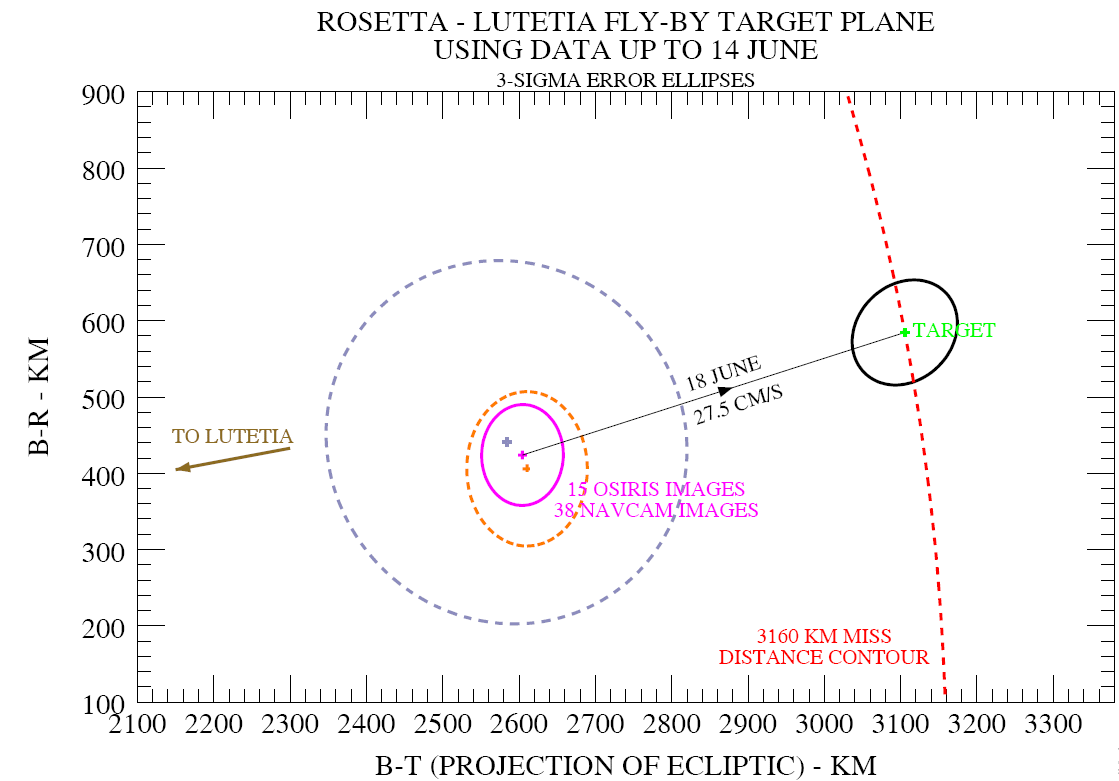
This plot shows the situation in the target plane for Rosetta's flyby of asteroid Lutetia on 10 July 2010. It is based on radiometric data and ground-based astrometric data, as well as the optical navigation data from Rosetta's on-board cameras up to and including 14 June 2010.
The target plane is a planar coordinate system centred on the asteroid and is used for targeting during this close flyby. The target relative position of Rosetta for the flyby is marked in green and is 3160 km from asteroid Lutetia (at the origin of the plot, direction indicated with arrow).
Ellipses indicate 3-sigma error circles around Rosetta's determined positions (crosses) relative to the asteroid.
Up to 14 June, 20 images have been obtained with each of Rosetta's two navigation cameras (NAVCAMs) and 15 images with the OSIRIS narrow angle camera (NAC). These images of Lutetia and the stellar background have been reduced to provide 55 measurements of the direction from Rosetta to the asteroid. Two of the NAVCAM measurements were discarded, leaving 53 for the orbit determination.
The blue and orange crosses and associated, dashed error ellipses are previous solutions in the target plane from 7 June 2010 - see the related image in right-hand menu.
The magenta cross and associated error ellipse is the new prediction based on data up to 14 June. Rosetta's projected position in the target plane lies 2639 km from Lutetia and 526 km from the target. The error ellipse has semi-axes of 66 × 54 km. Since the previous result from 7 June, the predicted time of closest approach has moved back by just 0.16 seconds to 15:45:00.03 UTC. The 3-sigma uncertainty is 7.47 seconds.
Trajectory control manoeuvre
A trajectory control manoeuvre (TCM) is planned for 18 June, with a magnitude of 27.5 cm/s, to move Rosetta's projected position in the target plane closer to the target point.
The black error ellipse shows the expected situation after the nominal TCM. The ellipse is larger than the orange one because of the uncertainty margins on the manoeuvre performance - 3% in magnitude and 1.7 degrees in direction (both 1-sigma). The ellipse has semi-axes of 75 × 63 km. For the same reason, the 3-sigma uncertainty on the time of closest approach increases from 7.58 to 8.12 seconds.
After the manoeuvre, the expected time of closest approach moves forward by 4.46 seconds to 15:44:55.57 UTC.