
Planetary Entry Probes (PEP) for Venus and Outer Planets
Study summary
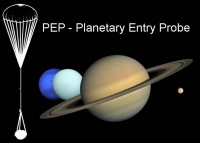 |
The main objective of the study was to analyse entry-probe missions to planets with - in Europe - currently largely unknown entry conditions. With the focus on entry and descent, a generic mission profile was derived for each analyzed planet to define arrival velocities and typical communication windows when the probe is released from a carrier spacecraft on hyperbolic approach. As an exception, the Venus case featured the option to have the probe as a piggy-back on-board a larger mission that uses a Venus gravity assist.
The probe mass target was around 200-300 kg with variations depending on the entry conditions and the resulting loads on the thermal protection system. Within this envelope a generic scientific payload of 10 kg could be accommodated on the probe, including for example a camera and a mass spectrometer. This payload is only to be understood as a strawman package interchangeable and adjustable to the needs of the scientific community in case such a mission is being studied further.
The study was split in two main parts, one investigating a Venus probe and one for the outer planets (higher entry velocity and colder environment than Venus, similarity in chemical composition but different from Venus). The probe design was adjusted and optimised to the specific entry conditions of each planet.
Following the entry phase, different descent profiles have been identified and traded-off. The main driver during descent is the communications link with the carrier spacecraft used for science and housekeeping data return. The communication window between probe and carrier is dependent on the carrier distance, the elevation of the probe as the carrier passes overhead, and the atmospheric attenuation which increases with depth of descent. A local optimum was found at descent times of 60 minutes at Venus (also driven by thermal constraints) and around 90 minutes at the outer planets. The descent strategy relies on parachutes, free-fall or a combination of both to reach down to 100 bar levels (92 bar for Venus on its surface).
The study identified commonalities and differences between the probe design and the driving entry conditions at the targets and thus should aide the scientific community in identifying suitable future mission candidates and their design.
Assessment study
The assessment study for Planetary Entry Probes was carried out between 14 April 2010 and 30 June 2010 in 16 design sessions. The internal final presentation was held on 30 June and is now available to the community as a PDF document. The document can be retrieved through the link in the right-hand menu under “related publications”.
Background Information: Mission Analysis Transfer Options
In the context of the PEP CDF study a survey of interplanetary transfer options to the outer planets in the 2025-2035 timeframe has been completed. Launch opportunities with Soyuz and Ariane 5 have been investigated, including the opportunity to deliver two probes in a single mission - one during flyby at Venus and one probe to the outer planets. For probes to Uranus and Neptune, as well as for the two-probe option, only an Ariane 5 launch seems feasible with sufficient margin. The transfer duration ranges from between 8 and 10 years for Saturn to around 20 years for Neptune, with launch opportunities every year to Saturn and three opportunities to Uranus or Neptune. For detailed information on all options please refer to the document provided through the link in the right-hand menu under "related publications".