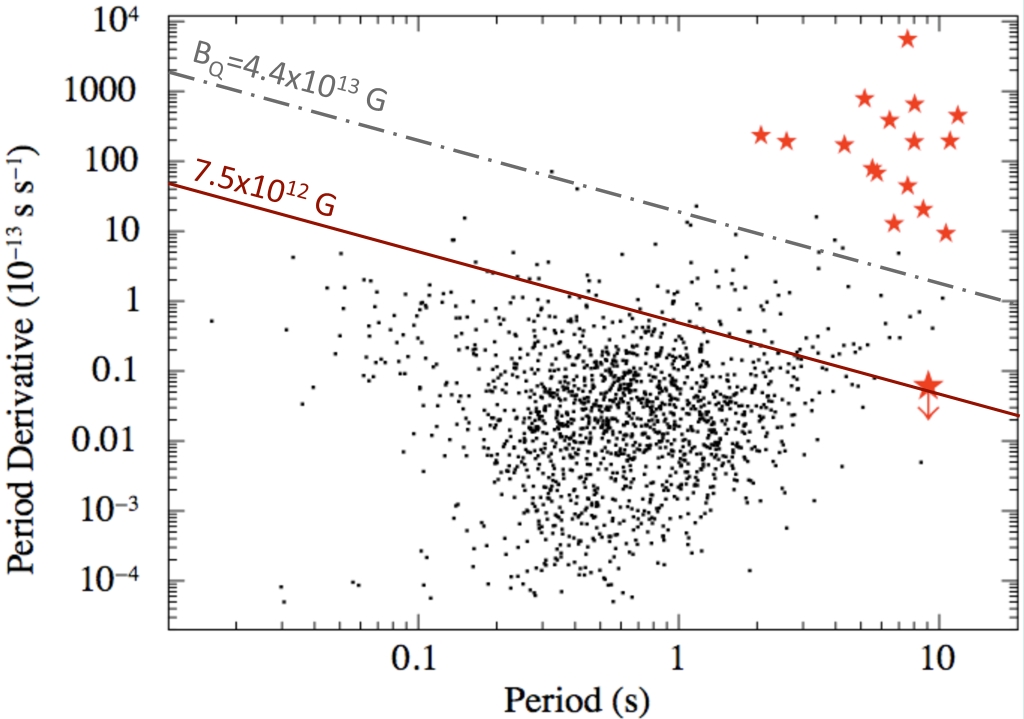
The spin-period/
spin-down rate diagram for pulsars

Date: 14 Oct 2010
Satellite: XMM-Newton
Copyright: From N. Rea et al., (2010)
Pulsars are spinning neutron stars that appear as pulsating sources because beams of electromagnetic radiation stream out above their magnetic poles, which are not always aligned with the star's axis of rotation.
Magnetars are pulsars characterised by long rotations periods, occasional episodes of extremely enhanced emission (about 10–100 times the usual value) and intense, short bursts of X-rays and gamma-rays; these highly energetic events are presumed to be powered by an intense magnetic field.
This graph shows all known pulsars as a function of their period (on the x-axis) and its derivative, or the spin-down rate (on the y-axis). All previously known magnetars, having dipolar magnetic fields B>4.4 x 10¹³ Gauss, are represented as red stars. SGR 0418+5729 is shown as a large red star, and the arrow represents the current upper limit on its dipolar magnetic field, B< 7.5 x 10¹² Gauss. The observations of SGR 0418+5729 expand the region of the period/period-derivative space in which magnetars may be found.
The new discovery, explained in terms of a strong inner magnetic field which, unlike the dipole, is not directly measurable through observations, implies that many pulsars, previously classified as 'ordinary' pulsars, might conceal a strong, inner magnetic field and thus might exhibit magnetar behaviour at any time.
Last Update: 19 Nov 2010