• → European Space Agency

    • About Science & Technology

    • For Public

    • For Educators

    • ESA

    • Science & Technology

    • Hubble

    • Missions
    • Show All Missions
    • Mission Home
    • Summary
    • Fact Sheet
    • About Hubble
    • Orbit View
    • Spacecraft
    • Spacecraft
    • 3D Model
    • Hubble instruments
    • Engineering
    • Mission Operations
    • Operating Hubble
    • Launch
    • SM 1
    • SM 2
    • SM 3A
    • SM 3B
    • SM 4
    • Timeline
    • Science Operations
    • Science Archive
    • Resources
    • News Archive
    • Multimedia Gallery
    • Publication Archive
    • Calendar of Events
    • Services
    • Contact Us
    • Subscribe
    • Terms and Conditions
    • Bookmark and Share

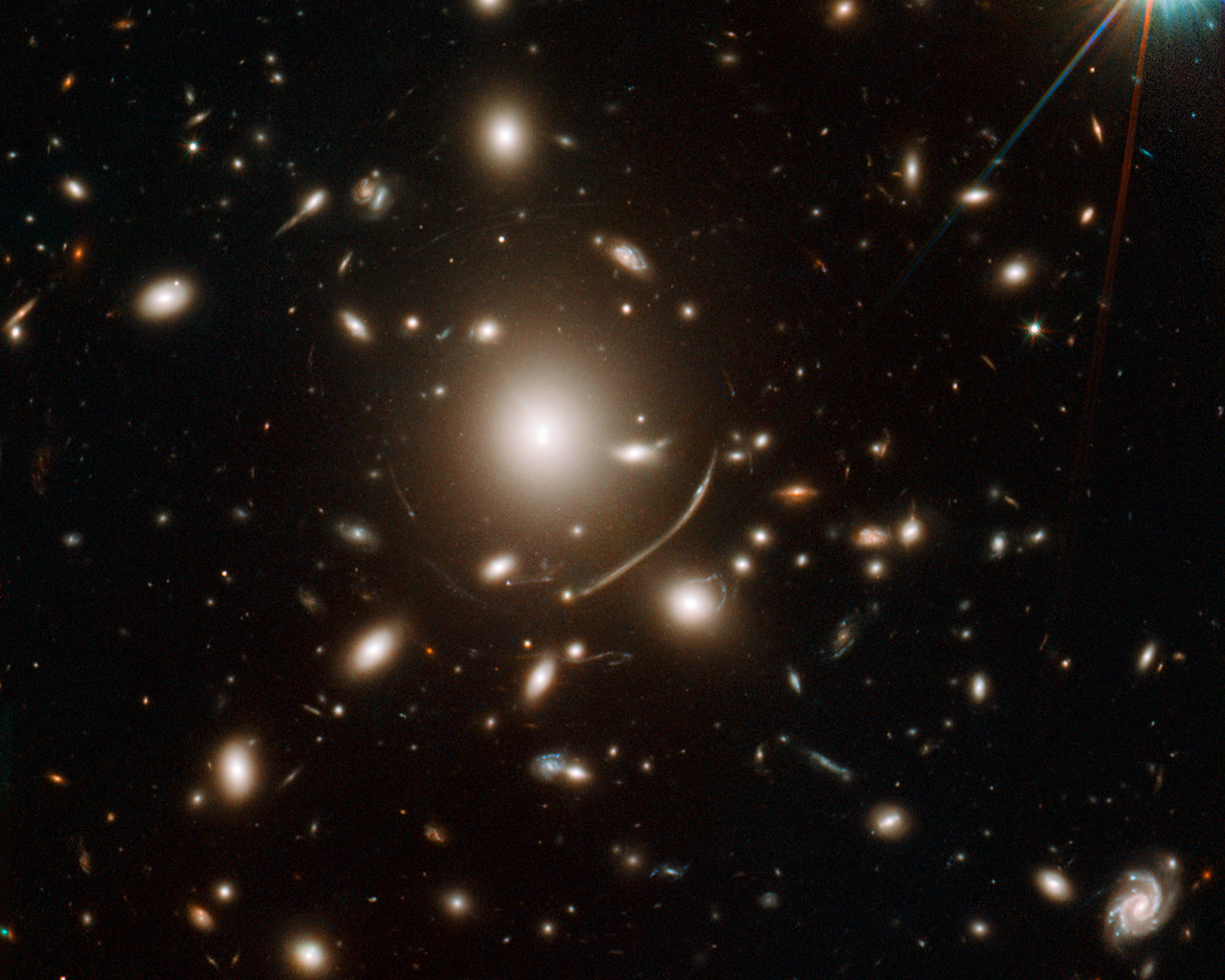
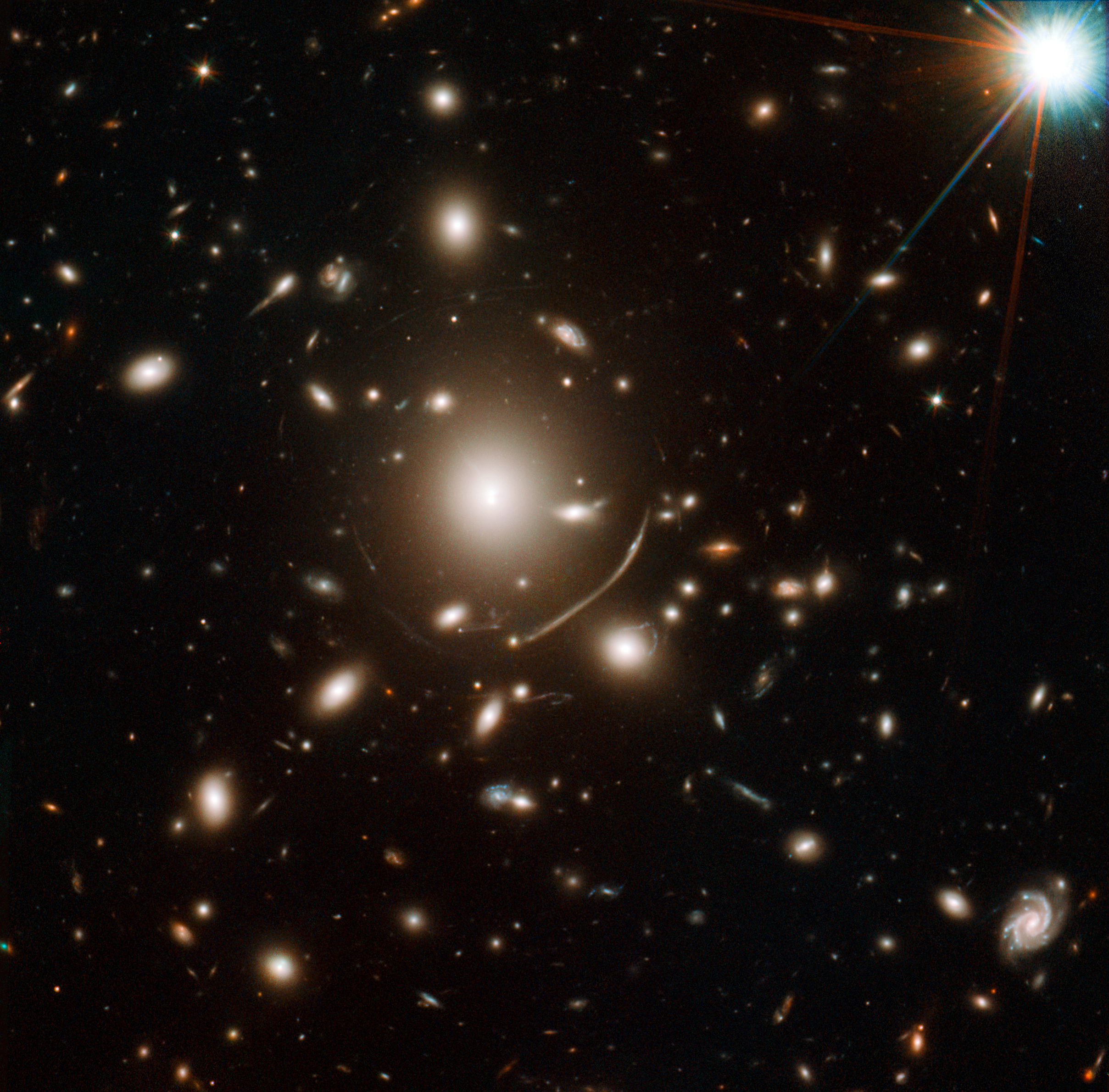
    Lensing cluster Abell 383

    Date: 12 Apr 2011
    Satellite: Hubble Space Telescope
    Depicts: Abell 383
    Copyright: NASA, ESA, J. Richard (CRAL) and J.-P. Kneib (LAM). Acknowledgement: Marc Postman (STScI)

    The giant cluster of elliptical galaxies in the centre of this image contains so much dark matter mass that its gravity bends light. This means that for very distant galaxies in the background, the cluster's gravitational field acts as a sort of magnifying glass, bending and concentrating the distant object's light towards Hubble. These gravitational lenses are one tool astronomers can use to extend Hubble's vision beyond what it would normally be capable of observing.

    Using Abell 383, a team of astronomers have identified and studied a galaxy so far away we see it as it was less than a thousand million years after the Big Bang. Viewing this galaxy through the gravitational lens meant that the scientists were able to discern many intriguing features that would otherwise have remained hidden, including that its stars were unexpectedly old for a galaxy this close in time to the beginning of the Universe. This has profound implications for our understanding of how and when the first galaxies formed, and how the diffuse fog of neutral hydrogen that filled the early Universe was cleared.


    Last Update: 12 Apr 2011

    • Shortcut URL
    • http://sci.esa.int/jump.cfm?oid=48614
    • Latest selection
    • Wide-field image of the Ring Nebula (ground-based image)
    • The geometry and structure of the Ring Nebula
    • The region around the Ring Nebula (Hubble/LBT composite)
    • Image Hi-Res Versions
    • Hi-Res [jpg]
      2,448.45 kb.
    • Hi-Res [tif]
      12,095.63 kb.
    • Download Wallpaper
    • Wallpaper [jpg]
      553.32 kb.
    • Related Images
    • Annotated view of Abell 383
    • See also
    • First galaxies were born much earlier than expected

    Connect with us

    • RSS
    • Youtube
    • Twitter
    • Flickr
    • Google Buzz
    • Livestream
    • Subscribe
    • App Store
    • ESA Science Twitter

    Follow ESA science

    • Copyright 2000 - 2013 © European Space Agency. All rights reserved.

    • Terms and Conditions