
Science Objectives
X-ray astronomy is a fundamental tool for studying ordinary matter in the Universe: that made up of baryons, like neutrons or protons. Current understanding is that the majority of this baryonic matter is trapped in hot, dispersed gas clouds, most of which make up the so-called warm-hot intergalactic medium. Since this web of galaxy-connecting gas streams has temperatures between 100 000 and 10 million degrees Kelvin, it emits mostly X-rays.
Some of the most exotic objects in the Universe – or, rather, their immediate surroundings – also emit most of their energy in X-rays. As gas and dust is swallowed by black holes, their strong gravitational fields heat up the material being accreted to very high temperatures (millions of degrees Kelvin), resulting in X-ray emission.
With the Earth's atmosphere blocking most X-ray emission, space missions are essential to seeing the hot and energetic Universe. Athena stands on the shoulders of giants: ESA X-ray observatories, such as EXOSAT and XMM-Newton, have provided (and in the case of XMM-Newton continue to provide) crucial insight into the nature of black holes, and have helped us better understand how galactic structures form.
Athena is the future of X-ray astronomy, aiming to probe both known and unknown high-energy astrophysical processes. It will address two important questions in astronomy: How does baryonic matter clump together to form the large-scale structures of the Universe? And how do supermassive black holes grow and shape the cosmos?
The Hot Universe
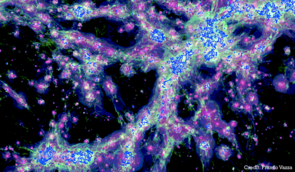 |
| Simulated X-ray and radio emission from gas in the cosmic web. Credit: Vazza et al. 2017 |
One of the main issues Athena will explore is the formation and evolution of galaxy groups and clusters. By mapping how hot gas clouds are distributed in these galactic structures at various redshifts, and determining the temperature and density of the gas, Athena will help astronomers understand how they formed and evolved.
Another open question Athena is set to answer is how carbon and heavier elements (metals) were distributed over galaxy groups and clusters throughout the history of the Universe. By measuring how abundant elements, such as nitrogen, oxygen or iron, were at different redshifts, Athena can determine when and through which processes the baryonic gas in large-scale structures became enriched with these elements. Astronomers will use the mission's instruments to identify the locations in galaxy clusters that are hotspots for the generation of metals, and to find out how these heavier elements are dispersed.
Athena is also set to shed light on the "missing baryon" problem. Current models of the Universe state that there should be about twice as much baryonic matter as can be accounted for in stars, galaxies and other light-emitting objects. In October 2017, two teams confirmed that much of this missing matter is in the strands of gas that make up the warm-hot intergalactic medium. Athena will determine how these filaments are distributed between galaxies and galaxy clusters, and characterise their physical properties, such as temperature, metallicity, and density, in great detail using high-resolution spectroscopy in X-rays.
In addition, the mission will further our understanding of how the hot gas permeating the intergalactic space is affected by the presence of Active Galactic Nuclei (AGN). These compact regions in galactic centres are powered by accretion onto supermassive black holes, a process that generates copious amounts of electromagnetic radiation. Many generate energetic jets, which interact and heat the hot gas surrounding the AGN-host galaxies. How exactly do the energetic AGN jets influence the intra-cluster medium, the super-hot plasma within a galaxy cluster? How do they affect the heating and cooling of gas clouds in the cluster? Athena will help find the answers to these and related questions.
The Energetic Universe
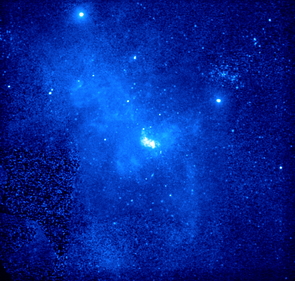 |
| Simulated Athena view of the galactic centre. Credit: A.Rau/WFI Team |
All massive galaxies, not just AGN, host supermassive black holes. X-ray observatories such as Athena provide unique ways of studying energetic processes associated with black holes, as they can probe the region close to the galactic centre with little contamination from light emitted by the material in the rest of the galaxy.
Looking into the cosmos at high redshifts (z>6), Athena will peer into a time in the history of the Universe when many supermassive black holes were just forming and starting to grow. The processes that are involved in the origin of this emergence and early evolution is not fully known. One theory is that the remnants of the first stars – massive and bright objects formed from primordial material from the Big Bang – could be the seeds of the supermassive black holes we see in today's Universe. Athena will follow explosive events occurring at the end of their life, measure with unprecedented accuracy their metal content, and allow us to understand if and how they could have formed black holes, and to study the mechanisms that dominated the early growth of these massive objects.
Since accretion onto supermassive black holes and galaxy formation and evolution are intrinsically linked, studying the energetic Universe with Athena will allow astronomers to finally have a complete understanding of the build-up of massive galaxies. To do this, Athena will look for supermassive black holes at redshifts between about 1 and 4, to cover the period when star formation in galaxies and accretion processes at their centres were most intense.
By tracing the X-ray emission of material just before it is swallowed by the central black hole, Athena will also give researchers the tools to increase our knowledge of the physics of accretion, and, by doing that, help astronomers determine the spin of the black holes. Theorists have proposed that the distribution of spin in the local Universe is a "fossil remnant" of the mechanism dominating the host galaxy evolution: repeated galaxy mergers or internal gas dynamics.
Another important goal of Athena is to figure out how accretion discs in AGN launch hot winds and energetic jets, and how these phenomena – which start at the galactic centre – can impact the galaxy at larger scales. How exactly these processes affect star formation, and what other roles they play in the formation and evolution of galaxies as a whole, is an open problem in astronomy, which Athena will help solve.
The Undiscovered Universe
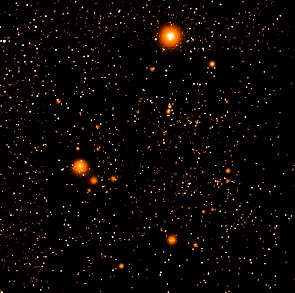 |
| Simulated Athena view of the Chandra Deep Field South. Credit: A.Rau/WFI Team |
The beauty of a mission like Athena, with a very large effective area X-ray mirror and powerful instruments at its focal plane, is that it will also enable new discoveries in virtually all areas of astrophysics.
Athena will further planetary science, including our knowledge of exoplanets, by helping astronomers better understand how planetary magnetic fields interact with stellar winds and flares, both in our Solar System and beyond.
It will advance stellar physics by allowing astronomers to explore both the early stages of stellar formation and the endpoints of stellar evolution. Astronomers will use the mission's instruments to study X-ray emission from young stars, for example, and uncover the processes that influence early stellar evolution and the formation of planetary discs.
The instruments will also pick up the bright X-ray emission coming from material surrounding some neutron stars, extremely dense objects left over after the death of certain stars, and investigate their internal structure, whose details are still unknown.
Additionally, the mission's instruments will be used to help determine the chemical composition of the hot gas and dust that makes up the interstellar medium and understand how it is changed by supernova explosions.
Last, but not least, Athena will contribute to the era of multi-messenger astronomy recently inaugurated by the discovery of almost simultaneous gravitational wave and electromagnetic emission originating in a neutron star merging event. Athena will be able to detect the faintest glow of kilonova explosions, as well as contributing with other large-scale astronomical facilities on-ground and in-space to the discovery of electromagnetic counterparts of black-hole merging events – should they exist!
Athena will have a profound impact on our understanding of the cosmos. It will allow us to study hot and energetic phenomena we know about, but it may also reveal an as yet undiscovered high-energy Universe.