Molecular clouds in the Cepheus region

Date: 12 February 2012
Satellite: Planck
Depicts: Cepheus molecular cloud
Copyright: ESA/Planck Collaboration; T. Dame et al., 2001
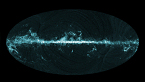
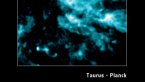
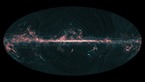
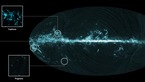
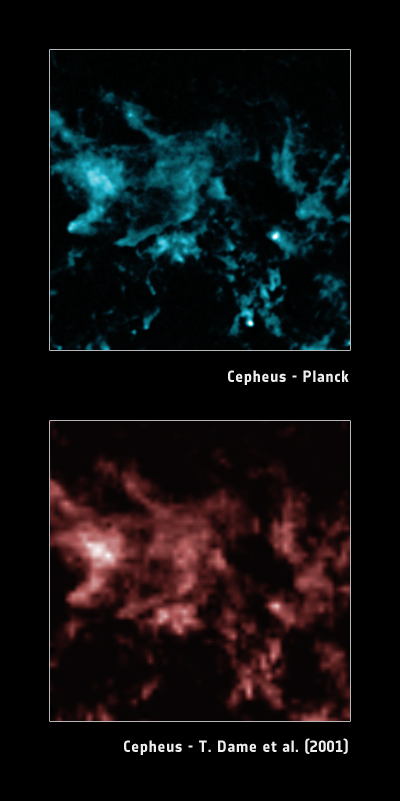
This image shows the Cepheus molecular cloud complex as seen through the glow of carbon monoxide (CO) with Planck (blue). The same region is shown as imaged by previous CO surveys (Dame et al., 2001) for comparison (red).
Molecular clouds, the dense and compact regions throughout the Milky Way where gas and dust clump together, represent one of the sources of foreground emission seen by Planck. The vast majority of gas in these clouds consists of molecular hydrogen (H2), and it is in these cold regions that stars are born. Since cold H2 does not easily radiate, astronomers trace these cosmic cribs across the sky by targeting other molecules, which are present there in very low abundance but radiate quite efficiently. The most important of these tracers is carbon monoxide (CO), which emits a number of rotational emission lines in the frequency range probed by Planck's High Frequency Instrument (HFI).
Emission lines affect a very limited range of frequencies compared to the broad range to which each of Planck’s detectors is sensitive, and are usually observed using spectrometers. But some CO lines are so bright that they actually dominate the total amount of light collected by certain detectors on Planck when they are pointed towards a molecular cloud like the Cepheus complex.
The Cepheus region is one of those which has been thoroughly observed from ground-based observatories. A comparison to the equivalent Planck map shows that: (a) all the large-scale features imaged from the ground are well-reproduced by Planck; (b) the high sensitivity and homogeneous mapping made by Planck reveals new details at small scales.
Follow-up observations and further studies of this and other stellar nurseries will allow a detailed investigation of the physical and chemical conditions that lead to the formation of molecular clouds, shedding new light on the very early phases of star formation.