• → European Space Agency

    • About Science & Technology

    • For Public

    • For Educators

    • ESA

    • Science & Technology

    • Cassini-Huygens

    • Missions
    • Show All Missions
    • Mission Home
    • Summary
    • Fact Sheet
    • Objectives
    • Mission Team
    • Orbit View
    • Science…

      • Saturn
      • Rings
      • Titan
      • Moons
      • Magnetosphere
    • Huygens Probe
    • Huygens
    • Instruments
    • Engineering
    • Cassini Orbiter
    • 3D Model
    • Instruments
    • Engineering
    • Mission Operations
    • Launch Vehicle
    • Launch Information
    • Approach and Arrival
    • Getting to Saturn
    • Huygens Probe Separation
    • Titan Surface Landing
    • Flybys
    • Science Operations
    • Data Archive
    • Resources
    • News Archive
    • Multimedia Gallery
    • Publication Archive
    • Calendar of Events
    • Services
    • Contact Us
    • Subscribe
    • Terms and Conditions
    • Bookmark and Share

    Saturn and Titan

    Date: 05 Mar 2012
    Satellite: Cassini
    Depicts: Saturn and Titan
    Copyright: NASA/JPL-Caltech/Space Science Institute

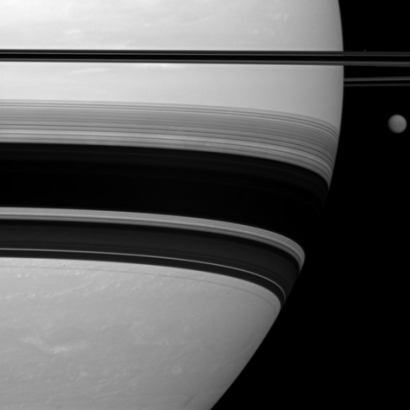
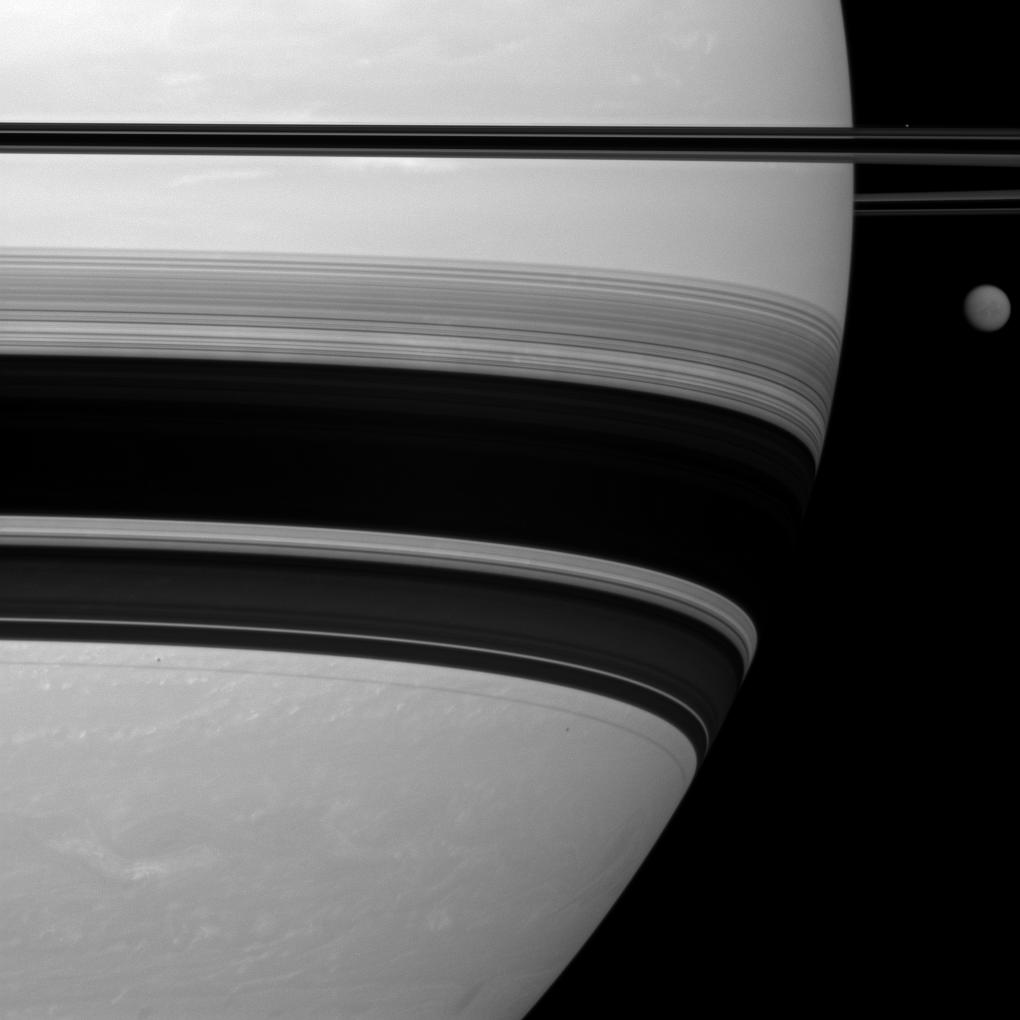
    Titan, Saturn's largest moon at 5150 km across, looks small here, pictured to the right of the gas giant in this infrared image taken by the Cassini spacecraft.
     
    Saturn's rings appear across the top of the image, casting shadows onto the planet across the middle of the image.

    A much smaller moon, Prometheus, 86 km across, appears as a tiny white speck above the rings in the far upper right of the image. The shadow cast by Prometheus can be seen as a small black speck on Saturn on the far left of the image, between the shadows cast by the main rings and the thin, faint F ring.

    The shadow of another moon, Pandora, 100 km at its widest, can be seen below the ring shadows towards the right side of the planet. However, Pandora itself is not visible in this image.

    Cassini's wide-angle camera captured the view on 5 January 2012, while it was about 685 000 km from Saturn. The image scale is 37 km per pixel on Saturn.

    The Cassini-Huygens mission is a cooperative project between NASA, ESA and the Italian space agency, ASI. The Jet Propulsion Laboratory, a division of the California Institute of Technology in Pasadena, manages the mission for NASA's Science Mission Directorate, Washington, DC. The Cassini orbiter and its two cameras were designed, developed and assembled at JPL. The imaging operations centre is based at the Space Science Institute in Boulder, Colorado.

    Last Update: 05 Mar 2012

    • Shortcut URL
    • http://sci.esa.int/jump.cfm?oid=50111
    • Latest selection
    • Close up of magnetic fields
    • Saturn's bow shock
    • Changes in trace gas abundances over Titan's south pole
    • Image Hi-Res Versions
    • Hi-Res [jpg]
      52.18 kb.

    Connect with us

    • RSS
    • Youtube
    • Twitter
    • Flickr
    • Google Buzz
    • Livestream
    • Subscribe
    • App Store
    • ESA Science Twitter

    Follow ESA science

    • Copyright 2000 - 2013 © European Space Agency. All rights reserved.

    • Terms and Conditions