• → European Space Agency

    • About Science & Technology

    • For Public

    • For Educators

    • ESA

    • Science & Technology

    • Cassini-Huygens

    • Missions
    • Show All Missions
    • Mission Home
    • Summary
    • Fact Sheet
    • Objectives
    • Mission Team
    • Orbit View
    • Science…

      • Saturn
      • Rings
      • Titan
      • Moons
      • Magnetosphere
    • Huygens Probe
    • Huygens
    • Instruments
    • Engineering
    • Cassini Orbiter
    • 3D Model
    • Instruments
    • Engineering
    • Mission Operations
    • Launch Vehicle
    • Launch Information
    • Approach and Arrival
    • Getting to Saturn
    • Huygens Probe Separation
    • Titan Surface Landing
    • Flybys
    • Science Operations
    • Data Archive
    • Resources
    • News Archive
    • Multimedia Gallery
    • Publication Archive
    • Calendar of Events
    • Services
    • Contact Us
    • Subscribe
    • Terms and Conditions
    • Bookmark and Share

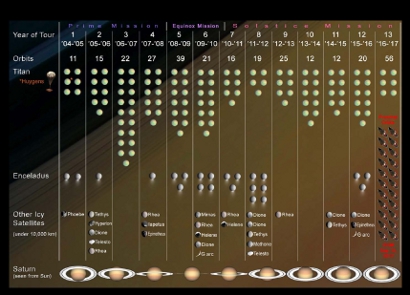
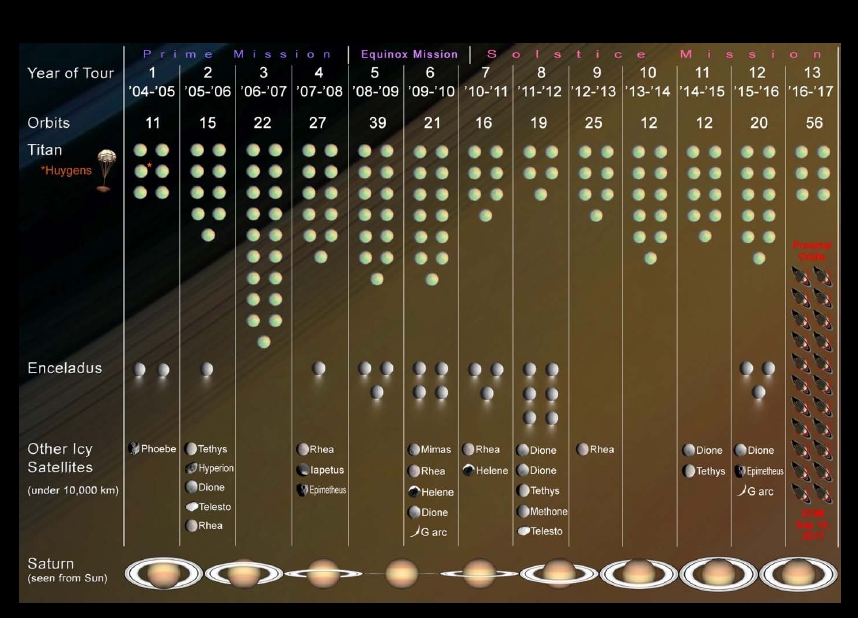
    Cassini mission overview
    Date: 27 Mar 2012
    Depicts: Cassini mission overview showing the Huygens landing, the number of Saturn orbits and flybys of different Moons
    Copyright: NASA/JPL-Caltech (Image by David Seal)

    Cassini's orbits of Saturn and flybys of its moons from launch (Prime mission), through the first (Equinox) and second extensions (Solstice), until the end of its mission (Proximal orbits).

    The Cassini-Huygens mission is designed to explore the Saturn system, including its rings and moons, with a special focus on Titan. After its launch on 15 October 1997, the nominal (Prime) mission at Saturn began on 1 July 2004. By the time the nominal mission was completed in July 2008, Cassini had completed 75 orbits around Saturn and 44 Titan flybys.

    A first mission extension, called the Equinox mission, started on July 2008 and lasted for two years until October 2010. A major objective of this mission phase was to observe the Saturn system while the Sun crossed Saturn's equatorial plane. The second extension, called the ‘Solstice mission' is now underway, and will last until 2017. It's major objective is the monitoring of seasonal changes induced by varying solar illumination, until the Sun reaches its highest elevation above Saturn's equatorial plane.

    Cassini-Huygens is a cooperative project of NASA, ESA, and the Italian Space Agency (ASI). NASA's Jet Propulsion Laboratory, a division of the California Institute of Technology in Pasadena, manages the mission for NASA's Science Mission Directorate, Washington, DC. The Cassini orbiter was designed, developed and assembled at JPL.

    Last Update: 27 Mar 2012

    • Shortcut URL
    • http://sci.esa.int/jump.cfm?oid=50203
    • Latest selection
    • Close up of magnetic fields
    • Saturn's bow shock
    • Changes in trace gas abundances over Titan's south pole
    • Image Hi-Res Versions
    • Hi-Res [jpg]
      294.99 kb.

    Connect with us

    • RSS
    • Youtube
    • Twitter
    • Flickr
    • Google Buzz
    • Livestream
    • Subscribe
    • App Store
    • ESA Science Twitter

    Follow ESA science

    • Copyright 2000 - 2013 © European Space Agency. All rights reserved.

    • Terms and Conditions