• → European Space Agency

    • About Science & Technology

    • For Public

    • For Educators

    • ESA

    • Science & Technology

    • Herschel

    • Missions
    • Show All Missions
    • Mission Home
    • Summary
    • Fact Sheet
    • Objectives
    • Participants
    • Mission Team
    • Industrial Team
    • Spacecraft
    • 3D Model
    • Instruments
    • Test Campaign
    • Mission Operations
    • Launch Information
    • Orbit/Navigation
    • Launch Vehicle
    • Launch Campaign
    • Status Reports
    • Science Operations
    • Science Ground Segment
    • Data Archive
    • Astronomers' Website
    • Outreach Resources
    • Resources
    • News Archive
    • Multimedia Gallery
    • Publication Archive
    • Status Report Archive
    • Calendar of Events
    • Services
    • Contact Us
    • Subscribe
    • Terms and Conditions
    • Bookmark and Share

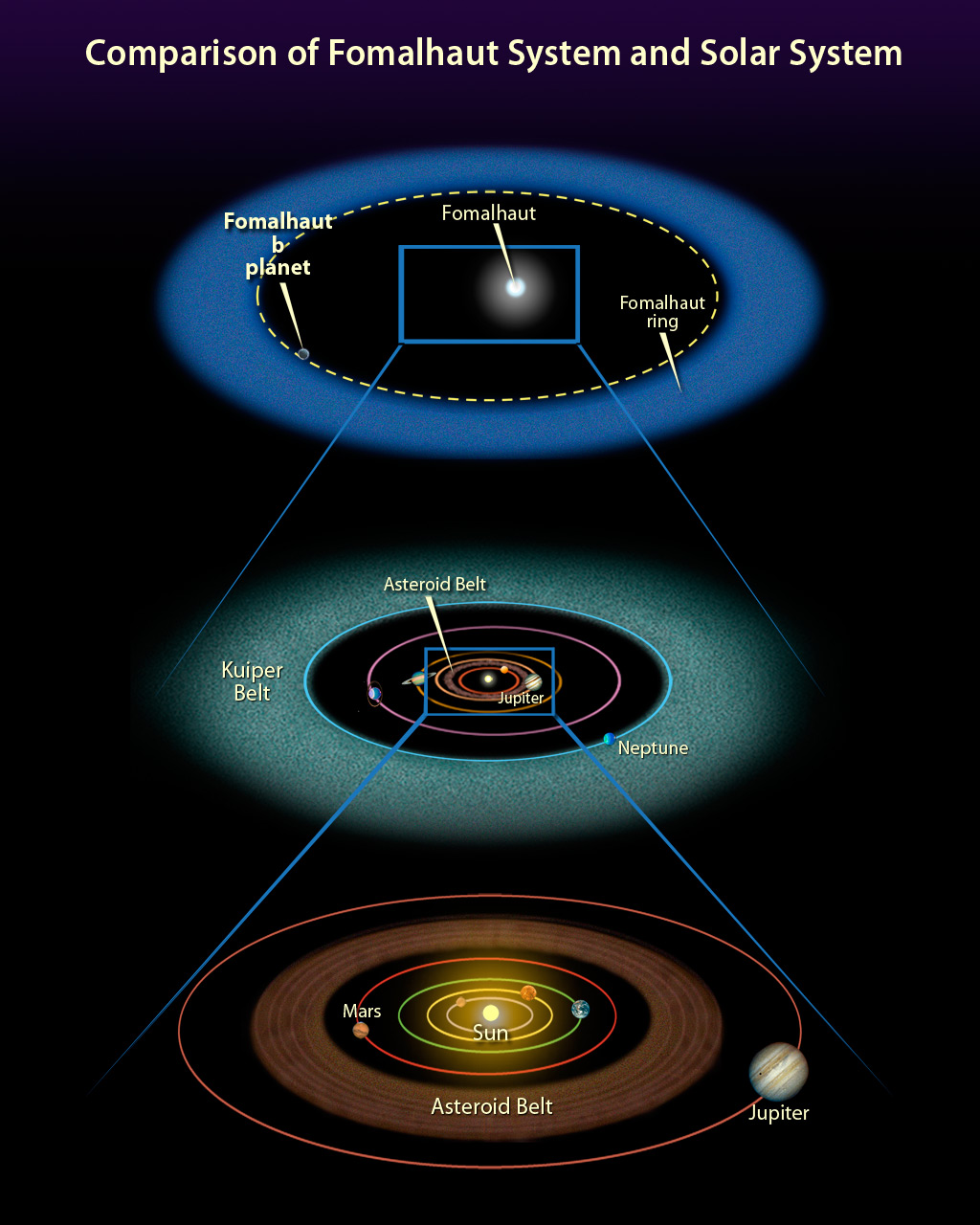
    Comparison of Fomalhaut's debris disc with the Solar System

    Date: 11 Apr 2012
    Depicts: Comparison of Fomalhaut's debris disc with the Solar System
    Copyright: NASA, ESA, and A. Feild (STScI)

    This illustration shows the size of the debris disc observed around the star Fomalhaut, as compared to the size of the Kuiper Belt and Asteroid Belt in the Solar System.

    The upper image shows the star Fomalhaut surrounded by its debris disc, which is located at a radius of about 130 astronomical units (AU) from the star. A candidate planet, Fomalhaut b, detected around the star in 2008, is also indicated; this detection is, however, still under debate.

    The central image shows the outer Solar System, with the Kuiper Belt, a rich reservoir of icy objects located beyond the orbit of Neptune and thought to be the source of short-period comets. The Kuiper Belt extends from 30 to 50 AU from the Sun.

    The lower image shows the inner Solar System, including the asteroid belt, which is located between the orbits of Mars and Jupiter and extends from roughly 2 to 4 AU from the Sun.

    Last Update: 11 Apr 2012

    • Shortcut URL
    • http://sci.esa.int/jump.cfm?oid=50255
    • Latest selection
    • Multi-wavelength view of the merging galaxy pair HXMM01
    • Herschel view of the merging galaxy pair HXMM01
    • Merging galaxies in the young Universe discovered with Herschel
    • Image Hi-Res Versions
    • Hi-Res [jpg]
      262.94 kb.
    • See also
    • Herschel images extrasolar analogue of Kuiper Belt

    Connect with us

    • RSS
    • Youtube
    • Twitter
    • Flickr
    • Google Buzz
    • Livestream
    • Subscribe
    • App Store
    • ESA Science Twitter

    Follow ESA science

    • Copyright 2000 - 2013 © European Space Agency. All rights reserved.

    • Terms and Conditions