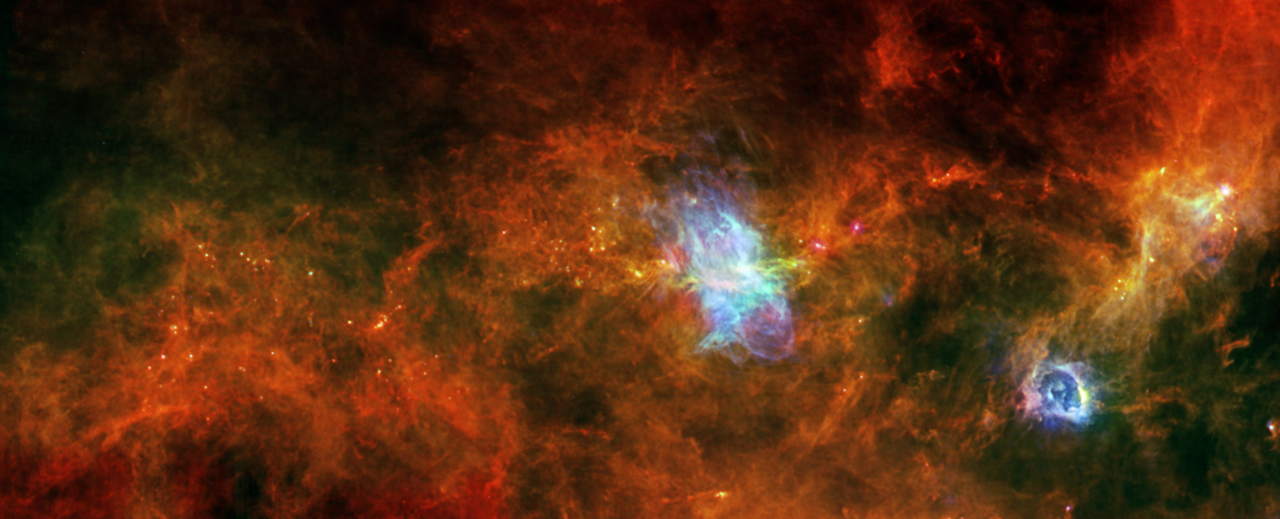
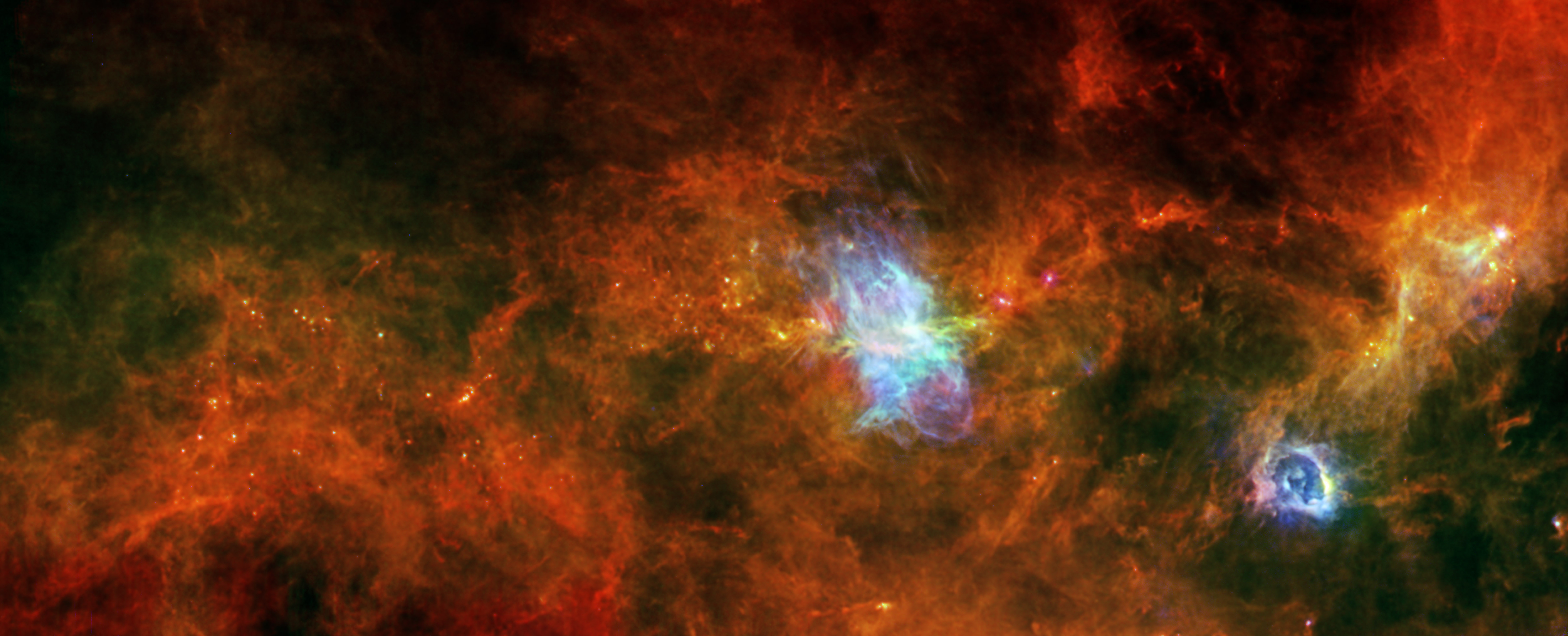
Herschel view of the Vela-C molecular cloud

Date: 09 July 2012
Satellite: Herschel
Depicts: Vela-C molecular cloud
Copyright: ESA/PACS/SPIRE/Tracey Hill & Frédérique Motte, Laboratoire AIM Paris-Saclay, CEA/Irfu - CNRS/INSU - Univ. Paris Diderot, France
This image shows Vela-C, a giant molecular cloud where stars are being born, as viewed at far-infrared wavelengths with ESA's Herschel Space Observatory. Vela-C is the most massive component of the Vela Molecular Ridge, a vast star-forming complex in the plane of our Galaxy, the Milky Way.
Located roughly 2300 light years away, Vela-C saw the onset of star formation less than a million years ago – relatively recently on astronomical timescales. Massive, as well as low- and intermediate-mass, stars are being born in this region, making it an ideal laboratory to study the birth of different populations of stars.
This image reveals previously unseen detail in the cold mixture of gas and dust that pervades the region. The coldest and densest portions of the cloud complex release most of their radiation at the longest wavelengths probed by Herschel, shown in red in this image. The cloud material is organised in a highly sub-structured network, with tangled and less organised material alternating with more defined and elongated filaments. Intricate bundles of material can be seen on the left, centre and right of the image. These nest-like structures are linked to one another by dense, ridge-like filaments.
A number of white flecks dot the clouds and, in particular, the prominent ridge-like filaments in Vela-C. These flecks are in fact pre-stellar cores – compact clumps of matter that might eventually give rise to star formation – and proto-stellar cores, whose density is high enough for star formation to have already begun, eventually resulting in fully-fledged stars.
Not only does Vela-C host seeds of future stellar generations, it also comprises a handful of objects that have already evolved into young, massive stars. Embedded in the central part of the image is a stellar cluster whose stars are not visible in the Herschel image, but their effects are. The butterfly-shaped structure at the centre of the image, known as RCW 36 (or Gum 20), is a result of winds and radiation released by the hot stars in this cluster. RCW 36 is an HII region – a pocket of gas that is being energised and ionised by the action of nearby young, massive stars. Due to its higher temperature relative to the colder material in the cloud, RCW 36 shines brightly at the shortest wavelengths probed by Herschel, indicated in blue in this image. In the lower right corner of the image is another HII region called RCW 34 (or Gum 19); it is unclear whether RCW 34 and the hot stars that illuminate it are part of the Vela-C molecular cloud or whether they are located farther away.
This false-colour image combines data acquired with the PACS instrument at 70 micron (shown in blue) and 160 micron (shown in green) and with the SPIRE instrument at 250 micron (shown in red).