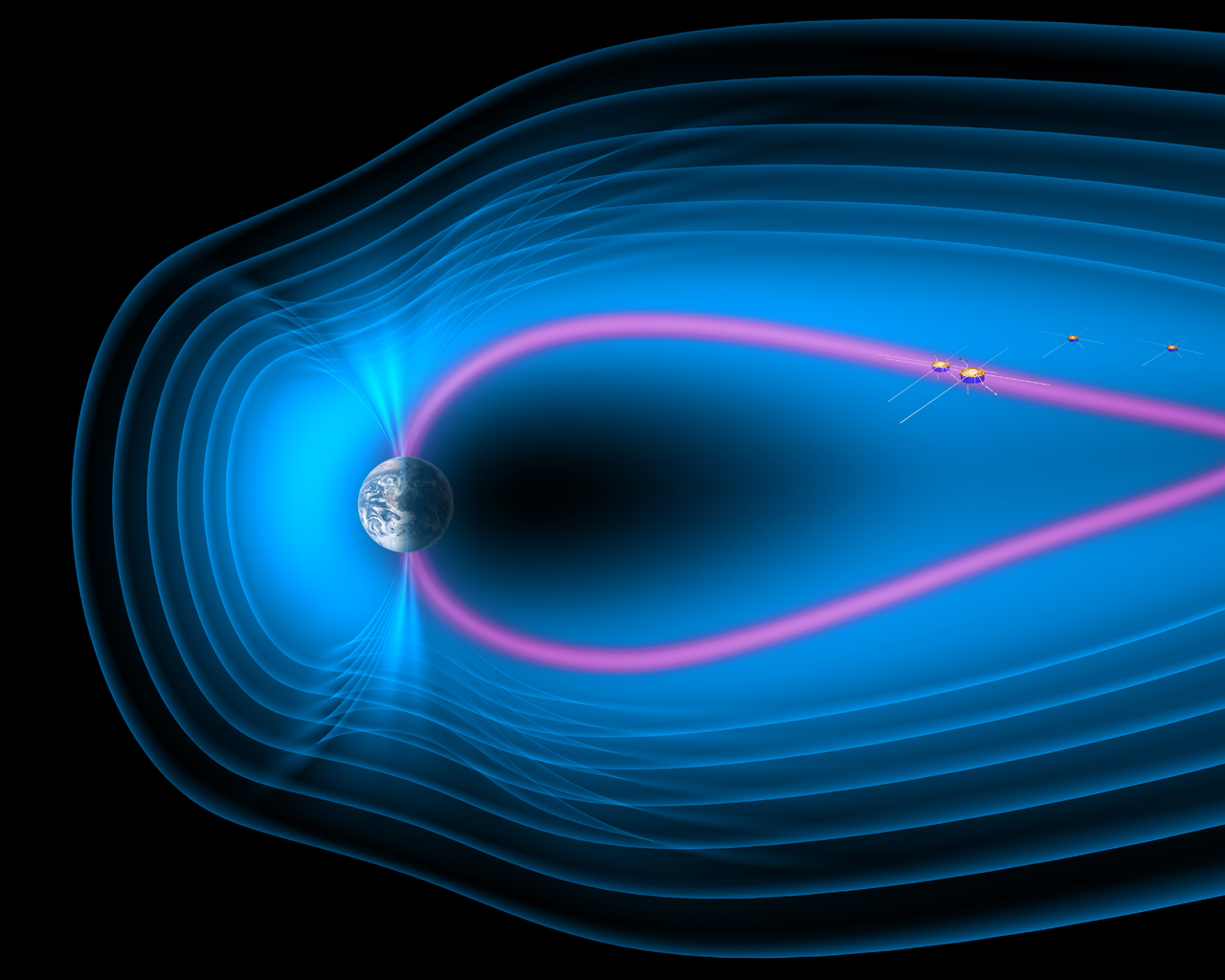
Cluster spacecraft flying through the thin boundary in the magnetotail (artist's impression)

Date: 27 July 2012
Satellite: Cluster
Depicts: Artist's impression of Cluster spacecraft flying through the thin boundary in Earth's magnetotail
Copyright: ESA / AOES Medialab
This illustration shows the magnetic environment of Earth, which arises from the interaction between the solar wind, a stream of electrically charged particles released by the Sun, and our planet's internal magnetic field. In fact, the magnetosphere acts as a shield that prevents most of the solar wind particles from infiltrating Earth's atmosphere.
Highlighted in purple is the plasma sheet boundary layer, a thin boundary in the magnetotail – the long and cylindrical end of the magnetosphere that extends in the direction opposite the Sun. This thin boundary divides various regions of the magnetotail, which are populated by plasma with significantly different properties. To the north and south of the boundary are the lobes, two plasma layers characterised by very low density and strong magnetic field. Enclosed within the thin boundary is the plasma sheet, a denser layer where the magnetic field is weaker than in the lobes. Due to the drastically different properties of plasma at either side, thin boundaries such as the one in the magnetotail host most of the energy exchanges that take place in a plasma.
In the illustration, the four spacecraft of ESA's Cluster mission are shown as they fly in the magnetotail, in the configuration they had on 31 August 2007: two of them were separated by only a few tens of kilometres and located in the thin boundary of the magnetotail, while the other two were much farther away. This was a very favourable event to probe the behaviour of plasma on the small scales where electrons become dominant. Using data from this event, scientists have for the first time characterised lower hybrid drift waves – plasma waves that develop in thin boundaries and play an important role in the dynamics of electrons and in the transfer of energy between different layers of plasma in Earth's magnetosphere.